
Solana's DDoS Resilience: A Strategic Edge for Institutional Adoption
In the rapidly evolving landscape of blockchain infrastructure, robustness under extreme stress has become a critical differentiator for institutional investors. Solana's ability to withstand a historic 6 terabits per second (Tbps) distributed denial-of-service (DDoS) attack in late 2025-ranked among the largest in internet history-has cemented its reputation as a hardened financial infrastructure layer. This event, coupled with architectural innovations and strategic institutional partnerships, positions SolanaSOL-- as a compelling long-term investment for capital seeking stability in decentralized systems.
The 2025 DDoS Attack: A Stress Test for Solana
In December 2025, Solana faced a sustained DDoS assault peaking at 6 Tbps, a scale typically reserved for global cloud providers like Google Cloud and CloudflareNET--. Despite this unprecedented pressure, the network maintained a median transaction confirmation time of 450 milliseconds, with no downtime or degradation in block production as reported by CoinPaper. This resilience was attributed to Solana's high-availability (HA) systems, which enable instant node degradation and automated failure detection, as well as protocol-level upgrades like QUIC, which filter malicious traffic at the ingress level.
The attack underscored Solana's capacity to function as a reliable backbone for high-volume financial transactions. Co-founder Anatoly Yakovenko noted that attackers were "spending as much as the chain earns on data transmission," a bullish signal for the network's economic defenses. By contrast, blockchains like SuiSUI-- experienced performance issues under similar conditions, highlighting Solana's architectural superiority.
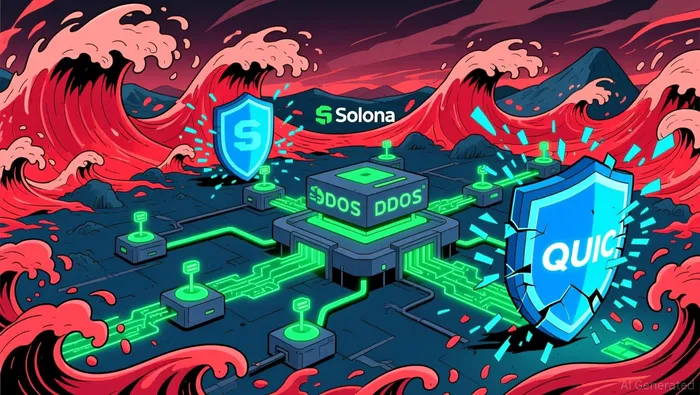 The hybrid architecture of Solana's consensus model, combining Proof of Stake (PoS) with Proof of History (PoH), enables the network to process over 65,000 transactions per second (TPS). This far exceeds Ethereum's 30 TPS and provides Solana with a significant throughput advantage. The 2025 DDoS attack demonstrated the network's ability to handle such massive traffic without sacrificing performance or security.
Technical Architecture: The Foundation of Resilience
Solana's hybrid consensus model-combining Proof of Stake (PoS) with Proof of History (PoH)-enables parallel transaction processing and a cryptographic timestamp system that minimizes coordination overhead. This design allows the network to process over 65,000 transactions per second (TPS), vastly outpacing Ethereum's 30 TPS. Crucially, the attack demonstrated that Solana's validator efficiency, rather than sheer numbers, is the key to resilience. While the validator count declined by 35% in 2025, the network became dominated by professional operators, enhancing its capacity to defend against large-scale threats.
This shift toward enterprise-grade infrastructure aligns with institutional demands for predictable performance. As Raj Gokal, Solana's co-founder, emphasized, the attack had "zero effect on performance", reinforcing the network's role as a production-grade financial rail.
Institutional Confidence and Financial Metrics
The DDoS event catalyzed a surge in institutional adoption. The Bitwise Solana Staking ETF (BSOL) attracted $417 million in its debut week, while the Grayscale Solana Trust (GSOL) drew over $1 million on its first day. These inflows reflect a broader shift from speculative trading to structured investment, with Solana processing $1.6 trillion in annual trading volume and supporting a tripled stablecoin float to $15 billion by year-end.
Institutional partnerships further validate Solana's strategic value. Collaborations with Visa and Western Union have positioned the network as a scalable solution for cross-border payments and crypto payroll. By December 2025, Solana's total value locked (TVL) reached $10.2 billion, underscoring its maturation into a credible infrastructure layer.
Long-Term Investment Viability
For institutional investors, Solana's resilience during the 2025 attack serves as a tangible proof point of its ability to withstand macroeconomic and technological volatility. The network's validator consolidation, while raising decentralization concerns, has enhanced its capacity to absorb volumetric threats-a critical feature for financial infrastructure. As Anatoly Yakovenko noted, the attack demonstrated that "attackers must expend more resources" to disrupt block production, a dynamic that strengthens Solana's economic moat.
Moreover, Solana's dominance in developer activity-capturing 26.8% of all blockchain-related engagement in 2025-signals sustained innovation in DeFi, NFTs, and dApps. This ecosystem growth, combined with its proven operational stability, positions Solana as a long-term asset for institutions prioritizing scalability and reliability.
Conclusion
Solana's 2025 DDoS resilience has redefined perceptions of blockchain infrastructure, transforming it from a high-throughput network into a trusted financial backbone. For institutional investors, the event highlighted the network's capacity to function under extreme stress, mirroring the reliability of traditional systems. As the demand for decentralized infrastructure grows, Solana's architectural strengths and institutional adoption trends suggest a compelling long-term investment thesis.





Comentarios
Aún no hay comentarios