
Why Solana's Current Price Correction Represents a Strategic Entry Point for Long-Term Investors
The recent pullback in Solana's price, while unsettling for short-term traders, presents a compelling opportunity for long-term investors. This correction occurs against a backdrop of unprecedented network fundamentals, institutional adoption, and technical resilience, all of which position SolanaSOL-- as a cornerstone of the next phase of blockchain innovation. By dissecting these pillars, we uncover why this dip is not a warning sign but a catalyst for strategic entry.
Network Fundamentals: A Scalable, Cost-Efficient Ecosystem
Solana's infrastructure has evolved into one of the most robust and scalable blockchain networks. In 2025, the network processes an average of 1,000–4,000 transactions per second (TPS) in real-world conditions, with stress tests demonstrating theoretical peaks exceeding 100,000 TPS. The launch of the Firedancer validator client in late 2025 pushed this metric to over 1 million TPS, a leap that rivals even the most optimistic projections for Ethereum's post-merge roadmap.
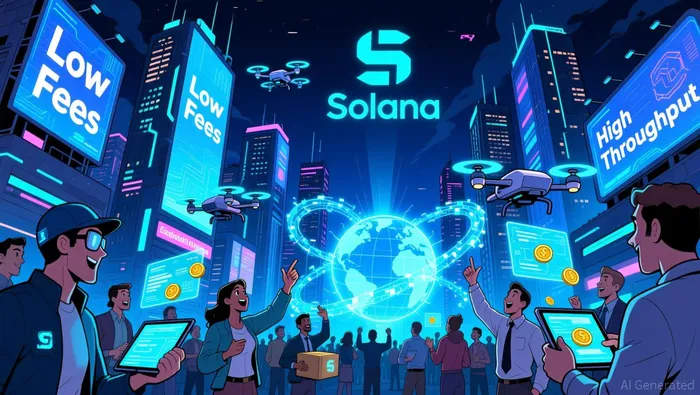
Transaction costs remain a critical differentiator. Solana's average fee of $0.00025 is among the lowest in the industry, enabling use cases like microtransactions, gaming, and NFT interactions that are cost-prohibitive on higher-fee chains according to analysis. This efficiency is not theoretical-it is operationalized daily by 17.2 million active addresses, a figure that outpaces Ethereum and BNB Chain. For investors, these metrics signal a network capable of sustaining high throughput without compromising affordability, a rare combination in the blockchain space.
Institutional Adoption: From Niche to Mainstream Infrastructure
Solana's institutional adoption in 2025 has been nothing short of transformative. The platform has transitioned from a speculative asset to a production-grade financial infrastructure, underpinned by partnerships with global giants like Visa, Stripe, and PayPal. These collaborations are not mere token listings but integrations into core financial systems. For instance, Visa's stablecoin settlement network now leverages Solana for real-time, low-cost cross-border transactions, a use case that directly competes with traditional SWIFT transfers.
Institutional confidence is further reinforced by Solana's stablecoin ecosystem, which has grown to become the third-largest in the world after EthereumETH-- and TronTRX--. This growth is amplified by U.S. legislation like the GENIUS Act, which creates a regulatory framework conducive to stablecoin innovation. Meanwhile, the rise of Digital Asset Treasuries (DATs)-where corporations convert cash reserves into digital assets for yield generation-has positioned Solana as a treasury-grade asset.
Capital flows also tell a story of institutional validation. By mid-2025, $706 million had already flowed into Solana-linked ETFs, signaling a shift in how institutional investors perceive the asset class. This trend is likely to accelerate as more enterprises adopt Solana for asset issuance and real-world asset (RWA) tokenization.
Technical Resilience: A Network Built for the Future
Solana's technical upgrades in 2025 have addressed historical vulnerabilities, enhancing its appeal for mission-critical applications. The Firedancer upgrade, for example, not only boosted throughput but also improved development speed and network robustness. Additional optimizations, such as increased block sizes and confidential transfers, have fortified the network against scalability bottlenecks and privacy concerns.
Regulatory engagement further underscores Solana's technical resilience. Through initiatives like the Solana Policy Institute, the network has proactively aligned with global compliance standards, reducing the risk of regulatory headwinds that have plagued other blockchains. This forward-looking approach ensures Solana remains a viable infrastructure layer as digital assets gain mainstream acceptance.
Why the Correction Is a Strategic Entry Point
The current price dip, while disheartening, is a function of short-term volatility rather than a reflection of Solana's long-term trajectory. Network fundamentals-TPS, fees, and active addresses-continue to trend upward. Institutional adoption is accelerating, with major corporations and financial institutions embedding Solana into their operational frameworks. Technically, the network is more resilient than ever, with upgrades that address past limitations.
For long-term investors, this correction offers a chance to acquire Solana at a discount to its intrinsic value. The platform's role in enabling real-time financial infrastructure, stablecoin ecosystems, and RWA tokenization is only beginning to materialize. As institutional capital continues to flow into the network and technical advancements compound, Solana's price is poised to reflect its growing utility and market dominance.
Conclusion
Solana's price correction is a temporary detour, not a dead end. The network's fundamentals, institutional traction, and technical resilience form a triad of strength that underpins its long-term potential. For investors with a horizon beyond quarterly earnings, this is a moment to act-not out of fear, but with the confidence that history will validate their decision.






Comentarios
Aún no hay comentarios