
Solana at Crossroads: Breakout or Breakdown Ahead?
Network Performance: The Bedrock of Solana's Resilience
Solana's technical infrastructure has emerged as a cornerstone of its appeal in 2025. The network's average transaction throughput of 65,000 TPS in real-time environments, with peak loads reaching 125,000 TPS, underscores its scalability advantages over EthereumETH-- and Bitcoin[5]. This performance is amplified by the Firedancer upgrade, which boosted capacity to 1,250 TPS per validator, while the Alpenglow consensus upgrade further reduced validator costs and improved finality to sub-150ms[3].
Validator health remains robust, with 3,248 active validators spread across 45+ countries ensuring decentralization and security[5]. Notably, the network has achieved 16 months of continuous uptime without major disruptions, even during high-load periods[3]. These metrics position SolanaSOL-- as a reliable settlement layer for high-frequency trading and tokenized assets, attracting institutional players seeking efficiency[5].
Institutional Adoption: A Structural Shift in Finance
Solana's institutional adoption in Q3 2025 marked a paradigm shift. Over $1.72 billion in institutional capital flowed into Solana treasuries, with 13 publicly traded firms collectively holding 1.44% of the total supply[3]. Entities like Forward Industries (NASDAQ: FORD) and DeFi Development Corp. exemplify this trend, staking millions of SOLSOL-- to generate 7–8% staking yields while aligning with infrastructure growth[3].
The REX-Osprey Solana Staking ETF (SSK), approved in Q2 2025, normalized institutional exposure, while ongoing SEC reviews of additional ETFs signaled broader acceptance[5]. Strategic partnerships with Visa, Stripe, and BlackRock further cemented Solana's role in real-time payments and asset tokenization[5]. However, challenges persist: institutional treasuries now control a growing share of the token supply, raising concerns about centralization[3].
Market Sentiment: Bullish Momentum vs. Lingering Risks
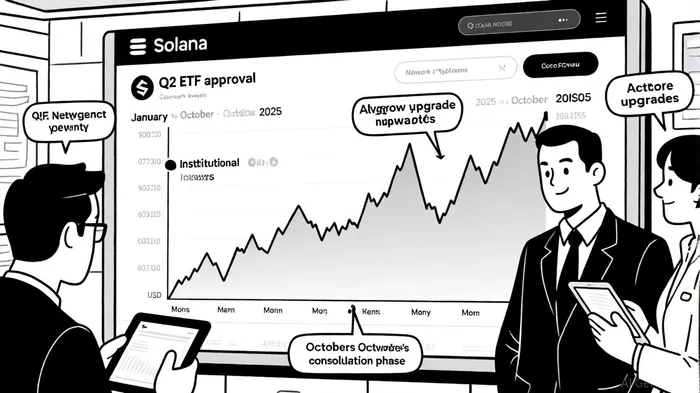
Market sentiment for Solana in Q3 2025 is a tug-of-war between optimism and caution. The price surged 65% quarter-on-quarter following ETF approvals, reaching $240 in October 2025[5]. Technical indicators suggest consolidation between $250–$270, with a potential breakout to $350–$370 by December if the $270 resistance is breached[5].
Yet, bearish factors linger. Past network outages in 2021–2022 and regulatory delays for ETFs have sown uncertainty[1]. The Fear & Greed Index at 44 reflects investor anxiety, while a $1 billion withdrawal of assets from Solana in October highlights short-term jitters[5]. Analysts project a base-case price of $185 by Q3's end, with long-term forecasts ranging from $200 to $400 by year-end[5].
Breakout or Breakdown?
Solana stands at a crossroads. Its technical resilience and institutional adoption have created a flywheel effect: high throughput and low fees attract DeFi and NFT ecosystems, while institutional capital drives liquidity and price stability[5]. However, regulatory clarity and validator decentralization remain critical risks.
If the $270 resistance is overcome, Solana could replicate BitcoinBTC-- and Ethereum's ETF-driven surges, pushing toward $350–$370 by year-end[5]. Conversely, a breakdown below $200 would test the network's ability to retain institutional confidence amid macroeconomic headwinds.
For investors, the key lies in balancing technical strength with regulatory developments. Solana's ecosystem-bolstered by 7,625 new developers in 2024 and projects like Remittix (RTX)-offers long-term upside[5]. Yet, hedging against volatility and monitoring validator health will be essential in this pivotal phase.






Comentarios
Aún no hay comentarios