
Is Solana's Recent Correction a Strategic Entry Point for Long-Term Investors?
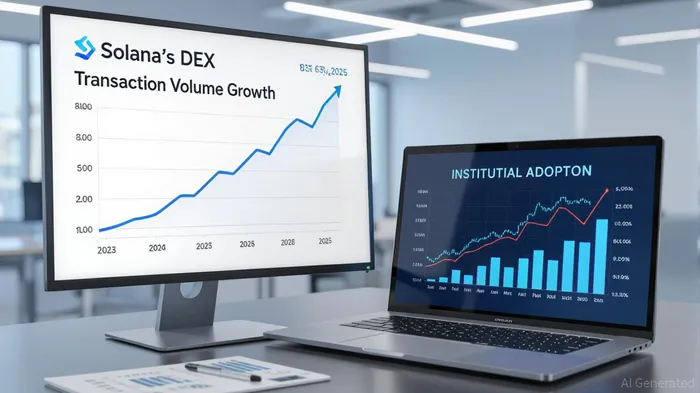
The recent correction in Solana's price has sparked renewed debate about its long-term investment potential. While short-term volatility is inevitable in crypto markets, the underlying fundamentals of Solana's ecosystem suggest that this dip may represent a strategic entry point for investors with a multi-year horizon. The key drivers—ecosystem growth and institutional adoption—are not only resilient but accelerating, positioning SolanaSOL-- as a unique contender in the blockchain space.
Ecosystem Growth: A Developer Magnet and Transaction Powerhouse
Solana's ecosystem has emerged as the fastest-growing environment for new builders, according to Electric Capital[1]. This is not merely a function of hype but a result of tangible infrastructure advancements. For instance, 81% of all decentralized exchange (DEX) transactions now originate from Solana[1], a figure that dwarfs the combined totals of EthereumETH-- and Binance Smart Chain (BSC). This dominance in DEX activity is driven by Solana's sub-second block times, low fees (under $0.0025 per transaction[1]), and developer-friendly tools like programmable wallets and the Solana Attestation Service.
The mobile push further amplifies this growth. Solana's partnership with hardware manufacturers has led to the shipment of 150,000+ Seeker phones, which integrate on-chain features such as Seed Vault key storage and a Solana dApp Store[1]. By embedding blockchain into consumer devices, Solana is bypassing the traditional onboarding friction that has hindered mass adoption. This hardware-software synergy creates a flywheel effect: more users, more transactions, and more incentives for developers to build on the network.
Institutional Adoption: From Niche to Mainstream
Institutional validation has been a critical catalyst for Solana's trajectory. Franklin Templeton's 2025 expansion of its Franklin Onchain U.S. Government Money Fund (FOBXX) to Solana is a landmark moment[1]. By enabling users to access this institutional-grade product via the BENJI platform, Solana is bridging the gap between traditional finance and decentralized infrastructure. This move signals confidence in Solana's security, scalability, and compliance capabilities—traits that institutional investors demand.
Such adoption is not isolated. Solana's energy efficiency (transactions consume roughly the energy of a few Google searches[1]) and enterprise-grade performance (400-millisecond block times[1]) have attracted interest from corporations and asset managers. These metrics outpace Ethereum's energy-intensive proof-of-work model and BSC's centralized validator structure, making Solana a more sustainable and scalable alternative for large-scale use cases.
Comparative Analysis: Solana's Edge Over Ethereum and BSC
While Ethereum remains dominant in DeFi and NFTs, and BSC continues to leverage its BNBBNB-- ecosystem, Solana's growth metrics tell a different story. Electric Capital's data reveals that Solana's developer activity and transaction volume are outpacing both competitors[1]. This is partly due to Solana's focus on speed and cost efficiency, which are critical for real-world applications like cross-border payments and tokenized assets.
Moreover, Solana's institutional partnerships are creating a network effect. Unlike Ethereum's gradual transition to proof-of-stake or BSC's reliance on BNB's price action, Solana's value proposition is increasingly tied to its ability to attract enterprises and institutional capital. This diversification reduces its exposure to crypto market cycles and enhances its long-term resilience.
Strategic Entry Point: Balancing Risk and Reward
The recent correction, while painful for short-term holders, has likely undervalued Solana's fundamentals. For long-term investors, this presents an opportunity to capitalize on a network that is:
1. Attracting top-tier developers (81% DEX share[1]),
2. Securing institutional partnerships (Franklin Templeton[1]), and
3. Scaling infrastructure (mobile integration, programmable wallets[1]).
However, risks remain. Regulatory shifts, technical vulnerabilities, or competition from emerging blockchains could disrupt Solana's momentum. Yet, given its current trajectory and the depth of its ecosystem, these risks appear manageable for a diversified, long-term portfolio.






Comentarios
Aún no hay comentarios