
Why Solana's On-Chain Dominance Doesn't Translate to Price Leadership-And What It Means for 2026
In the world of blockchain, metrics like transaction volume, active addresses, and dApp activity often serve as proxies for success. SolanaSOL--, the high-performance blockchain, has consistently led in these categories. Yet, despite its on-chain dominance, the price of SOLSOL-- has struggled to reflect this strength. By late 2025, Solana's Total Value Locked (TVL) had plummeted from $15 billion to below $5 billion, while its price had fallen 46% over three months according to data. This disconnect between usage and valuation raises a critical question: Why does Solana's on-chain success fail to translate into price leadership?
To answer this, we must dissect Solana's economic capture model and compare it to competitors like EthereumETH-- and BNBBNB-- Chain. The answer lies in how these networks convert usage into economic value-through fee retention, staking yields, and DApp monetization.
The Illusion of On-Chain Dominance
Solana's on-chain metrics are undeniably impressive. In Q4 2025, the network processed 70 million transactions per day, with 15.5 million active addresses. Its dApp ecosystem grew to 2,100 projects, and according to the report, decentralized exchange (DEX) activity accounted for 81% of all crypto transactions in 2024. These numbers suggest a thriving ecosystem.
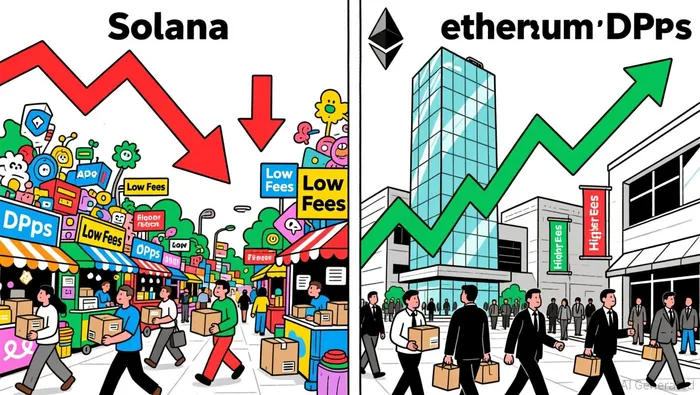
However, usage does not equal economic capture. Solana's median transaction fee is under a penny, and according to data, its block builders capture only 40% of Maximal Extractable Value (MEV), compared to Ethereum's 95%. This means that even with high volume, the network generates less revenue per transaction than Ethereum. For example, in January 2025, Solana's Real Economic Value (REV) hit $550 million, but this pales against Ethereum's $94 billion TVL in DeFi.
The problem is structural: Solana's low fees and high throughput create a "volume trap." While the network attracts users with speed and affordability, it struggles to retain economic value. In contrast, Ethereum's higher fees and slower speeds generate more revenue per transaction, which is then funneled into staking rewards and validator incentives.
Staking Yields and Institutional Adoption: A Double-Edged Sword
Staking is a cornerstone of Solana's economic model. By November 2025, 75% of circulating SOL was staked, with institutional-grade products like Marinade Select capturing $436 million in TVL. Staking yields averaged 7–8%, significantly higher than Ethereum's 3–4%. This has attracted institutional capital, including Franklin Templeton's Solana ETF and BlackRock's tokenized money market funds according to reports.
Yet, high staking yields come with volatility. When TVL in DeFi and DApps declines-due to waning interest in memecoins or reduced DApp revenues-validator rewards shrink, eroding confidence. For instance, weekly DApp revenues fell from $37 million to $26 million between September and November 2025. This volatility undermines the sustainability of staking yields, making Solana less attractive to long-term investors.
Ethereum, by contrast, offers more stable staking returns. Its proof-of-stake model prioritizes decentralization and security, with a validator set that is less susceptible to short-term market fluctuations. This stability has made Ethereum the preferred choice for institutional capital, even as its transaction speeds lag behind Solana's.
DApp Monetization: The Missing Link
Solana's dApp ecosystem is a double-edged sword. While it leads in transaction volume and user engagement, its monetization rates are underwhelming. In Q1 2025, Solana's top dApps-like JupiterJUP-- Perps and Pump.fun-generated $1 billion in daily trading volume but captured only 79.2% of market share. This fragmentation reduces the network's ability to retain value.
BNB Chain, meanwhile, has mastered the art of DApp monetization. Its TVL reached $58 billion in mid-2025, driven by a concentrated dApp ecosystem where PancakeSwapCAKE-- alone accounted for 91.8% of DEX volume according to the report. BNB Chain's low fees and streamlined validator set enable higher fee retention, creating a flywheel effect that boosts TVL and price.
Solana's dApp landscape, by contrast, is fragmented and speculative. The rise and fall of memecoins like BONKBONK-- and SAMO have driven short-term activity but failed to create lasting value. As one analyst noted, "Solana's dApps are great for virality, not for durability" according to insights.
The Price Divergence: Why Solana Lags
The divergence between Solana's usage and price is not unique. In 2025, Ethereum's market cap fell 45.2% quarter-over-quarter, while BNB Chain's network revenue grew 58.1% according to analysis. This highlights a broader trend: blockchains that prioritize economic capture over pure usage tend to outperform in price.
Ethereum's deflationary model-burning transaction fees to reduce supply-has created a strong narrative for long-term value. BNB Chain's PoSA consensus and low fees have made it a hub for retail DeFi, where price stability is prioritized. Solana, however, lacks a clear mechanism to convert its high volume into sustainable value.
Institutional adoption is a partial offset. Solana's integration with Visa and Mastercard, along with Franklin Templeton's ETF, signals growing legitimacy. Yet, these developments are not enough to counteract the network's structural weaknesses. As one report concluded, "Solana's technical superiority is not matched by economic resilience" according to findings.
What This Means for 2026
For investors, the key takeaway is clear: Usage metrics are a lagging indicator, not a leading one. Solana's on-chain dominance is impressive, but it must evolve its economic model to retain value. This could involve:
- Raising transaction fees to increase fee retention, though this risks deterring users.
- Centralizing MEV capture to boost validator rewards, as Ethereum has done.
 Consolidating dApp ecosystems to reduce fragmentation and enhance monetization.
If Solana fails to address these issues, Ethereum and BNB Chain will likely continue to outperform in price. However, if it can bridge the gap between usage and economic capture-through upgrades like Firedancer or Alpenglow-its price trajectory could shift dramatically.
As 2026 approaches, the battle for blockchain dominance will not be won by the fastest network, but by the one that best converts usage into value. For Solana, the clock is ticking.







Comentarios
Aún no hay comentarios