
Solana's On-Chain Activity and Institutional Adoption: Whale Behavior as a Leading Indicator of Institutional Interest in SOL
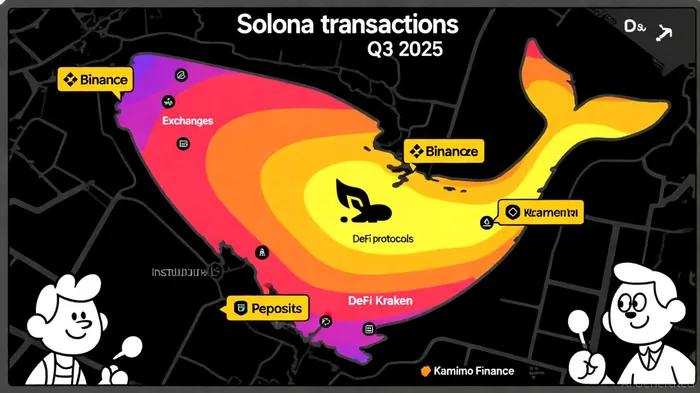
In the fast-evolving world of blockchain and digital assets, SolanaSOL-- (SOL) has emerged as a standout performer, driven by its high throughput, low fees, and growing institutional adoption. But beneath the surface, on-chain activity tells a compelling story of whale behavior that serves as a leading indicator of broader institutional interest. By analyzing these patterns, we can uncover how Solana's ecosystem is being shaped by strategic capital flows and long-term confidence.
Whale Behavior: A Window into Institutional Strategy
Whale activity on Solana in 2025 has been nothing short of dramatic. Over a nine-hour period in August, three major wallets deposited over $40 million worth of SOLSOL-- into centralized exchanges like Binance and Kraken, including a $17.45 million transfer from the CMJiHu wallet and a $15.98 million move from the 5PjMxa wallet [1]. While these deposits might initially suggest short-term selling pressure, deeper analysis reveals a different narrative. For instance, a June 2025 transfer of 3.5 million SOL ($487 million) between wallets—without involving exchanges—signals strategic accumulation rather than panic selling [2]. Such movements align with broader trends of institutions building long-term exposure to Solana's deflationary tokenomics and high staking yields.
Institutional entities now hold roughly 8% of Solana's circulating supply, with firms like DeFi DevelopmentDFDV-- Corp and UpexiUPXI-- Inc. adding 590,000 SOL ($123 million) to their holdings in a single month [1]. These entities are notNOT-- merely holding tokens; they are staking them for 7–8% annualized yields and participating in validator networks, governance, and DeFi protocols. For example, a whale transferred 240,000 SOL ($35 million) to Binance over 72 hours in late June 2025, a move analysts attributed to profit rotation rather than immediate liquidation [3].
Institutional Adoption: From Partnerships to Treasury Strategies
Solana's institutional adoption is not limited to on-chain activity. Public companies and investment firms are increasingly treating SOL as an institutional-grade asset. PayPal's expansion of its PayPalPYPL-- USD (PYUSD) stablecoin to Solana in May 2024 and Visa's USD Coin (USDC) integration in 2023 have cemented Solana's role in the stablecoin and payments landscape [4]. These partnerships leverage Solana's 65,000 transactions per second and low fees to future-proof financial infrastructure.
Meanwhile, investment firms like Galaxy DigitalGLXY-- and Pantera Capital are making large-scale commitments. Galaxy Digital's $536 million acquisition of 2.31 million SOL and Pantera's $1.25 billion Solana-focused treasury initiative highlight a strategic alignment with the blockchain's scalability and innovation [5]. These investments are further amplified by corporate treasuries: public firms collectively hold 5.9 million SOL (1% of the circulating supply), staking it to generate yields while supporting validator operations [4].
Staking Yields and the Rise of Solana Treasuries
Solana's staking ecosystem has become a magnet for institutional capital. With annualized yields averaging 7–8%, over $1.72 billion was staked on the network in Q3 2025 [1]. This has spurred the creation of regulated products like the REX-Osprey Solana Staking Fund (SSK), which raised $1.2 billion in its first month [1]. Institutions are also diversifying into yield-generating strategies: a whale's $12 million transfer from Binance to Kamino FinanceKMNO-- in August 2025 exemplifies how capital is being deployed for leveraged trading and liquidity provision [6].
The correlation between whale behavior and institutional moves is further underscored by short liquidations. In June 2025, a surge in short liquidations coincided with a $487 million whale transfer, suggesting behind-the-scenes buying by institutions [2]. This dynamic is reinforced by regulatory progress, including CME Group's Solana futures and potential ETF approvals, which have bolstered confidence in the asset class [5].
Future Outlook: Solana as the Institutional Blockchain
As Solana continues to attract capital through staking, validator participation, and strategic partnerships, it is increasingly positioned as a bridge between traditional finance and decentralized innovation. However, challenges remain. Regulatory clarity, while improving, is still a wildcard, and macroeconomic shifts could impact risk-on sentiment.
Conclusion
Solana's on-chain activity and institutional adoption are inextricably linked. Whale behavior—whether through strategic deposits, off-exchange transfers, or staking—serves as a leading indicator of institutional confidence. As the ecosystem matures, the interplay between these factors will likely drive Solana's trajectory in the institutional crypto landscape. For investors, the message is clear: Solana is not just a high-performance blockchain; it's a proving ground for the next era of institutional-grade digital assets.







Comentarios
Aún no hay comentarios