
Solana's Alpenglow Upgrade and Its Implications for On-Chain Trading Dominance
Blockchain has long been positioned as a disruptive force in finance, but its adoption in high-speed, high-stakes environments like trading has been limited by latency and scalability bottlenecks. Solana's upcoming Alpenglow upgrade aims to change this narrative by introducing sub-second finality, a technical leap that could position the network as a direct competitor to traditional financial infrastructure. For investors, this upgrade represents not just a technical milestone but a strategic inflection point in the blockchain industry's race to capture on-chain trading dominance.
The Technical Breakthrough: Sub-Second Finality
At the heart of Alpenglow is a reimagining of Solana's consensus mechanism. The upgrade replaces the existing Tower BFT and Proof of History (PoH) protocols with Votor and Rotor, two components designed to drastically reduce latency while maintaining security.
Votor, the new consensus layer, enables blocks to be finalized in 100–150 milliseconds, a 100x improvement over Solana's current finality time of 12.8 seconds according to technical documentation. This is achieved through two finalization paths:
1. Fast Finalization: A block is finalized in a single confirmation round if it receives 80% or more stake approval.
2. Slow Finalization: If approval is between 60% and 80%, a second round is required, ensuring robustness without sacrificing speed.
Complementing this is Rotor, which optimizes block propagation by prioritizing stake-weighted relay paths. High-stake validators with reliable bandwidth act as key relay points, reducing block propagation latency to as little as 18 milliseconds under ideal conditions. This replaces Solana's previous Turbine gossip network, which relied on multi-hop relays and introduced bottlenecks.
Together, these innovations enable SolanaSOL-- to achieve median finality latency of ~150 milliseconds and best-case latency of ~100 milliseconds according to performance benchmarks. Crucially, the upgrade is designed to tolerate up to 20% adversarial stake and an additional 20% offline stake, ensuring resilience in challenging network conditions.
Implications for On-Chain Trading
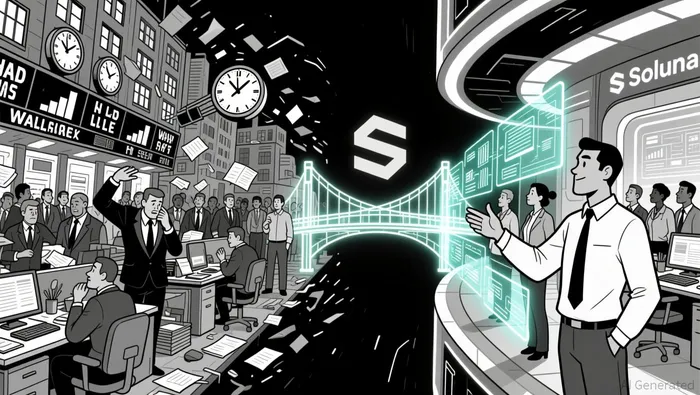 The significance of sub-second finality for on-chain trading cannot be overstated. Traditional financial markets operate on millisecond-level timing, with high-frequency trading (HFT) firms investing billions to shave microseconds off execution speeds. Solana's Alpenglow upgrade bridges the gap between blockchain and these legacy systems, enabling use cases that were previously unfeasible.
- Real-Time Trading Execution: With finality times rivaling those of centralized exchanges, Solana can support on-chain order books and programmable trading strategies that execute with minimal slippage. This could attract institutional traders seeking transparency and reduced counterparty risk.
- Decentralized Derivatives and Futures: Sub-second finality is critical for derivatives markets, where price updates and position settlements must occur rapidly to avoid arbitrage or liquidation risks. Solana's improvements make it viable for protocols to offer on-chain futures trading with Web2-like performance.
- Live Auctions and NFT Marketplaces: High-throughput, low-latency finality enables real-time bidding and dynamic pricing models, opening new revenue streams for NFT platforms and auction houses.
According to a report by Yellow, the Alpenglow upgrade is expected to unlock $100 billion+ in on-chain trading volume by 2027, driven by institutional adoption and the proliferation of decentralized trading protocols. This aligns with broader trends in DeFi, where users are increasingly prioritizing speed and reliability over pure decentralization.
Competing with Traditional Infrastructure
The Alpenglow upgrade positions Solana to directly challenge traditional financial infrastructure in three key areas:
- Speed vs. Cost: Traditional exchanges like NASDAQ or NYSE rely on expensive, proprietary hardware to achieve low latency. Solana's open-source, stake-weighted model offers similar performance at a fraction of the cost, democratizing access to high-speed trading.
- Transparency and Trust: Unlike centralized exchanges, Solana's on-chain trading infrastructure is fully auditable and censorship-resistant, reducing the risk of market manipulation or regulatory overreach.
- Scalability: With Rotor's optimized propagation layer, Solana can sustain high-throughput trading without compromising finality times-a challenge that has plagued EthereumETH-- and other Layer 1s.
As noted by Delphi Digital, Solana's ability to achieve sub-second finality while maintaining 20% adversarial tolerance sets it apart from competitors like Ethereum or Bitcoin, which lack comparable consensus efficiency. This technical edge could accelerate Solana's adoption in institutional-grade applications.
Risks and Considerations
While the Alpenglow upgrade is a game-changer, investors must remain cautious. Key risks include:
- Validator Centralization: Stake-weighted relay paths could concentrate network influence among high-stake validators, potentially undermining decentralization.
- Adoption Uncertainty: Even with superior performance, on-chain trading protocols must attract liquidity and user trust to compete with established exchanges.
- Regulatory Scrutiny: High-speed trading on decentralized networks may attract regulatory attention, particularly if it disrupts existing market structures.
The upgrade is slated for activation between early and mid-2026 according to project timelines, giving developers time to build and test applications. However, delays or bugs in implementation could impact timelines and investor sentiment.
Conclusion
Solana's Alpenglow upgrade is more than a technical overhaul-it's a strategic move to position blockchain as a viable alternative to traditional financial infrastructure. By achieving sub-second finality and ultra-low propagation latency, Solana addresses the core limitations that have hindered on-chain trading. For investors, this represents a high-conviction opportunity to bet on the convergence of Web3 and Web2, with potential first-mover advantages for early adopters.
As the upgrade approaches deployment, the focus will shift to ecosystem adoption and real-world performance. If successful, Solana could redefine the boundaries of what's possible in decentralized finance-and in the process, capture a significant share of the $10 trillion global trading market.






Comentarios
Aún no hay comentarios