
Solana's Agave 3.0: A Catalyst for Long-Term Growth in Blockchain Ecosystems
The Technical Revolution: Agave 3.0's 40% Performance Boost
Solana's Agave 3.0 upgrade, launched on the testnet in late August 2025, has delivered a seismic shift in blockchain performance. According to a CoinViews report, the update introduced the eXpress Data Path (XDP), which optimizes the Turbine protocol to reduce latency and improve block propagation. This, combined with a 30–40% faster transaction processing speed and the adoption of ahash (a faster hashing algorithm), has pushed Solana's theoretical throughput to 65,000 TPS, per a CryptoPotato report.
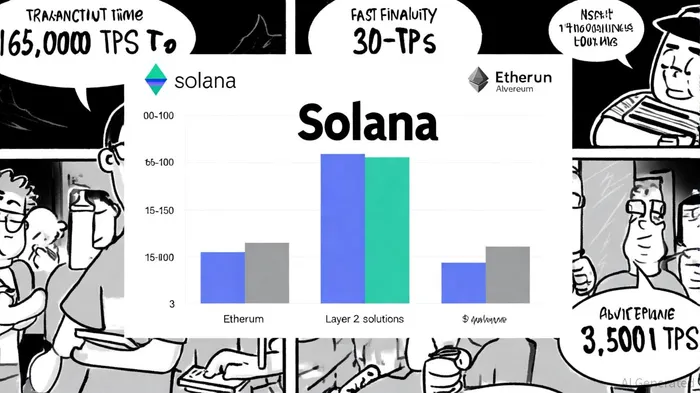
A synthetic benchmark by Phemex News revealed that Agave 3.0 achieved 1.1 million TPS on a single node, matching the previous record set by Firedancer, according to the CoinViews report. While this is a controlled environment, it underscores the potential for real-world scalability. The upgrade also prepares the network for Alpenglow, a consensus overhaul that will reduce block finalization times from 12.8 seconds to 100–150 milliseconds, as detailed in a Medium post. This leap in speed positions SolanaSOL-- as a prime candidate for high-frequency applications like DeFi, gaming, and AI-driven platforms.
Developer Adoption: Solana's 83% Surge in New Talent
Developer activity is a critical barometer for blockchain ecosystems. Solana Compass data shows that Solana attracted 7,625 new developers in 2024, an 83% year-over-year increase. This growth outpaces EthereumETH--, which saw a 17% decline in active developers to 6,244 in Q3 2025. Solana's developer incentives, including grants and hackathons, have fueled projects like Kamino Finance (now $1.5 billion in TVL) and Jupiter (a leading DEX aggregator).
The SLV platform, an open-source validator operations tool, has further streamlined migration to Agave 3.0.0, with over 50% of testnet validators already running the update. This ease of adoption ensures that developers can focus on building rather than troubleshooting infrastructure. As Markaicode notes, Solana's Rust and TypeScript-friendly environment has attracted engineers seeking high-performance solutions.
Institutional Interest: From ETF Hype to $1.25B Treasury Models
Institutional adoption is accelerating, driven by Solana's low fees and high throughput. OKX reports that public companies now hold nearly $4 billion in SOLSOL--, with firms like Forward Industries (6.8 million SOL) and Galaxy Digital (6.5 million SOL) pre-positioning for a U.S. spot ETF approval. This mirrors the institutional behavior seen before BitcoinBTC-- and Ethereum ETFs, signaling long-term confidence.
Pantera Capital's $1.25 billion initiative, as highlighted by CoinBureau, is reshaping Solana's treasury model from speculative token holding to structured institutional strategies. Meanwhile, VanEck and Bitwise have applied for Solana ETFs, with the former launching Europe's first Solana ETN, including staking rewards. These developments are notNOT-- just speculative-they reflect a broader integration into traditional finance.
Solana vs. Ethereum: The 2025 Scalability Showdown
While Ethereum remains dominant in enterprise-grade DeFi, Solana's Agave 3.0 has closed the gap in developer growth and performance. CoinViews data reveals that Solana processes 2,000–4,000 TPS in real-world conditions, dwarfing Ethereum's 15–30 TPS on its base layer. Layer 2 solutions like ArbitrumARB-- and OptimismOP-- have boosted Ethereum's effective TPS to 4,000, but Solana's native speed and cost efficiency (averaging $0.00025 per transaction) make it a more attractive option for microtransactions and high-frequency use cases, as Markaicode argues.
Ethereum's 38,000+ active developers still outpace Solana's 21,000+, but the latter's 83% growth rate suggests a shift in momentum. As Markaicode notes, Solana's focus on speed and developer-friendly tools is attracting a new generation of builders.
The Investment Case: Why Early Adoption in SOL Matters
Solana's Agave 3.0 is not just a technical upgrade-it's a strategic pivot toward institutional and developer dominance. With Alpenglow on the horizon, the network is poised to redefine blockchain finality and throughput. The $173 million in Q3 2024 funding and growing ETF interest further validate its potential.
For investors, the key metrics are clear:
- Scalability: 65,000 TPS with Alpenglow's 100–150 ms finality.
- Developer Growth: 83% YoY increase in new developers.
- Institutional Confidence: $4 billion in corporate holdings and ETF applications.
As the blockchain landscape evolves, Solana's Agave 3.0 represents a rare confluence of technical innovation, ecosystem growth, and institutional validation. Early adopters stand to benefit from a network that is not only scaling but also reshaping the future of decentralized finance and applications.





Comentarios
Aún no hay comentarios