
Solana's $8B Open Interest Surge: Liquidity Dynamics and Institutional Positioning in Derivatives Markets
Solana's open interest (OI) has surged to $8 billion in early 2026, marking a pivotal moment in the blockchain's evolution as a derivatives trading hub. This surge reflects a confluence of speculative fervor, institutional adoption, and technical advancements, yet it also raises critical questions about liquidity sustainability and network decentralization. By dissecting the interplay between derivatives market dynamics, validator economics, and institutional positioning, we can better understand Solana's trajectory-and the risks and opportunities it presents.
The OI Surge: A Double-Edged Sword
Open interest-a measure of the total value of outstanding derivative contracts- reached $8 billion in early 2026, signaling robust speculative activity. This level of leverage amplifies price volatility, as even minor price movements can trigger cascading liquidations or forced rebalancing, particularly during low-liquidity periods. For example, in Q1 2026, Solana's derivatives OI hit $4.33 billion, with funding rates averaging +0.46% (63.1% APR), reflecting a sustained long bias. Such dynamics suggest a market primed for explosive growth-or collapse-depending on liquidity depth and institutional participation.
However, the surge in OI contrasts with a troubling trend: Solana lost 97% of its retail traders in 2025 as institutional wallets exited the market. This divergence highlights a critical question: Can Solana's derivatives market sustain its current OI levels without broad retail participation? The answer may lie in the network's institutional infrastructure.
Institutional Adoption: From ETFs to RWAs
Institutional capital has become a cornerstone of Solana's derivatives ecosystem. The launch of Solana-focused ETFs, such as Franklin Templeton's and BlackRock's BUIDL tokenized fund, brought $1.02 billion in assets under management in 2025. These products have proven resilient, with positive net inflows despite bearish price action, signaling growing institutional confidence.
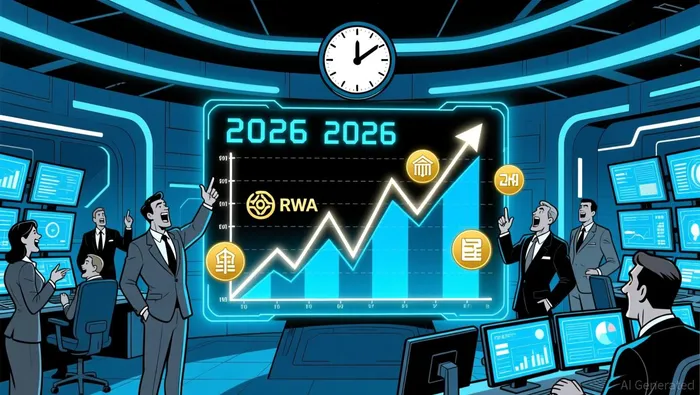
Moreover, Solana's integration of real-world assets (RWAs) has unlocked new capital flows. Tokenized assets from companies like Tesla and NVIDIA generated over $931 million in RWA value on the network. This innovation bridges traditional finance and DeFi, enabling institutions to deploy capital in high-yielding DeFi strategies while maintaining regulatory compliance. For instance, J.P. Morgan's U.S. commercial paper issuance and State Street's tokenized private liquidity fund underscore the blockchain's institutional-grade utility.
Derivatives Market Liquidity: Jupiter and Beyond
Liquidity is the lifeblood of any derivatives market, and Solana's ecosystem has seen remarkable growth. Jupiter, a leading decentralized exchange (DEX), processed $17.4 billion in perpetual futures notional volume and $716 billion in token trading volume in 2025. This dwarfs centralized exchanges like CoinbaseCOIN-- and Bybit, which collectively accounted for 62.3% of the global derivatives market in Q4 2025.
The rise of hybrid platforms-combining centralized exchange (CEX) liquidity with DeFi custody-has further enhanced Solana's appeal. Protocols like Hyperliquid and Kamino Finance offer low-latency trading and automated compounding, attracting institutional-grade participants. Additionally, stablecoin supply on SolanaSOL-- surged to $15 billion, with FRNT and JupUSD backed by major institutions like Franklin Templeton and BlackRock. This liquidity influx has been critical for yield generation, with native staking offering ~7% APY and liquidity provider positions yielding 15–40% during high-volume periods.
Validator Economics: Centralization Risks and Upgrades
While Solana's derivatives market thrives, its validator landscape reveals growing centralization risks. The number of active validators dropped by 42% from 1,364 to 783 by late 2025, as smaller operators struggled with profitability. Only 18% of the network's stake had migrated to the latest secure validator client (v3.0.14) by early 2026, leaving the network vulnerable to security threats.
However, validator economics have improved. Increased block rewards and MEV (miner extractable value) infrastructure have boosted returns. For example, Figment reported that MEV rewards contributed 13–15% of total staking rewards in Q2 2025. This trend is expected to grow as inflation shrinks, with MEV potentially accounting for 20–25% of validator rewards during high-activity periods.
Upcoming upgrades like Alpenglow (reducing block finality times) and SIMD-123 (enabling transparent reward distribution) aim to address centralization risks and improve performance. These upgrades could attract more validators, but their success hinges on widespread adoption of the latest software.
The Retail-Risk Paradox
Despite institutional strength, Solana's retail participation remains weak. While on-chain spot volume hit $1.6 trillion in 2025-surpassing major CEXs like Coinbase and Bybit-retail trading data has not mirrored this momentum. This disconnect has contributed to price stagnation for SOLSOL--, despite robust fundamentals. If retail participation aligns with institutional activity, it could trigger a new bullish cycle. However, the loss of 97% of traders in 2025 suggests that retail confidence is fragile.
Conclusion: A Network at a Crossroads
Solana's $8 billion OI surge reflects a derivatives market poised for institutional dominance. The blockchain's technical advantages-high throughput, low latency, and low fees-have made it a hub for yield generation and RWA integration. Yet, centralization risks in the validator network and the absence of retail participation pose significant challenges.
For investors, the key question is whether Solana can balance institutional growth with decentralization and retail appeal. Upcoming upgrades like Alpenglow and the maturation of RWA infrastructure may tip the scales. In the short term, the network's derivatives liquidity and institutional positioning suggest a strong case for continued adoption-but long-term success will depend on addressing its structural vulnerabilities.







Comentarios
Aún no hay comentarios