
Solana's $80B Market Cap: A Make-or-Break Threshold for $1,000 Potential?
ETF Inflows: A New Era of Institutional Confidence
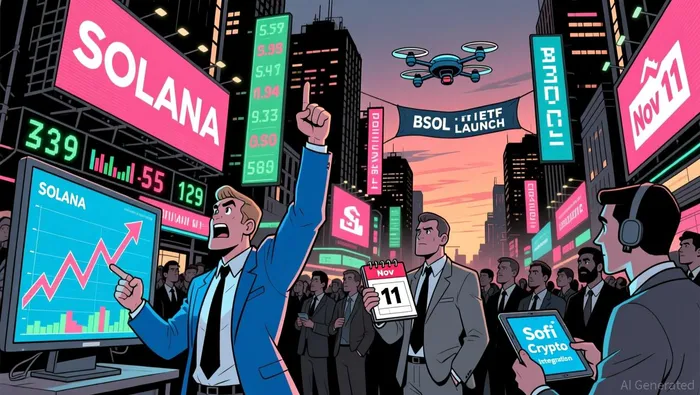
The recent launch of U.S. spot Solana ETFs has catalyzed unprecedented capital inflows. As of November 12, 2025, these products have attracted $369 million in net inflows since their October 28 debut, with Bitwise's BSOL and Grayscale's GSOL leading the charge. On November 12 alone, BSOL recorded $12.46 million in inflows, while GSOL added $5.59 million according to data. This momentumMMT-- has exceeded pre-launch expectations, which had predicted minimal institutional adoption due to regulatory and technical concerns as reported.
The significance of these inflows lies in their consistency. For 10 consecutive days, Solana ETFs have seen net positive flows, signaling growing trust in the asset class. This trend aligns with broader institutional interest, as 19 public companies now hold 15.4 million SOLSOL-- tokens-valued at $3 billion-as strategic reserves according to market data.
Technical Upgrades: Scaling to Compete with Ethereum
Solana's technical roadmap has been a critical driver of its market momentum. The deployment of the Firedancer validator client in Q3 2025 increased the network's transaction throughput to over 1 million transactions per second (TPS), a 15-fold improvement over previous capabilities. This upgrade also reduced validator hardware costs by 50–80%, making the network more accessible to smaller participants.
Complementing this, ZK Compression v2 has revolutionized on-chain efficiency. By leveraging zero-knowledge proofs, the upgrade slashed transaction fees by 5,200 times, enabling large-scale airdrops and NFT launches without compromising performance. These innovations have positioned Solana as a viable alternative to EthereumETH--, particularly for developers seeking high throughput at low cost.
On-chain metrics further underscore Solana's strength. In November 2025, the network recorded 17.236 million active addresses and 543 million weekly transactions, surpassing both Ethereum and BNB Chain. Despite a 30% quarterly drop in active addresses-a potential sign of broader market cooling-Solana maintains an 8% share of the DeFi market, with Kamino's $2.8 billion TVL leading the sector according to analysis.
Selling Pressure and Institutional Counterbalance
While technical and fundamental factors paint an optimistic picture, Solana's path to $1,000 is not without headwinds. The Alameda Research and FTX estate continue to release large quantities of SOL tokens through structured vesting programs. On November 11, 2025, a $30 million unlock event saw 193,000 SOL tokens distributed to exchanges, primarily to repay creditors. These monthly unlocks, which have totaled over 8 million SOL since November 2023, pose a persistent supply-side risk.
However, institutional adoption is emerging as a counterbalance. SoFi, a publicly traded fintech firm, reentered the crypto market in 2025 with SoFi Crypto, a service allowing users to trade SOL directly from FDIC-insured accounts. This integration marks a pivotal shift in mainstream adoption, as it enables retail investors to access crypto assets through a trusted, regulated platform according to reports. SoFi's CEO emphasized that the move aligns with the company's mission to modernize finance, leveraging blockchain to enhance accessibility and security according to statements.
The $1,000 Question: Balancing Forces
For Solana to reach $1,000, it must navigate a delicate balance between supply-side pressures and demand-side catalysts. The $80 billion market cap represents a critical threshold, as it reflects both institutional confidence and technical readiness. However, sustained growth will depend on:
1. Continued ETF inflows that outpace Alameda/FTX unlocks.
2. Further adoption by major institutions, such as SoFi's integration, which could normalize Solana as a mainstream asset.
3. Execution on the technical roadmap, including upgrades that maintain Solana's edge over Ethereum and other Layer 1s.
If these factors align, Solana's valuation could theoretically justify a $1,000 price target. At that level, the network's market cap would approach $180 billion, a 112% increase from current levels. While ambitious, this trajectory is not inconceivable given the asset's recent performance and the broader crypto market's appetite for innovation.
Conclusion
Solana's $80 billion market cap is more than a number-it's a testament to the convergence of institutional adoption, technical excellence, and regulatory progress. While selling pressure from legacy players like Alameda remains a wildcard, the rise of ETFs and SoFi's crypto integration suggest a growing consensus that Solana is here to stay. For investors, the next few months will be pivotal: If inflows continue and technical upgrades deliver, the $1,000 milestone may no longer be a question of if, but when.






Comentarios
Aún no hay comentarios