
Solana's 2026 RWA Tokenization Surge: A High-Conviction Play for Institutional-Grade Growth
The real-world asset (RWA) tokenization market is on the cusp of a seismic shift, and SolanaSOL-- is emerging as the most strategically positioned blockchain to capitalize on this transformation. By 2026, the confluence of institutional-grade infrastructure, regulatory alignment, and scalable execution will redefine how traditional assets are tokenized, traded, and settled. Solana's 2023–2025 upgrades-ranging from throughput enhancements to compliance tools-have laid the groundwork for a $1–3 trillion RWA market, with institutional partnerships and case studies already validating its leadership.
Infrastructure: The Bedrock of RWA Scalability
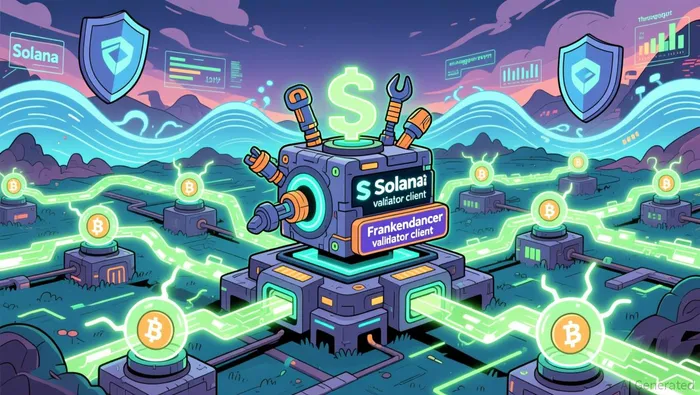
Solana's technical advancements have been pivotal in enabling RWA tokenization at scale. By 2025, the network's block space had nearly doubled, pushing transaction throughput to over 1,100 transactions per second. This was achieved through protocol-level innovations such as a consensus algorithm that eliminates vote transactions and supports concurrent proposers, alongside the Frankendancer validator client, which improved reliability and performance. These upgrades are critical for RWA applications, where high-frequency settlements and micro-transactions are common.
Moreover, Solana's Solana Attestation Service (SAS) has addressed institutional compliance needs by anchoring offchain data-such as KYC checks and geographic eligibility-to onchain accounts according to network health reports. This ensures tokenized assets like U.S. Treasuries and real estate meet regulatory standards without sacrificing speed or cost efficiency. With transaction fees as low as $0.00025 and finality under 400 milliseconds as per technical analysis, Solana outperforms EthereumETH-- and other Layer 1s in RWA use cases requiring frequent trading and instant liquidity.
Institutional Partnerships: Validating Solana's Ecosystem
Solana's institutional partnerships have cemented its role as the go-to blockchain for RWA tokenization. BlackRock's USD Institutional Digital Liquidity Fund (BUIDL), launched in 2024, attracted over $500 million in assets by tokenizing U.S. Treasuries, leveraging Solana's infrastructure for near-instant settlements. Similarly, Apollo Global and Securitize's native RWA lending market allows investors to collateralize ACRED tokens-representing shares in Apollo's credit fund-to borrow stablecoins like USDG, reducing counterparty risk through direct ownership.
Collaborations with R3's Corda Protocol further underscore Solana's institutional appeal. By enabling real-time transaction confirmations and stablecoin settlements, this partnership bridges Corda-based assets to Solana's high-throughput network. The Solana Foundation's $500 million Tokenization Regatta fund, announced at Breakpoint 2025, is another strategic move to accelerate RWA projects, targeting $2–3 billion in on-chain RWA value by 2025 and $25 billion by 2030.
Market Projections: A 2026 RWA Boom
By January 2026, Solana's RWA ecosystem had already hit $873 million in total value, with 125,000 distinct RWA holders. Analysts project this figure to surge as tokenization expands beyond T-bills into private credit, real estate, and consumer-grade applications. For instance, Homebase's platform on Solana has tokenized $400,000 in real estate, enabling fractional ownership starting at $100.
Market share data reinforces this optimism. As of December 2025, Solana held a 4.36% share of the RWA tokenization market, representing $836.4 million in value. With the broader RWA market projected to grow from $30–50 billion in 2025 to $1–3 trillion by 2030 according to industry forecasts, Solana's infrastructure and partnerships position it to capture a disproportionate share. The Firedancer upgrade, expected to push throughput beyond 1 million TPS by 2026, will further solidify its dominance in high-frequency RWA settlements.
Case Studies: Proving the Model
Tokenized real estate and private credit have demonstrated Solana's viability for institutional-grade RWA. A New York luxury hotel was tokenized in 2025, allowing investments starting at $1,000 and creating liquidity in an otherwise illiquid asset class. Similarly, Hamilton Lane's tokenization of middle-market corporate loans streamlined issuance and reduced costs, showcasing Solana's utility in private debt markets.
Institutional adoption is also accelerating. JPMorgan's pilot of tokenized deposit tools, and State Street's Digital SWEEP Fund on Solana is expanding its footprint, highlight the blockchain's role in integrating traditional finance with crypto-native infrastructure. These projects are not speculative-they are operational, scalable, and compliant.
Conclusion: A High-Conviction Investment Thesis
Solana's 2026 RWA surge is not a speculative bet but a well-validated inevitability. Its infrastructure upgrades have solved the scalability and compliance bottlenecks that plagued earlier blockchain networks. Institutional partnerships with BlackRock, Apollo, and R3 Corda have proven its ability to tokenize and settle real-world assets at scale. And with market projections pointing to a $1–3 trillion RWA market by 2030, Solana's 4.36% share in 2025 is poised to grow exponentially.
For investors, the question is no longer if Solana will lead the RWA boom-it's how much they are willing to allocate to a platform that has already demonstrated its strategic positioning.






Comentarios
Aún no hay comentarios