
SOL Gains Momentum on Institutional Adoption and 2026 Growth Catalysts
Solana's Institutional Growth and Market Positioning
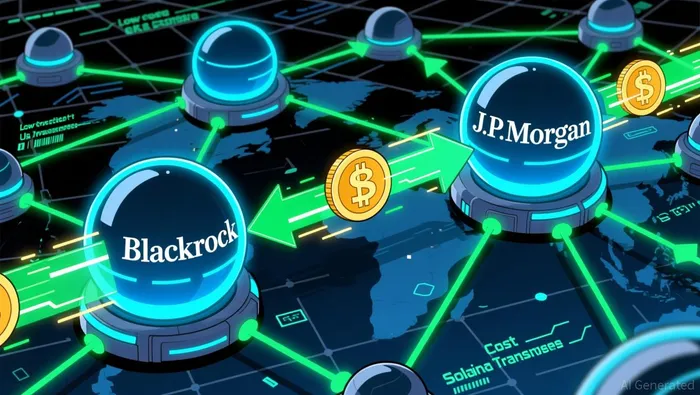
Solana is gaining institutional traction through ETF approvals and partnerships with firms like BlackRockBLK-- and J.P. Morgan according to reports. The blockchain's high speed and low costs fuel growth in real-world asset tokenization, with RWA TVL hitting $873 million. Analysts project SolanaSOL-- could reach between $280 and $900 by late 2026 depending on upgrade execution and macro conditions based on analysis.
Solana (SOL) is positioning itself as institutional-grade infrastructure heading into 2026. Major financial players are adopting its blockchain for tokenized assets and settlements according to market data. This momentum comes alongside record ETF inflows and network upgrades that could redefine its market position. Investors are watching whether its technical advantages translate into sustained growth.
Why Is Solana Attracting Major Financial Institutions?
Solana secured partnerships with BlackRock, J.P. Morgan, and State StreetSTT-- for tokenizing real-world assets like U.S. Treasuries according to industry sources. These collaborations leverage Solana's 65,000 TPS throughput and average transaction costs of $0.0035. Visa's use of Solana for USDCUSDC-- settlements further validates its payment infrastructure capabilities as analysts note. Six Solana-based ETFs attracted $647 million in 2025 inflows, signaling deepening institutional commitment. Tokenized asset markets on Solana now hold lending TVL of $3.6 billion. Regulatory clarity under the U.S. GENIUS Act provides tailwinds for these applications according to market analysts. Institutional adoption is accelerating through both products and infrastructure integration.
How Does Solana's Economic Model Outperform Competitors?
Solana's fee structure creates a direct economic loop where validators and stakers receive transaction rewards immediately according to blockchain analysis. This contrasts with Ethereum's model where fees fragment across L2 sequencers and MEV builders as reported by industry experts. The design incentivizes network participation during demand spikes, reinforcing growth. Solana's rebranding as "Global Financial Infrastructure" in 2024 emphasized institutional-grade security according to industry reports. Its $13.5 billion TVL demonstrates capital efficiency advantages over chains relying on Layer 2 solutions based on financial data. The upcoming Firedancer upgrade aims to boost throughput further while Alpenglow enhances cross-chain capabilities according to development timelines. Solana's architecture offers a unified environment for global capital markets.
What Price Targets Are Analysts Setting for Solana in 2026?
Analysts project Solana could trade between $280 and $400 by late 2026 based on current trends. More bullish scenarios see $900 if Firedancer upgrades succeed and macro conditions improve as analysts suggest. Bearish targets sit at $1,004 by 2030, with a base case of $1,042 according to market projections. These projections factor in Solana's revenue potential after it surpassed Ethereum's $522 million with $1.4 billion in 2025 as reported by financial data sources. Technical indicators show SOLSOL-- consolidating with key support at $78-$80. The tokenized RWA market's 400% YoY growth to $873 million provides fundamental backing according to market analysis. Price trajectories remain contingent on institutional accumulation patterns and upgrade timelines.





Comentarios
Aún no hay comentarios