
SOL's Break Below $160: A Strategic Reassessment of Entry Points and Risk Management
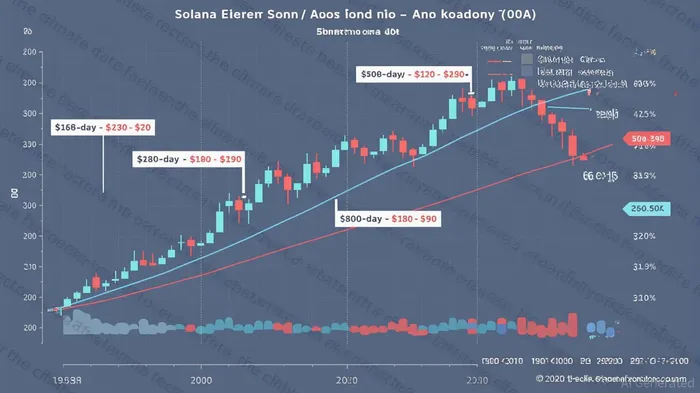
The recent breakdown of Solana (SOL) below the $160 level in August 2025 has ignited a critical debate among traders and institutional investors. This move, which followed a brief surge above $159.24 and consolidation near $155, has triggered a recalibration of technical and sentiment-driven strategies. With the Put/Call ratio spiking to 1.19—a stark indicator of bearish positioning—and Open Interest in derivatives stagnating at $7.1 billion, the market is grappling with the interplay of ETF-driven optimism and short-term volatility.
Technical Analysis: A Fractured Momentum
The breakdown below $160, a psychologically significant level, has exposed vulnerabilities in Solana's recent bullish narrative. The asset's failure to breach the $160–$162 resistance zone—a key catalyst for a potential $178–$185 rally—has shifted the technical outlook to bearish. Key indicators confirm this shift:
- Heikin Ashi Candles: Five consecutive red candles signal a loss of bullish momentum.
- Bollinger Bands: The price has dropped to the middle band at $179, suggesting a retest of the 200-day SMA ($181.22) as a critical resistance level.
- Fibonacci Retracements: A breakdown below $170 could trigger a retest of the 61.8% level at $152, with further downside risk to $145–$130.
The 200-day SMA, which has historically acted as a rejection zone, now looms as a critical threshold. A daily close above $200 would invalidate the current pullback and reignite bullish sentiment, while a sustained drop below $170 could cement a bearish trend.
Market Sentiment: ETF Optimism vs. Short-Term Volatility
The institutional landscape for Solana remains a double-edged sword. While Franklin Templeton, Fidelity, and Grayscale have updated their ETF filings to include staking mechanisms—a move analysts estimate has an 90% approval probability by year-end—the market has not yet priced in these developments. CoinShares' recent registration of a Solana staking ETF in Delaware signals growing institutional-grade adoption, yet the price action tells a different story.
On July 31, Solana fell 3.29% despite the publicization of ETF filings, contrasting with Bitcoin and Ethereum's post-ETF approval rallies. This divergence raises questions about whether the ETF narrative is being overhyped or if the market is simply consolidating ahead of a larger move. The CME's 370% surge in Solana futures open interest in July—a peak of $5 billion—highlights speculative activity, but spot demand has waned, with derivative volume rising 11% in early July.
The introduction of a 2.5% management fee by Grayscale, paid in SOL, further complicates traditional investors' calculus. While crypto-native investors may embrace this model, mainstream adoption hinges on regulatory clarity and fee structures that align with traditional finance norms.
Risk Management: Navigating a Volatile Landscape
For investors, the breakdown below $160 necessitates a strategic reassessment of entry points and risk mitigation. Key considerations include:
1. Support Zones as Entry Opportunities: The $168–$170 range represents a critical floor. A rebound here could signal a short-term bounce, but aggressive entry requires confirmation above $180.
2. Stop-Loss Placement: Traders should consider stop-loss orders below $170 to limit downside risk, with a tighter bracket at $165 to avoid liquidation clusters at $145.
3. Position Sizing: Given the high volatility, position sizes should be capped at 5–10% of a portfolio to mitigate the impact of sudden swings.
4. Hedging with Derivatives: Options strategies, such as long puts at $160, can protect against further declines while allowing upside participation if the ETF narrative gains traction.
Conclusion: A Pivotal August for Solana
August 2025 will be a defining period for Solana. A bullish scenario requires the asset to hold the $168–$170 support zone, regain momentum above $180, and test $190–$210. Conversely, a breakdown below $170 could trigger a deeper correction to $145–$130. While the long-term implications of ETF approval are positive, the immediate outlook remains uncertain.
Investors should adopt a cautious, data-driven approach, balancing optimism about institutional adoption with the realities of short-term volatility. The $160 breakdown is not a terminal event but a catalyst for reevaluating risk-reward profiles. For those with a longer-term horizon, the growing ecosystem—evidenced by 21% weekly transaction volume growth—suggests Solana's fundamentals remain intact. However, in the near term, patience and discipline will be paramountPARA--.







Comentarios
Aún no hay comentarios