
SoFi's Resurgence in Fintech: A Masterclass in Platform Economics and Network Effects
In the ever-evolving fintech landscape, SoFi TechnologiesSOFI-- has emerged as a standout example of how strategic innovation, disciplined unit economics, and network effects can drive sustainable growth. By leveraging its digital-first platform to expand into new markets, optimize customer acquisition, and scale fee-based revenue streams, SoFiSOFI-- is redefining what it means to be a "financial super app."
Strategic Expansion: Building a Diversified Ecosystem
SoFi's 2024-2025 strategic initiatives have been nothing short of transformative. The company secured a $3.2 billion partnership with Fortress and Edge Focus to bolster its loan origination capabilities, a move that has already driven a 59% year-over-year increase in student loan originations in Q1 2025, according to a Monexa update. Simultaneously, the launch of Galileo Deposit Sweep-a product that automates high-yield savings for fintech clients-has enhanced customer retention while extending FDIC coverage, as noted by StocksToTrade.
The company's foray into private markets and cryptocurrency further underscores its ambition. By reintroducing BitcoinBTC-- and EthereumETH-- trading and piloting crypto-backed loans, SoFi is positioning itself to capture a growing segment of digitally native investors, according to a Dafinchi analysis. These expansions are not isolated bets but part of a broader strategy to create a self-reinforcing ecosystem where each new product enhances the value of the platform as a whole.
Unit Economics: A LTV/CAC Ratio That Speaks Volumes
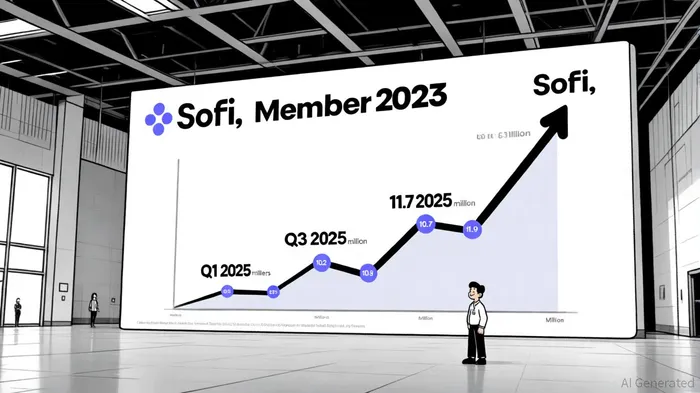
SoFi's financial health is best understood through its unit economics. In Q4 2023, the company reported a 44% year-over-year increase in total members, reaching 7.5 million, while total products grew by 41% to 11.1 million, according to a Nasdaq press release. Crucially, its customer acquisition cost (CAC) has been optimized to 40% below traditional banks, and its cross-buy rate of 42%-meaning 42% of customers use multiple products-has driven a customer lifetime value (LTV) that comfortably exceeds the 3:1 LTV/CAC benchmark, per an ESSEC-KPMG analysis.
This efficiency is a testament to SoFi's data-driven marketing and its ability to convert free users into paying customers. For instance, the company's Financial Services segment now generates 41% of adjusted net revenue from fee-based income, a capital-light model that reduces reliance on interest rate cycles, as highlighted in a SteveWagsInvest post.
Network Effects: The Flywheel of Growth
SoFi's true strength lies in its network effects. The company's Financial Services Productivity Loop (FSPL) strategy-where product innovation and cross-selling create a virtuous cycle-has led to a 35% year-over-year increase in new products opened by existing members in Q2 2025, according to a SoFi press release. This is not merely a function of aggressive marketing but of a platform designed to deepen engagement.
Consider the Loan Platform Business (LPB), which originated $2.4 billion in loans for third-party partners in Q2 2025 alone, as reported in a Nasdaq article. By acting as a white-label lender, SoFi not only diversifies its revenue streams but also strengthens its relationships with partners like Blue Owl and Fortress, creating a flywheel effect where each partnership enhances the platform's scalability.
The Galileo Financial Technologies segment further exemplifies this. With 168 million enabled accounts as of Q4 2024 and a 15% year-over-year increase, per a Galileo release, Galileo's infrastructure is becoming a critical node in the fintech ecosystem. Its recent selection by the U.S. Treasury for the Direct Express program-a $3.4 billion federal benefits distribution system-highlights its institutional credibility, according to Yahoo Finance highlights.
The Investment Case: A Platform in Motion
SoFi's Q3 2025 results reinforce its momentum. Adjusted net revenue surged to $689.4 million, surpassing analyst estimates, while EBITDA hit $186.2 million, a 459% year-over-year increase, as detailed in a Yahoo Finance report. The company raised its full-year 2025 revenue guidance to $3.375 billion, reflecting confidence in its ability to add 3 million members by year-end, according to Investor's Business Daily.
Analysts are taking notice. Needham and Goldman Sachs have both raised price targets for SOFI stock, citing the company's ability to balance growth with profitability; those upgrades were noted in the Yahoo Finance report above. This is no surprise: SoFi's platform economics-characterized by low CAC, high LTV, and scalable fee-based revenue-position it to thrive even in a high-interest-rate environment.
Historical data on SOFI's earnings beats since 2022 reveals a nuanced picture. While the stock has historically seen a median 1-day gain of +2.6% following a beat, the cumulative return over 30 days averages +7.8%, outperforming the benchmark's +5.2% but with a win rate near 50%. This suggests that while positive earnings surprises can drive short-term momentum, the long-term value creation hinges on SoFi's ability to sustain its operational and strategic execution.
Conclusion: A Model for the Future of Finance
SoFi's resurgence is not a flash in the pan but a calculated evolution. By combining strategic expansion, disciplined unit economics, and self-reinforcing network effects, the company is building a platform that scales with every new user and product. For investors, this represents a rare opportunity to back a fintech innovator that is not just surviving but redefining its industry.







Comentarios
Aún no hay comentarios