
The Social Media Mirage: How Compromised Accounts Fuel Meme Coin FOMO and Market Manipulation
In the volatile intersection of social media and cryptocurrency, a new breed of market manipulation has emerged-one driven by hacked accounts, viral hype, and the psychological fragility of FOMO (fear of missing out). The rise of memecoins, once a niche joke, has become a playground for scammers and influencers alike, leveraging compromised social media profiles to orchestrate speculative frenzies. This article unpacks how these tactics exploit human behavior, the mechanics of pump-and-dump schemes, and the systemic risks they pose to retail investors.
The Hacked Account Playbook: From Influencers to Pump-and-Dump
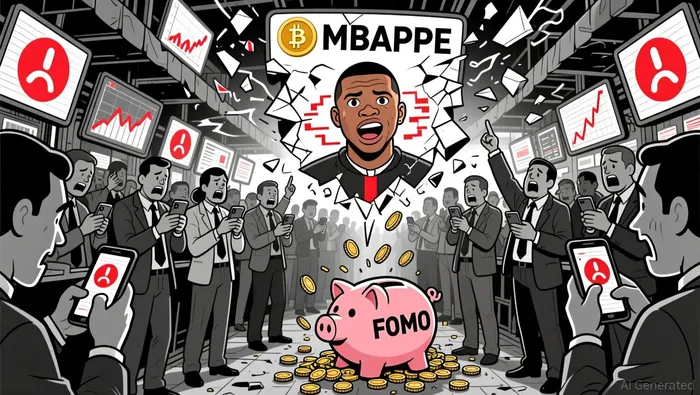
Compromised social media accounts have become a cornerstone of memecoinMEME-- manipulation. In February 2025, BBC broadcaster Nick Robinson's X account was hijacked to promote the $TODAY memecoin, while Kylian Mbappé's account endorsed $MBAPPE, which briefly hit a $460 million market cap before collapsing. Similarly, Drake's X account was used to push $ANITA, generating over $5 million in trading volume according to reports. These incidents are not isolated but part of a broader strategy: hackers exploit the trust and reach of high-profile figures to create artificial demand, triggering FOMO-driven buying sprees.
The mechanics are simple yet effective. Once an account is compromised, scammers post urgent calls to action-"Mint now!" or "This is the next DOGE!"-capitalizing on the audience's desire to avoid regret. The result? A rapid price spike followed by a crash as early buyers (often the hackers themselves) exit positions, leaving retail investors with devalued assets according to data. This mirrors classic pump-and-dump schemes, where coordination in Discord servers or bot-driven trading allows insiders to profit milliseconds before the market corrects as research shows.
FOMO as a Weapon: The Psychology of Meme Coin Speculation
FOMO is not just a buzzword-it's a cognitive bias weaponized by bad actors. Memecoins like DogecoinDOGE-- and Shiba InuSHIB-- (SHIB) thrive on community-driven hype, often created by influencers or anonymous developers according to studies. When a hacked account amplifies this hype, the effect is exponential. For instance, a 2025 study on financial influencers (finfluencers) found that negative returns frequently follow influencer-driven price surges, as retail investors buy at peak prices according to research.
The role of social identity further exacerbates the problem. As noted by Professor Alan Jagolinzer, influencers exploit followers' need for belonging, fostering cult-like communities that normalize risky behavior according to findings. This dynamic was evident in the case of Dave Portnoy, whose promotion of low-market-cap tokens triggered price spikes before he exited his positions, leaving retail investors to absorb losses as reported. The result is a self-reinforcing cycle: the more a memecoin is promoted, the more its value becomes decoupled from fundamentals, creating a house of cards built on social media sentiment.
The crypto market's lack of oversight enables these schemes to flourish. Pump-and-dump groups operate in decentralized, anonymous environments, often using bots to execute trades faster than human investors can react as research indicates. Meanwhile, compromised accounts exploit the trust associated with real-world identities, making it harder for regulators to trace and prosecute perpetrators.
The SEC has taken steps to address this, fining celebrities like Kim Kardashian and Justin Sun for undisclosed crypto promotions. However, enforcement remains challenging. As one investor's $60,000 loss from a phishing link demonstrates, individual users are often left to bear the costs of systemic vulnerabilities according to analysis.
Conclusion: A Call for Caution and Reform
The vulnerability of social media in crypto markets underscores a deeper issue: the exploitation of human psychology in decentralized finance. While memecoins may offer short-term gains for the well-connected, they pose long-term risks to retail investors and market integrity. To mitigate these dangers, stronger regulatory frameworks are needed-ones that hold influencers accountable, mandate transparency in promotions, and close loopholes enabling bot-driven manipulation.
Until then, investors must approach memecoins with skepticism. As the $MBAPPE and $TODAY collapses show, the only thing viral about these tokens is their hype-and their potential to leave you holding the bag.






Comentarios
Aún no hay comentarios