
SNX Q3 Performance: Leveraging AI Infrastructure to Capture Global Demand
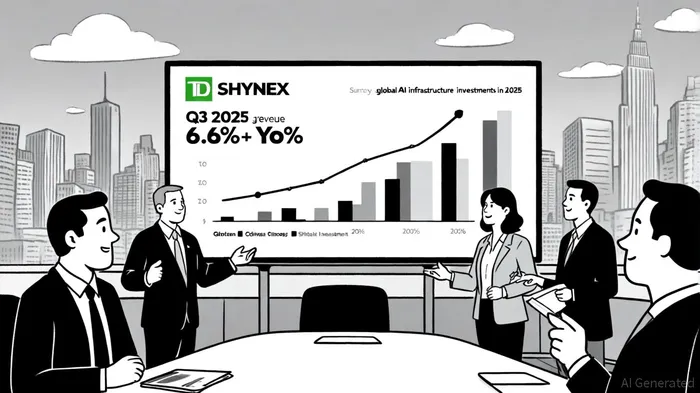
In 2025, the global financial infrastructure sector is undergoing a seismic shift driven by artificial intelligence. As enterprises and hyperscalers race to secure AI-ready infrastructure, companies like TD SYNNEXSNX-- (SNX) are emerging as pivotal players. The Q3 2025 results for SNXSNX-- underscore its strategic alignment with this megatrend, delivering revenue of $15.65 billion—6.6% higher year-on-year—and surpassing analyst estimates by 3.5%[1]. This outperformance is not accidental but a reflection of SNX's deliberate focus on AI infrastructure, a sector projected to command $200 billion in global investment this year alone[2].
Strategic AI-Driven Growth
SNX's Hive data center segment, a cornerstone of its AI infrastructure strategy, reported mid-thirties year-over-year growth in Q3 2025, fueled by demand from hyperscale cloud providers for networking and compute solutions[1]. Management explicitly highlighted a pipeline of GPU and AI-integrated rack projects, positioning the company to capitalize on the surging need for high-performance computing. This aligns with broader industry trends: 70% of organizations now allocate at least 10% of their IT budgets to AI initiatives, and AI workloads are expected to consume 20% of data center power by 2030[3].
The company's software segment further reinforced its AI-centric positioning, with gross billings rising 26% year-on-year, driven by cybersecurity and infrastructure solutions[1]. These offerings are critical for enterprises deploying AI systems, where data security and computational efficiency are paramount. SNX's expansion into AI-enabled PCs and cloud infrastructure—key drivers of its Q4 guidance of $16.9 billion—reflects a forward-looking strategy to meet the evolving demands of a digitized economy[1].
Global Demand and Regional Momentum
SNX's strategic positioning extends beyond North America. Double-digit growth in Latin America and Asia-Pacific, driven by localized product introductions and market-specific strategies, highlights its ability to scale AI infrastructure solutions globally[1]. This regional diversification is crucial as AI adoption accelerates in emerging markets, where demand for cloud and edge computing is outpacing traditional IT spending.
The company's financial discipline and digital transformation initiatives—such as the launch of the Partner First portal—further enhance its operational efficiency, enabling faster deployment of AI-centric solutions[1]. As noted in the Fourth Annual Direction of Technology (DoT) Report by SNX, nearly 75% of partners view AI as essential to their future, underscoring the urgency for vendors to align with this paradigm shift[2].
Future Outlook and Investment Implications
With Q4 guidance exceeding analyst expectations by 6%, SNX's trajectory suggests sustained momentum in AI infrastructure. The company's focus on GPU-integrated projects, cybersecurity, and global expansion positions it to benefit from long-term tailwinds in cloud computing and AI adoption. For investors, SNX represents a compelling case study in strategic alignment with the AI-driven financial infrastructure sector—a space where execution and differentiation are rewarded.
However, historical analysis of SNX's earnings beats from 2022 to 2025 reveals that the stock has not consistently delivered positive returns in the short term. The average return on the day after a beat was -1.1%, with returns remaining mildly negative through day 15 and turning slightly positive only after day 25. Additionally, none of the daily excess returns were statistically significant at the 95% level, except for day 2, which was significantly negative. The win rate remained around 50%, indicating no consistent positive edge[4].
As the AI infrastructure race intensifies, SNX's Q3 performance demonstrates its ability to translate macro trends into tangible growth. With a clear roadmap for scaling AI solutions and a proven track record of outperforming expectations, the company is well-positioned to capture a significant share of the $200 billion global AI market in 2025 and beyond.





Comentarios
Aún no hay comentarios