
Is Snowflake (SNOW) Poised to Outperform in the AI-Driven Cloud Data Infrastructure Era?
Strategic AI Ecosystem Expansion: Partnerships as a Catalyst
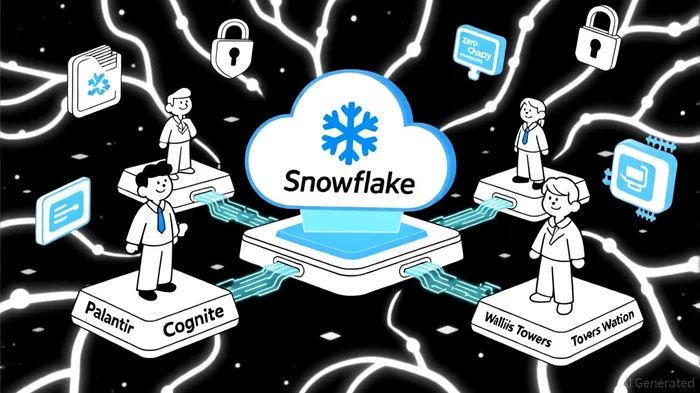
Snowflake's 2025 AI ecosystem expansion has been defined by high-impact partnerships that bridge data warehousing and enterprise AI workflows. The collaboration with Palantir stands out as a cornerstone of this strategy. By integrating Snowflake's AI Data Cloud with PalantirPLTR-- Foundry and the Palantir Artificial Intelligence Platform (AIP), the partnership enables bidirectional, zero-copy interoperability between Snowflake Iceberg Tables and Palantir systems, as reported in a Joplin Globe report. This eliminates data duplication, accelerates analytics, and streamlines AI application development-a critical advantage for enterprises like Eaton, which has leveraged the integration to enhance governance and reduce operational friction, according to Reuters coverage.
Further, Snowflake's alliances with Cognite and Willis Towers Watson underscore its focus on vertical-specific AI solutions. For instance, Willis Towers Watson's Radar Connector for Snowflake allows insurance firms to access and analyze data securely within Snowflake, cutting manual effort and errors, as detailed in a Yahoo Finance article. These partnerships highlight Snowflake's ability to tailor its AI Data Cloud to industry pain points, fostering stickiness in sectors like energy and insurance.
Competitive Advantages: Cloud-Agnostic Architecture and AI Specialization
Snowflake's cloud-agnostic architecture-operating on AWS, Azure, and Google Cloud-aligns with the multi-cloud strategies of enterprises seeking to avoid vendor lock-in, as noted in the MarketMinute report. This flexibility contrasts with hyperscalers like Amazon Redshift or Google BigQuery, which are tethered to single cloud ecosystems. Additionally, Snowflake's AI Data Cloud, bolstered by tools like Cortex, has carved a niche in integrating data warehousing with machine learning and generative AI capabilities, a point also highlighted in the MarketMinute report.
Financial metrics reinforce this competitive edge. In Q2 2025, Snowflake reported a 32% year-over-year increase in product revenue to $1.09 billion, driven by demand for its AI-driven analytics, data that the MarketMinute report documents. Its stock hitting a 52-week high of $250.15 on October 8, 2025, reflects investor confidence in its ability to outperform traditional cloud data providers.
Revenue Growth Potential: A $7.8 Billion Horizon
Snowflake's AI-driven ecosystem is not just a strategic play-it's a revenue engine. Analysts project the company to generate $7.8 billion in revenue and $497.5 million in earnings by 2028, per the Yahoo Finance article, fueled by expanding AI adoption and enterprise demand for secure, scalable data solutions. Partnerships like the Palantir integration, which accelerates AI development for clients, directly translate to recurring revenue streams and higher customer lifetime value.
However, this growth narrative hinges on Snowflake's ability to mitigate risks. While its AI tools like Cortex Search Service enhance data accessibility, they also introduce security vulnerabilities. For example, misconfigured AI services operating under "owners' rights" can bypass access controls, exposing sensitive data, as discussed in a CyberPress analysis. Snowflake has acknowledged these risks and is implementing mitigations, but enterprises must remain vigilant in governance practices, according to a Cybersecurity News article.
Navigating Risks: Competition and Security Challenges
Snowflake's ascent is not without headwinds. Hyperscalers like AWS, Azure, and Google Cloud are rapidly enhancing their AI data infrastructure offerings, threatening to erode Snowflake's market share, as the MarketMinute report observes. Additionally, the evolving AI landscape-marked by tools like generative AI and advanced analytics-demands continuous innovation to maintain relevance.
Yet, Snowflake's agility and focus on AI specialization provide a buffer. Unlike generalist cloud providers, Snowflake's niche in AI-driven data warehousing allows it to address specific enterprise needs, such as secure data sharing and governance-a critical differentiator in regulated industries.
Conclusion: A Calculated Bet on AI's Future
Snowflake's strategic AI ecosystem expansions, cloud-agnostic architecture, and revenue growth trajectory position it as a strong contender in the AI-driven cloud data infrastructure era. While risks from hyperscalers and security vulnerabilities persist, its partnerships and innovation pipeline suggest a resilient path forward. For investors, the key lies in monitoring Snowflake's ability to balance rapid AI adoption with robust security frameworks-a challenge it appears well-equipped to navigate.







Comentarios
Aún no hay comentarios