
Snap Inc.'s Securities Fraud Allegations: Legal and Financial Risks for Shareholders in a Volatile Tech Landscape
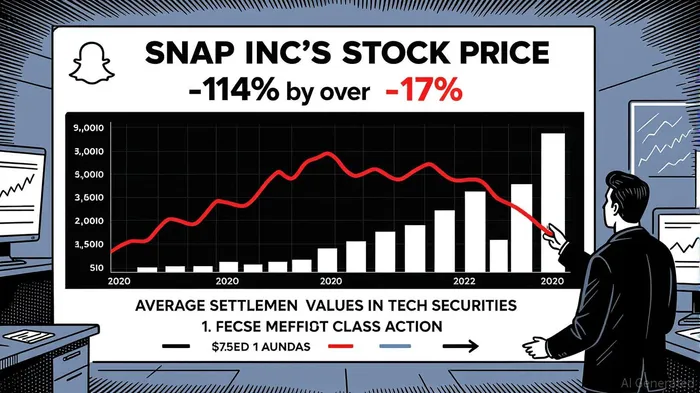
The recent securities class action lawsuit against Snap Inc.SNAP-- (SNAP) underscores the growing legal and financial risks facing tech stocks amid earnings volatility and regulatory scrutiny. The case, Abdul-Hameed v. SnapSNAP-- Inc., filed on August 21, 2025, accuses the company and its executives of misleading investors about its advertising revenue growth and concealing a critical glitch in its ad auction system [5]. This lawsuit, coupled with broader trends in securities litigation, raises urgent questions for shareholders about corporate transparency, market resilience, and the long-term implications of class-action exposure.
The Allegations: A Perfect Storm of Technical and Strategic Failures
The lawsuit alleges that Snap’s leadership, including CEO Evan Spiegel and CTO Derek Andersen, misrepresented the health of its advertising platform during the class period (April 29, 2025, to August 5, 2025). According to the complaint, a “significant execution error” in the ad auction system caused inventory to be sold at prices far below intended rates, slashing ad revenue growth from 9% in Q1 2025 to just 1% in Q2 [4]. This revelationREVB-- triggered a 17% stock price plunge on August 6, 2025, erasing roughly $12 billion in market value [5].
The case mirrors broader patterns in tech securities fraud, where firms often downplay internal operational issues while emphasizing external factors like macroeconomic instability [5]. For example, the lawsuit claims Snap attributed its Q2 performance to “market conditions” rather than admitting to systemic flaws in its ad platform—a tactic that has historically inflated short-term stock prices while masking deeper vulnerabilities [3].
Financial and Legal Exposure: A High-Stakes Scenario
Snap’s legal exposure is substantial. The company now faces a federal class action in California, with investors encouraged to seek lead plaintiff status by October 20, 2025 [1]. While no official response from Snap has been disclosed, historical settlement trends suggest the stakes are rising. In H1 2025 alone, the average settlement value in tech securities cases reached $56 million, a 27% increase from 2024, according to a Cooley report [1]. This reflects a shift toward larger, more complex cases, particularly in AI and biotech sectors, where investor losses are often magnified by high valuations [1].
The financial impact on shareholders is equally concerning. Snap’s stock has already lost over 30% of its value since April 2025, with the lawsuit exacerbating investor anxiety. For context, the Disclosure Dollar Loss Index (DDL Index) for tech stocks hit $403 billion in H1 2025, a 56% jump from the previous year [2]. This metric highlights how even minor earnings shortfalls in high-growth tech firms can translate into massive investor losses when combined with regulatory scrutiny.
Broader Industry Implications: A Cautionary Tale for Tech Investors
Snap’s case is emblematic of a broader trend: the increasing frequency of securities litigation in the tech sector. From fintech to AI, companies are facing heightened scrutiny over earnings forecasts, operational transparency, and executive accountability. For instance, fintechs—once celebrated for hypergrowth—have seen a 50% decline in new unicorn creation since 2022, as investors demand more rigorous risk assessments [1]. This shift underscores the importance of due diligence in an era where regulatory and technical risks are intertwined.
Moreover, investor behavior has evolved in response to these challenges. Google search trends (GST) now closely track market uncertainty, with spikes in queries like “securities fraud lawsuits” and “tech stock volatility” aligning with major financial events [2]. This suggests that retail and institutional investors alike are becoming more attuned to legal risks, potentially altering capital allocation strategies in the tech sector.
Conclusion: Navigating the New Normal
For shareholders in Snap and other tech firms, the Abdul-Hameed case serves as a stark reminder of the dual threats posed by earnings volatility and class-action litigation. While Snap’s ad platform issues may be technical in nature, the legal and reputational fallout could linger for years. Investors must weigh not only the company’s ability to resolve operational glitches but also its capacity to withstand prolonged legal battles that could further depress stock value.
In this environment, diversification and a focus on companies with robust governance practices are critical. As the Cooley report notes, the average settlement value in tech fraud cases is likely to rise, driven by the sector’s outsized role in global markets [1]. For now, Snap’s shareholders—and the broader tech sector—will be watching closely to see how this case unfolds.
Source:
[1] Securities Class Action Trends: AI and Biotech Cases Continue to Rise, Uptick in Alleged Losses and Average Settlement Values [https://sle.cooley.com/2025/08/28/securities-class-action-trends-ai-and-biotech-cases-continue-to-rise-uptick-in-alleged-losses-and-average-settlement-values/]
[2] Snap Inc. (SNAP) Faces Securities Class Action Amid Impact of Ad Platform Changes [https://www.globenewswire.com/news-release/2025/09/05/3145449/0/en/Snap-Inc-SNAP-Faces-Securities-Class-Action-Amid-Impact-of-Ad-Platform-Changes-Hagens-Berman.html]
[3] Snap,
https://dicellolevitt.com/securities/snap/
[4] Snap Inc. Hit With Investor Suit Over Ad Platform Glitch [https://www.law360.com/articles/2379800/snap-inc-hit-with-investor-suit-over-ad-platform-glitch]
[5] Abdul-Hameed v. Snap Inc. et al 2:2025cv07844 [https://dockets.justia.com/docket/california/cacdce/2:2025cv07844/983871]





Comentarios
Aún no hay comentarios