
SMX and the Transformation of Fashion Supply Chains: A Material-Level Revolution in Circularity and ESG Compliance
The fashion industry stands at a crossroads. As global demand for sustainable practices intensifies, brands face mounting pressure to decarbonize supply chains, verify recycled content, and comply with evolving ESG regulations. Enter SMXSMX-- (NASDAQ: SMX), whose molecular identity technology is redefining the infrastructure of circularity by embedding verifiable identity into materials at the molecular level. This innovation not only solves longstanding traceability challenges but also positions SMX as a critical enabler of the circular economy-a strategic imperative for fashion and luxury brands navigating a regulatory and consumer-driven shift toward transparency.
A Molecular Solution to a Systemic Problem
Traditional mechanical recycling processes strip cotton of its identity, rendering it impossible to track recycled content through production. SMX's breakthrough lies in its ability to mark fibers at the molecular level, ensuring these identifiers survive even the most rigorous transformations, from carding to finishing according to Enterprise News. This technology transforms recycled cotton into a measurable commodity, allowing brands to quantify and verify the exact volume of recycled input in final products according to Enterprise News. For industries where greenwashing accusations persist, this capability is transformative.
According to a report by Enterprise News, SMX's system creates a "circularity engine" by enabling brands to track recycled fibers across global supply chains. This is not merely a technological advancement but a structural fix for an industry struggling to align sustainability goals with financial outcomes. By embedding traceability directly into materials, SMX eliminates the need for fragmented documentation systems, streamlining compliance with regulations such as the EU's upcoming Digital Product Passport mandate according to Times Online.
ESG Compliance as a Competitive Advantage
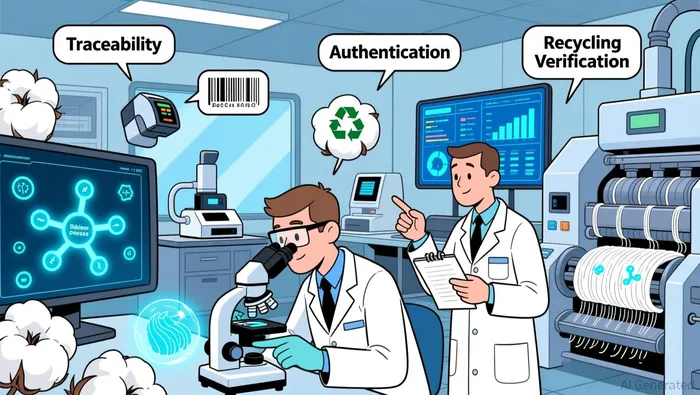 The European Union's push for circularity is accelerating the need for verifiable supply chain data. SMX's molecular markers generate authenticated, machine-readable information that populates Product Digital Passports-a requirement for brands operating in the EU according to Times Online. This alignment with regulatory frameworks is not incidental; it is a strategic design. As noted in Times Online, the technology reduces "documentation friction in trade" while enhancing ESG compliance, a critical factor for brands seeking to avoid penalties and capitalize on market incentives.
Moreover, SMX's partnerships with research institutions like CETI validate its industrial scalability. These collaborations focus on solving global challenges such as textile waste and counterfeit materials, with verified fibers retaining up to 25% higher resale value. For luxury brands, where authenticity and provenance are paramount, this premium valuation underscores the financial upside of adopting SMX's infrastructure.
Financial Performance and Market Adoption: A Capital-Efficient Play
SMX's valuation is no longer being assessed through a traditional lens. The company's execution phase-marked by capital efficiency and multi-market scalability-has repositioned it as an infrastructure play akin to foundational platforms like GPS or blockchain according to Enterprise News. According to Newark Advocate, SMX's core technology requires minimal incremental costs for new deployments, enabling rapid expansion into sectors beyond fashion, including rare earth minerals and digital assets.
A critical component of this ecosystem is the Plastic Cycle Token (PCT), a digital asset that converts authenticated material performance data into tradable value according to Nasdaq. This innovation shifts the paradigm from theoretical sustainability metrics to market-ready documentation, allowing brands to monetize verified recovery efforts according to Nasdaq. For investors, the implications are clear: SMX is not just solving a supply chain problem but creating a new asset class tied to decarbonization.
Financially, SMX's access to over $111 million in institutional funding-via non-toxic convertible notes and a discretionary equity facility-reduces execution risk and supports long-term planning. As North Jersey highlights, this structured capital framework positions SMX to compound value across markets, leveraging interaction effects between industrial validation, partnerships, and regulatory alignment.
The Strategic Imperative for Fashion Brands
For fashion and luxury brands, the adoption of SMX's technology is no longer optional-it is a necessity. The EU's Digital Product Passport mandate, coupled with consumer demand for transparency, creates a regulatory and market-driven tailwind that SMX is uniquely positioned to exploit according to Miami Herald. Brands that integrate SMX's infrastructure gain a dual advantage: they future-proof their operations against compliance risks while unlocking new revenue streams through authenticated recycled materials.
Furthermore, SMX's technology enables brands to transition from aspirational sustainability goals to operational systems of circularity according to Yahoo Finance. By proving the authenticity of recycled content, brands can build consumer trust and differentiate themselves in a crowded market. As Miami Herald notes, this shift from cost centers to revenue-linked activities is redefining how sustainability is monetized.
Conclusion: SMX as the Infrastructure of the Circular Economy
SMX's molecular identity technology is more than an innovation-it is a foundational infrastructure play. By solving the structural failure of material traceability, SMX is enabling a global shift toward verifiable circularity, ESG compliance, and decarbonization. For fashion and luxury brands, investing in SMX is not merely a sustainability initiative; it is a strategic move to secure long-term competitiveness in an economy where transparency is currency.
As the market increasingly recognizes the inevitability of SMX's system, the question is no longer whether brands need this infrastructure but how quickly they can integrate it. In a world where identity at the molecular level defines value, SMX is the blueprint for the future.





Comentarios
Aún no hay comentarios