
SMX Technology: Pioneering the Future of Sustainable Supply Chains in the ESG-Driven Plastics Market
In an era where environmental, social, and governance (ESG) criteria are reshaping global industries, the plastics sector stands at a crossroads. Plastic waste accounts for 80% of marine debris, while annual CO₂ emissions from plastic production reach 1.8 billion tons [1]. Regulatory pressures, investor demands, and consumer expectations are converging to force a reimagining of how plastics are produced, used, and recycled. Enter SMXSMX-- Technology, a company leveraging molecular-level traceability and blockchain to transform the plastics supply chain into a verifiable, enforceable, and economically viable system.
The "Local to Global" Plastics Passport: A Technological Breakthrough
SMX's "Local to Global" Plastics Passport initiative, launched in collaboration with Singapore's A*STAR, embeds invisible chemical markers into plastics, creating a tamper-proof digital identity for every material. This system enables real-time verification of recycled content, compliance with safety standards, and traceability from production to end-of-life [2]. Singapore's adoption of this model as the world's first national plastics passport program marks a regulatory milestone, shifting recycling from voluntary reporting to policy-driven enforcement [3].
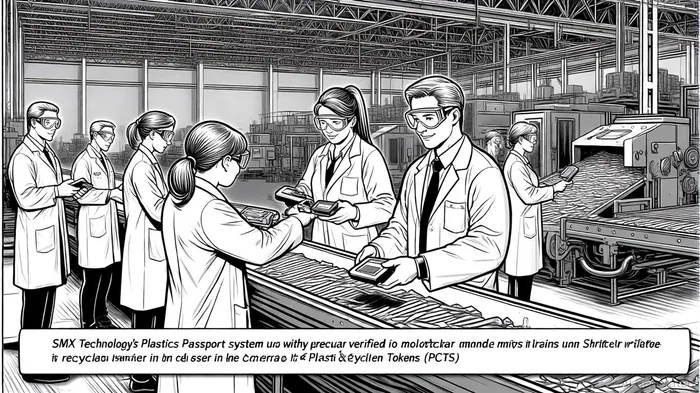
The implications are profound. By embedding molecular markers into plastics, SMX ensures that compliance is not a paper exercise but an automated, real-time process. For instance, complex materials like carbon black plastics and flame-retardant polymers—traditionally unsortable due to their properties—can now be scanned and certified at high speeds on conveyor belts [4]. This innovation addresses a critical gap in recycling infrastructure, unlocking the potential for closed-loop systems in industries such as automotive, electronics, and food packaging.
Strategic Value in the ESG-Driven Market
SMX's approach aligns with the circular economy's core principles: reducing waste, maximizing resource efficiency, and creating economic value from recycled materials. The company's Plastic Cycle Token (PCT), a blockchain-backed digital asset representing verified recycled content, turns sustainability into a tradable commodity. This tokenization model not only incentivizes recycling but also provides investors with a measurable, auditable asset class [5].
The financial potential is staggering. Analysts estimate that if SMX's model scales across Southeast Asia, the region could unlock a $4.2 billion annual market for verified recycled content [6]. In Singapore alone, redirecting a third of plastic waste into an SMX-verified recycling loop could generate over S$100 million annually in avoided incineration costs and new resin value [7]. These figures underscore the economic viability of SMX's technology, which bridges environmental goals with market-driven incentives.
Competitive Positioning and Regulatory Momentum
SMX's competitive edge lies in its ability to enforce compliance through technological proof rather than relying on self-reported data. Unlike bio-based alternatives such as PLA or PHA, which face scalability and cost challenges, SMX enhances the value of traditional plastics by ensuring their responsible use and reuse. Partnerships with entities like REDWAVE in Europe and the North American Flame Retardant Alliance (NAFRA) further solidify its global reach, embedding verification into industrial processes and aligning with regulations like the EU's Circular Economy Action Plan and California's SB 54 [8].
Regulatory adoption is accelerating. The passage of the GENIUS Act in the U.S., which legally validates modern verification systems, and Singapore's national implementation of the Plastics Passport signal a shift toward enforceable ESG standards [9]. These developments mirror historical market transitions, such as the rise of carbon credits, where early innovation gained traction once codified into policy. SMX's technology is positioned to follow a similar trajectory, with Singapore serving as a replicable model for other regions.
Investor Reception and Market Dynamics
Investor enthusiasm for SMX is driven by its dual promise of environmental impact and financial returns. The company's PCT has attracted interest from GenX and Millennial investors, who are increasingly prioritizing transparency and outcome-based ESG investments [10]. By creating a market for recycled materials, SMX transforms compliance from a cost center into a revenue stream, appealing to both institutional and retail investors.
Moreover, SMX's expansion into sectors like MedTech and aerospace—where traceability and safety are paramount—highlights its versatility. The company's ability to blend government validation with market-driven solutions positions it as a leader in redefining global plastics sustainability [11].
Conclusion: A New Era for Plastics Sustainability
SMX Technology is not merely responding to ESG trends—it is redefining them. By embedding traceability into the very fabric of plastics, the company addresses the root causes of waste mismanagement while creating economic incentives for circularity. Its partnerships, regulatory milestones, and innovative tokenization model position it as a pivotal player in the transition to sustainable supply chains. For investors, SMX represents a rare convergence of environmental stewardship and financial potential, offering a blueprint for how technology can transform one of the world's most pressing industries.





Comentarios
Aún no hay comentarios