
Catch pre-market movers with AI signals.
SMX Stamped a Passport Story and Tagged $20—The Rejection Now Decides Who's Trapped
SMX (Security Matters) jumped about 14% to roughly $19.50 on Friday after a company press release stamped a one-word story across a fragile chart. The release's title, "The Age of Parity Has a Passport; SMX Provides the Stamp", is narrative, not numbers: no new contract, no revenue figure, no guidance. The stock still hit an intraday high of exactly $20.00, then round-tripped to $17.21 before stabilizing near $19.50.

That round-trip is the part worth reading. On a tape turning over a little over $1.5 million in dollar volume, a handful of orders can print a 14% candle. Before anyone calls the passport a breakout, the chart has a more important question to answer: which side of $20 owns the trapped inventory now, and who gets to sell the next pop?
The signal is real only in one sense
The picture cleared the headline. SMXSMX-- gapped from a $17.07 prior close to a $17.63 open, extended to $20.00, got sold back to $17.21 near the prior close, and recovered to about $19.48. That tall, choppy range—roughly $2.79 against a 14-day average true range near $1.71—is the whole session in one shape: momentum up, then supply that refused to let it stick.
Displacement is present. Participation is the problem. Roughly 84,000 shares changed hands for about $1.59 million. Against a market value near $20 million—call it under a million shares—that is meaningful churn for this name, but the entire float is small enough that "heavy volume" here is a rounding error for any normal stock. A move this size on this little actual money is a story about thin supply, not fresh institutional conviction.
Volatility-normalized, the pop is also tamer than it looks. This is a name that ran about 300% in two days in December 2025 and another triple-digit leg in February 2026. By its own recent standard, a 14% mark on a narrative release is a modest bounce, not a historic event.
The catalyst that wasn't a catalyst
The press release frames a macro story: higher oil volatility, inflation, and supply-chain pressure make recycled material competitive with virgin material—an "Age of Parity"—and SMX's Digital Material Passport, built from invisible molecular markers linked to a secure digital record, verifies recycled content and chain of custody. It cites media coverage rather than a commercial win. Nothing in the release reports revenue, a customer, or an order.
That matters because it removes the one thing a durable breakout needs: a reason the next buyer shows up after the initial crowd. A real catalyst gives the chart a clock and a follower. This one gives a story.
The structural counterweight: the company is its own seller
Here is the part a chart of the day cannot show. SMX finances itself through equity lines. It has a $250 million equity line of credit that management has said extends liquidity into 2028, on top of an earlier equity-purchase arrangement with Target Capital designed to let the company issue fresh ordinary shares. In the first half of 2026 the company raised about $50.5 million through its existing equity facility—and still reported a net loss of about $45.5 million for the period.
Translate the mechanics: every time the stock climbs, the company's funding arrangements hand it an opportunity to sell newly created shares into that strength. Rallies become raw material for supply. For a holder, the question is not just whether the passport story is catchy; it is whether a breakout can survive a tape whose most motivated marginal seller is the issuer itself.
Add the context the chart won't decorate. SMX fell roughly 99% during 2025 and executed a one-for-2.285 reverse stock split effective June 1, 2026—one of a series of reverse splits in its history. That is not a flaw in the technology story; it is the equity-market history a buyer is inheriting, and it raises the bar for what a real follow-through must show.
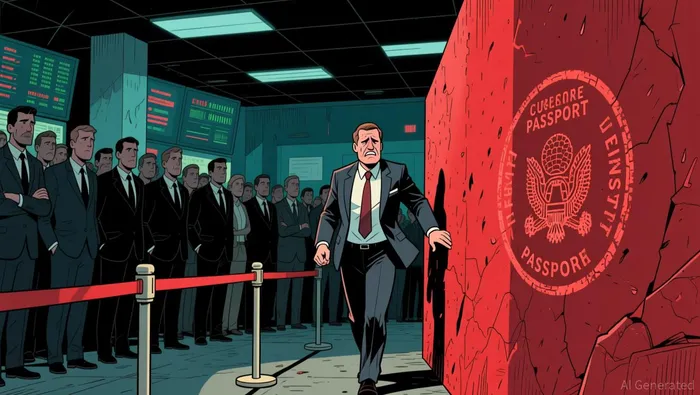
The line that matters: $20.00
Everything trained into the day now runs through the intraday high. $20.00 is a round number, which is exactly why it holds memory: orders gather there, and the day's sharp rejection from it gives the level a fresh, tradeable identity.
Hold below and the failed-top reading stands: the buyers who chased the $20 tag are trapped inventory, and the supply that capped the move stays the more credible force. That framing doesn't need a fight to be useful. On a ~$1.6-million-a-day stock with a $250 million supply overhang, the base case is that the next leg of strength gets sold into.
A genuine test of the bullish reading requires three things at once, not one: a heavy-volume close back through $20—volume meaningfully beyond this session's ~84,000 shares—a hard catalyst (a named customer, a contract, revenue), and evidence that the equity line is not feeding the tape. Without all three, a poke back to $20 is a second chance for trapped buyers to leave, not a breakout.
The decision map
- The line: $20.00 (today's intraday high) and the $17.20 prior-close zone under it.
- Above, if it earns it: a multi-million-share push through $20 backed by an actual contract could open a fresh map. That condition is not met today.
- Below: losing the gap back under the $17.60 open and the 50-day average near $16.40 turns the pop into a faded gap with support nowhere until the mid-teens.
- Horizon: session-level event on a daily chart; nothing here is a durable trend signal.
The charting discipline, restated simply: keep the passport story and the share-price signal separate. A narrative press release moved a ~$20-million micro-cap 14% one morning on roughly $1.6 million of trading. That is not institutional validation; it is a thin tape reacting to a story. Until SMX can hold $20 on real volume with a hard catalyst, the stamp the company wants to sell is on the wrong side of the trade.

Everything leaves a footprint. The chart already knows.







Comentarios
Aún no hay comentarios