
Smurfit Westrock's Strategic Position in the Sustainable Packaging Revolution
In an era where sustainability is no longer a peripheral concern but a core driver of corporate strategy, Smurfit WestrockSW-- has emerged as a pivotal player in the global shift toward circular economy principles. As institutional investors increasingly prioritize environmental, social, and governance () criteria, the company's alignment with these values positions it as a compelling case study in long-term value creation. By embedding circularity into its business model-from renewable material sourcing to innovative packaging design-Smurfit Westrock is not only addressing environmental challenges but also securing its competitive edge in a rapidly evolving market.
Circular Economy Leadership: A Foundation for Sustainable Growth
Smurfit Westrock's commitment to the circular economy is evident in its product development and operational strategies. The company designs packaging solutions that are recyclable, reusable, or made from renewable resources, ensuring minimal waste and maximum resource efficiency. For instance, its Better Planet Packaging initiative, launched in 2017, has driven innovations such as RFID-tagged connected packaging, which enhances recyclability and supply chain transparency. By 2025, the company had surpassed its waste reduction targets, , Spain mill, .
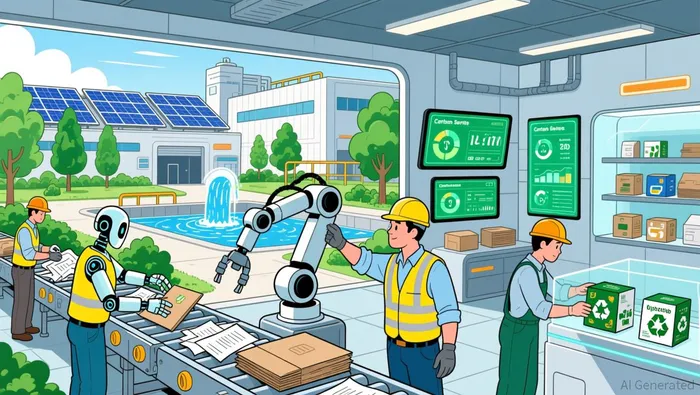
This focus on circularity extends beyond product design to end-to-end sustainability. Smurfit Westrock emphasizes sustainable forestry, water stewardship, and community engagement, aligning its operations with the United Nations Sustainable Development Goals (SDGs). Its recognition as one of the Top 250 World's Most Sustainable Companies in 2025 underscores its leadership in this space.
ESG Performance and Financial Resilience
Smurfit Westrock's ESG initiatives are not merely symbolic; they are deeply integrated into its financial strategy. In Q3 2025, , , driven by operational improvements in North America and strong performance in EMEA and APAC. This financial resilience is bolstered by its Green Finance Framework, toward sustainability goals, including transitioning to 100% renewable energy in key mills.
Institutional investors have taken notice. , which adjusts interest rates based on ESG key performance indicators (KPIs) such as CO2 intensity reductions, reflects its commitment to measurable outcomes. Additionally, the company's ESG metrics are tied to executive incentives, ensuring accountability and alignment with investor expectations. These efforts have earned it a credit rating upgrade to 'BBB+' from Fitch, citing its strong long-term demand and financial performance.
Institutional Buying Trends: ESG as a Catalyst
The interplay between Smurfit Westrock's ESG performance and institutional investment trends is particularly noteworthy. In 2025, the company's sustainability-linked financing and transparent reporting attracted investors prioritizing ESG criteria. For example, , directly addressing a critical ESG metric. Such initiatives resonate with institutional buyers, who increasingly view sustainability as a risk-mitigation and growth strategy.
Data from Q3 2025 highlights this trend: , driven by commercial improvements and ESG-aligned cost efficiencies. Looking ahead, , further solidifying its appeal to capital allocators.
Conclusion: A Model for Long-Term Value Creation
Smurfit Westrock's strategic position in the sustainable packaging revolution is underpinned by its circular economy leadership and robust ESG performance. By transforming waste into value and aligning its operations with global sustainability goals, the company is not only reducing its environmental footprint but also enhancing its financial resilience. For institutional investors, this dual focus on environmental impact and profitability offers a compelling proposition. As the demand for sustainable solutions intensifies, Smurfit Westrock's ability to innovate and scale circular practices will likely cement its role as a leader in the transition to a low-carbon economy.







Comentarios
Aún no hay comentarios