
Smiths Group plc: A Blueprint for Long-Term Value Creation in a Shifting Industrial Landscape
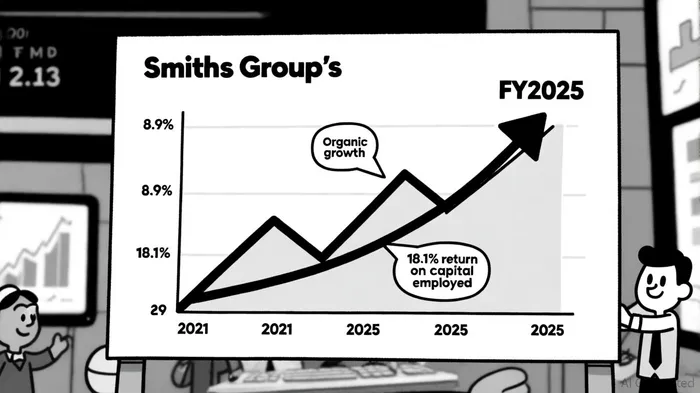
In an industrial sector marked by macroeconomic volatility and shifting demand dynamics, Smiths Group plc has emerged as a standout performer in FY2025, delivering robust financial results and strategic clarity that underscore its commitment to long-term value creation. With revenue climbing to £3,336 million—a 6.5% increase year-over-year and 8.9% organic growth—the company has demonstrated operational resilience amid global headwinds[1]. This performance, coupled with a disciplined capital allocation strategy and a refocused business model, positions Smiths Group as a compelling case study in navigating industrial transformation.
Financial Fortitude: Metrics That Signal Strength
Smiths Group's FY2025 earnings report reveals a company in sync with its strategic priorities. Operating profit surged by 10.3% to £580 million, with the operating margin expanding by 60 basis points to 17.4%[1]. This margin improvement, driven by cost discipline and pricing power in high-margin segments, reflects the company's ability to convert top-line growth into profitability. Equally impressive is the 18.1% return on capital employed (ROCE), a metric that highlights efficient capital utilization and aligns with the company's focus on high-performance industrial technologies[1].
Cash flow generation further reinforces this narrative. A 99% operating cash conversion rate[1]—a near-perfect indicator of liquidity management—ensures the company can fund reinvestment, dividends, and shareholder returns without overleveraging. Free cash flow of £336 million[2] has enabled a £500 million share buyback program, with £398 million already executed by October 2025[1]. This aggressive buyback, paired with a 5.1% dividend increase[1], signals confidence in the business's ability to sustain profitability while rewarding shareholders.
Strategic Refinement: Focusing on Core Competencies
Smiths Group's strategic initiatives in FY2025 are not merely reactive but transformative. The company has embarked on a deliberate divestiture of non-core assets, including Smiths Interconnect and Smiths Detection, to sharpen its focus on high-margin industrial technologies[1]. These moves, expected to culminate in a transaction announcement for Smiths Interconnect by year-end 2025[1], are designed to unlock latent value and streamline operations. By concentrating on its flagship businesses—John Crane and Flex-Tek—Smiths Group is aligning itself with structural growth trends in energy and infrastructure, where demand for advanced flow and heat management solutions remains robust[4].
The Acceleration Plan, a cost-reduction initiative targeting £50 million in annualized savings by FY2027[3], further underscores this strategic clarity. Roland Carter, CEO, emphasized that these actions are part of a broader effort to “enhance returns to shareholders while maintaining an investment-grade rating”[1]. This balance between growth and prudence is critical in an industry where capital intensity and cyclical risks are ever-present.
Analyst Endorsement: A Resilient Growth Outlook
Third-party analysis reinforces Smiths Group's favorable trajectory. Jefferies analyst Andrew Douglas has maintained a “Buy” rating, citing the company's “resilient growth outlook and disciplined capital allocation”[5]. The FY2026 guidance—organic revenue growth of 4–6% and margin expansion—may appear conservative on the surface, but it reflects a realistic assessment of macroeconomic uncertainties, including potential tariff impacts and inflationary pressures[3]. Notably, Smiths Group has not observed material shifts in customer behavior despite these risks[3], a testament to its diversified customer base and local-for-local business model.
The company's exposure to the U.S. market, while significant, is mitigated by its localized supply chains and engineering expertise[4]. This adaptability, combined with its focus on decarbonization technologies—a sector expected to grow as global infrastructure investments accelerate—positions Smiths Group to capitalize on long-term trends[3].
A Model for Industrial Resilience
Smiths Group's FY2025 performance exemplifies how strategic agility and operational discipline can drive value creation in a volatile industrial landscape. By prioritizing high-margin core businesses, optimizing capital returns, and proactively managing risks, the company has built a foundation for sustained growth. As it executes its divestiture plans and advances the Acceleration Program, the path to unlocking shareholder value becomes increasingly clear.







Comentarios
Aún no hay comentarios