
Smithfield Foods' Undervalued Position in the Growing Packaged Pork Sector: A Value Investor's Opportunity
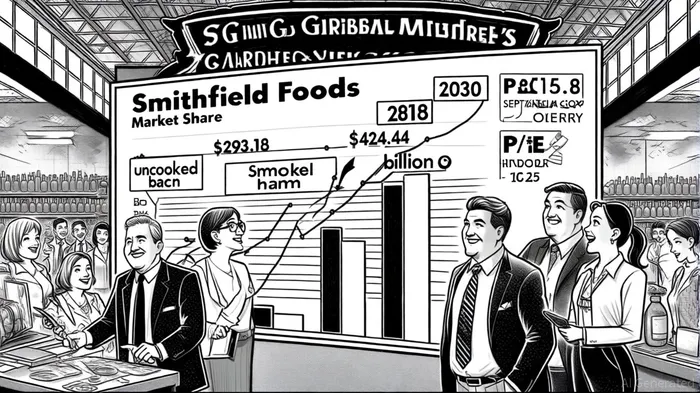
For value investors, few opportunities are as compelling as Smithfield FoodsSFD-- (SFD), a leader in the packaged pork sector trading at a discount to its intrinsic value. With a trailing twelve-month price-to-earnings (P/E) ratio of 10.8[1], SmithfieldSFD-- is significantly undervalued relative to the broader food industry, which averages a P/E of 15.2[2]. This discount, combined with robust sector tailwinds and a strategic pivot toward high-margin products, positions the company as a prime candidate for long-term capital appreciation.
Sector Tailwinds: A $424 Billion Opportunity
The global packaged pork market is poised for substantial growth, expanding from $293.18 billion in 2023 to an estimated $424.44 billion by 2030, driven by a 5.5% compound annual growth rate (CAGR)[3]. This expansion is fueled by shifting consumer preferences toward convenience and protein-rich diets, particularly in dual-income households where time-efficient meal solutions are in high demand[4]. Smithfield is uniquely positioned to capitalize on these trends. Its Packaged Meats segment, which includes bacon, lunch meats, and dry sausages, saw a 6.9% year-over-year sales increase in Q2 2025, driven by resilient demand and cost-cutting measures[5].
The company's strategic focus on innovation further aligns with sector dynamics. For instance, Smithfield has expanded dry sausage production capacity by 50 million pounds since 2019, with sales in this category rising 37%[6]. By converting holiday hams into smaller, higher-margin products like Smithfield Prime Fresh, the company is tapping into the growing demand for ready-to-eat meals[7].
Financial Resilience and Strategic Leverage
Smithfield's balance sheet reinforces its value proposition. Despite a debt-to-equity ratio of 30.6%[8], the company maintains financial flexibility, with a market capitalization of $9.41 billion[9] and a 2025 adjusted operating profit outlook of $1.15–$1.35 billion[10]. Notably, the Packaged Meats segment alone is projected to contribute $1.05–$1.15 billion in operating profit this year, reflecting its role as a cash-generating engine[11].
The company's decision to reduce self-produced hog supply to 30% of its needs by 2025[12] is a masterstroke. By insulating itself from volatile commodity cycles, Smithfield can focus on value-added segments with more predictable margins. This strategy has already yielded results: the segment's adjusted operating profit margin hit 13.1% in Q1 2025[13], outpacing many peers.
Market Leadership and Competitive Advantages
Smithfield's dominance in key subcategories underscores its competitive edge. As of Q2 2025, the company holds 22% of the uncooked bacon market and 51% of the smoked ham market[14], leveraging its strong brand portfolio to command premium pricing. Its investments in automation and operational efficiency[15] further enhance margins, countering inflationary pressures and raw material costs.
However, challenges persist. Environmental concerns and competition from plant-based alternatives threaten long-term growth. Smithfield's response? A dual focus on innovation (e.g., launching protein-rich, nutrient-dense products[16]) and cost discipline, ensuring it remains agile in a shifting landscape.
Conclusion: A Value Play with Sector Momentum
Smithfield Foods embodies the principles of value investing: a low P/E ratio, strong cash flow, and a strategic alignment with secular growth trends. While the company trades at a discount to its intrinsic value, its leadership in the packaged pork sector—backed by a 5.5% CAGR in market size[17]—suggests significant upside. For investors seeking a balance of undervaluation and sector momentum, Smithfield presents a compelling case.





Comentarios
Aún no hay comentarios