
A. O. Smith's Stock Decline: A Compelling Entry Point or a Cautionary Tale?
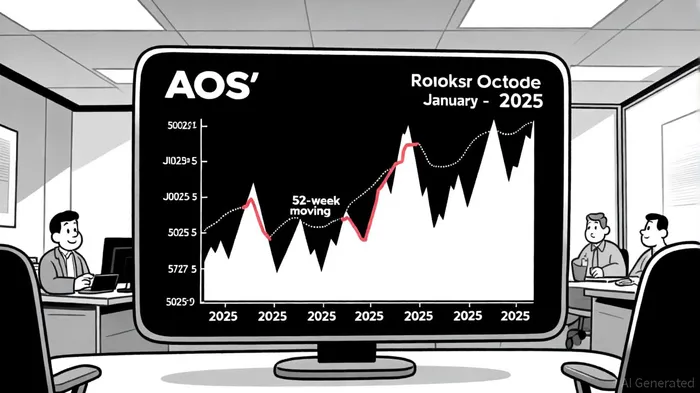
A. O. Smith (AOS) has experienced a turbulent year in 2025, with its stock price declining 12.40% as of August 21, 2025, despite showing recent signs of recovery[1]. This decline, however, must be evaluated through the lens of macroeconomic headwinds, operational challenges, and long-term fundamentals to determine whether it presents a compelling entry or accumulation opportunity for investors.
Drivers of the Recent Downturn
The stock's pullback reflects a confluence of factors. Macroeconomic pressures, including rising interest rates and inflation, have dampened consumer demand, particularly in China, where A. O. Smith's international operations contribute significantly to revenue[2]. The company reported an 8% decline in its China segment during the first half of 2025, prompting a strategic review of its operations in the region[3]. Additionally, margin pressures from surging raw material costs-especially steel-and limited pricing power amid inflationary trends have weighed on profitability[2].
Supply chain disruptions and regulatory changes in commercial gas products further complicate the near-term outlook[6]. For instance, AOS's Q1 2025 earnings report revealed a 2% year-over-year sales decline to $964 million, with North America accounting for 75% of total sales[5]. While the company's earnings per share (EPS) fell 5% compared to the prior year, it still outperformed market forecasts, leading to a 4.31% post-earnings stock rally[5].
Valuation and Analyst Sentiment
Despite these challenges, A. O. Smith's valuation appears attractive. As of October 2025, the stock trades at a P/E ratio of 19.88, significantly below its 3-year average of 26.94 and 10-year average of 25.35[1]. This compares favorably to peers like Lennox International (LII) at 28.1 and RBC Bearings (RBC) at 50.17[1]. Analysts have set an average 12-month price target of $77.43, implying a 10.20% upside from the current price[3]. While seven Wall Street analysts have issued a "Hold" consensus rating, two "Buy" ratings underscore optimism about the company's ability to navigate near-term challenges[3].
The debt-to-equity ratio of 0.16 as of October 2025 highlights AOS's strong balance sheet, with low leverage providing flexibility for growth initiatives[2]. This financial resilience, combined with free cash flow generation of $139.9 million in the first half of 2025, positions the company to return value to shareholders through share repurchases[4].
Industry Tailwinds and Strategic Positioning
A. O. Smith operates in a sector poised for growth. The North American residential water heater market is projected to expand at a 3% CAGR through 2025, driven by demand for energy-efficient solutions[1]. Meanwhile, the global HVAC market is expected to grow from $243.44 billion in 2024 to $442.68 billion by 2033, fueled by urbanization, green technologies, and AI-driven innovations[1]. AOS's focus on high-efficiency products, such as the Home Shield Whole House Water Filter and Cyclone Flex commercial water heater, aligns with these trends[4].
However, the company's exposure to China remains a risk. Weak consumer demand in the region contrasts with growth in markets like India, necessitating a strategic pivot to stabilize international operations[2].
Is This a Buy Opportunity?
The recent stock decline offers a nuanced opportunity. While macroeconomic and regional challenges persist, AOS's low valuation, strong balance sheet, and alignment with industry growth trends suggest the pullback may be overdone. Analysts' mixed ratings reflect caution but also highlight confidence in the company's long-term potential. For investors with a medium-term horizon, the current price represents a compelling entry point, particularly if the company executes its strategic review in China and capitalizes on North America's robust demand.
Conclusion
A. O. Smith's stock decline is a product of short-term headwinds rather than a fundamental deterioration in its business. With a strong competitive position in the water heating/HVAC industry, a disciplined approach to cost management, and a valuation that discounts many of its risks, the company appears undervalued. While risks remain-particularly in its China operations-the combination of industry tailwinds and operational strengths makes AOSAOS-- a compelling candidate for accumulation by investors who can tolerate near-term volatility.





Comentarios
Aún no hay comentarios