
Smith-Midland's SlenderWall: A Scalable Innovation Reshaping Commercial Real Estate with Proven ROI and Sustainability
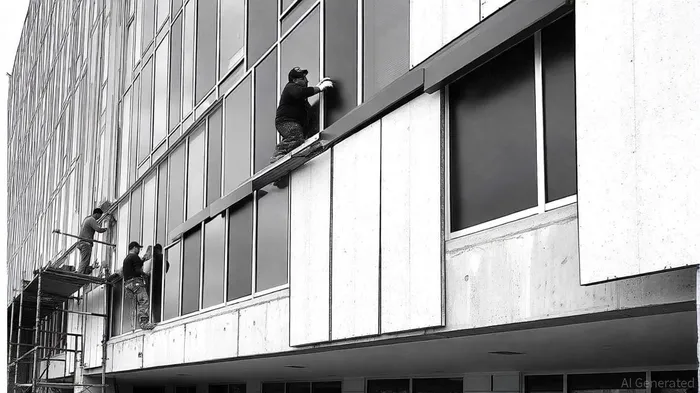
The commercial real estate sector is undergoing a quiet revolution driven by innovations that marry sustainability with cost efficiency. At the forefront is Smith-MidlandSMID-- Corporation's SlenderWall® architectural precast cladding system, a technology redefining how buildings are constructed. With secured contracts totaling over $2 million in Virginia and New York, according to a Morningstar report-spanning educational campuses and utility facilities-the system's market traction and ROI potential are gaining investor attention. This analysis evaluates SlenderWall's competitive differentiation, quantifies its financial and environmental benefits, and assesses its scalability in the evolving green building landscape.
Market Traction: From Virginia to New York
Smith-Midland's recent projects underscore the SlenderWall system's growing adoption. In Northern Virginia, the company supplied its cladding for a $1 million expansion of Northern Virginia Community College's (NVCC) Medical Education Campus. The system's lightweight design-66% lighter than traditional precast concrete-reduced foundation and structural costs while enabling rapid installation. Similarly, Central Hudson Gas & Electric's $1.2 million Lake Katrine training facility in New York leverages SlenderWall's energy efficiency and durability, aligning with New York State's climate goals as described on Central Hudson's sustainability page. These projects, coupled with a $5 million FBI dorm re-cladding contract in Quantico, Virginia, as Smith-Midland reported, demonstrate the system's versatility across public and private sectors.
ROI and Cost Savings: A Data-Driven Edge
The SlenderWall system's value proposition lies in its ability to reduce lifecycle costs. According to Smith-Midland's Q2 2025 report, the FBI project is expected to cut operating expenses by 15–20% per unit due to lower energy consumption. While specific figures for the Virginia and New York projects remain undisclosed, the system's inherent advantages-such as built-in insulation, reduced labor requirements, and faster construction timelines-suggest comparable savings. For instance, the NVCC project's use of prefabricated panels minimized on-site labor, accelerating installation by weeks, according to a Yahoo Finance article. These efficiencies translate to higher ROI for developers and institutional clients, particularly in large-scale infrastructure projects where time and material costs are critical.
Sustainability Metrics: Decarbonizing Construction
In an era where ESG criteria dominate investment decisions, SlenderWall's environmental credentials are a key differentiator. The system reduces material use by up to 40% compared to traditional precast methods, according to Smith-Midland's product page, lowering embodied carbon. At Central Hudson's Lake Katrine facility, the integration of closed-cell insulation and low-maintenance finishes further enhances energy efficiency, supporting the utility's commitment to New York's Clean Energy Fund goals as outlined on Central Hudson's news page. While project-specific carbon reduction data for 2025 is pending, Smith-Midland's broader sustainability narrative-highlighted in SlenderWall product literature-positions the system as a future-ready solution for decarbonizing construction.
Financial Performance and Investor Implications
Smith-Midland's financials reflect the SlenderWall segment's recovery and potential. After a 100% sales decline in 2024, per a Panabee earnings summary, the company reported $1.5 million in SlenderWall revenue for Q2 2025, signaling renewed market confidence according to Smith-Midland's Q2 2025 results. With multiple projects scheduled for 2025 production, including the FBI and NVCC contracts, the segment is poised for growth. For investors, this represents a compelling case study in innovation-driven recovery: a niche technology addressing pain points in cost, speed, and sustainability, with scalable applications in infrastructure and education sectors.
However, historical performance around earnings releases offers mixed signals for investors. A backtest of SMID's earnings events from 2022 to 2025 reveals that post-earnings returns have not consistently outperformed the Nasdaq benchmark, with a win rate hovering near 50% and limited statistical significance. This suggests that while the company's fundamentals are improving, relying on earnings-driven timing strategies may not yield reliable alpha.
Conclusion: A Strategic Bet on the Future of Construction
Smith-Midland's SlenderWall system exemplifies the disruptive potential of construction technology. By securing high-profile projects in Virginia and New York, the company has demonstrated its ability to deliver ROI through cost efficiency and sustainability-a critical combination in an industry grappling with rising material costs and regulatory pressures. For investors, the system's scalability, coupled with Smith-Midland's strategic focus on green building markets, presents a unique opportunity to capitalize on the infrastructure boom while aligning with global decarbonization trends. As the sector shifts toward smarter, cleaner solutions, SlenderWall is not just a product-it's a harbinger of the next construction era.





Comentarios
Aún no hay comentarios