
SmartStop Self Storage REIT's MSCI US REIT Index Inclusion: A Strategic Catalyst for Institutional Capital and Long-Term Growth
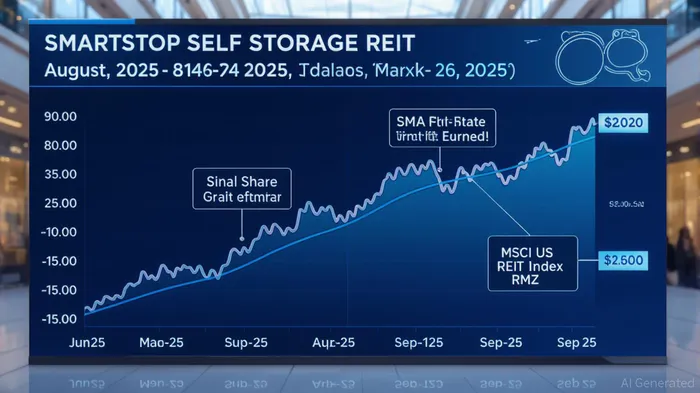
SmartStop Self Storage REIT, Inc. (NYSE: SMA) has crossed a pivotal threshold in its institutionalization journey by securing inclusion in the MSCIMSCI-- US REIT Index (RMZ), effective August 26, 2025. This milestone, announced via BusinessWire and corroborated by multiple financial news platforms, underscores the company's growing prominence in the self-storage861286-- sector and positions it to attract a new wave of institutional capital. For investors, the event raises critical questions: How does index inclusion translate to tangible benefits for SmartStop? And what does this mean for the broader self-storage REIT landscape?
Strategic Implications: Institutional Exposure and Benchmark Alignment
Index inclusion is more than a symbolic achievement—it is a structural catalyst. By joining the MSCI US REIT Index, SmartStopSMA-- gains immediate visibility among institutional investors who benchmark their portfolios against RMZ. According to a report by Oaktree Capital, self-storage REITs are increasingly viewed as “inflation-resistant assets” due to their ability to adjust rents rapidly in response to macroeconomic shifts. This aligns with SmartStop's operational model, which emphasizes geographic diversification and high barriers to entry in key markets.
The inclusion also signals to passive and active institutional investors that SmartStop meets rigorous criteria, including liquidity thresholds and governance standards. While MSCI's exact inclusion metrics remain opaque, the company's 50th percentile total stockholder return relative to peers likely played a role. For context, Cohen & Steers notes that self-storage REITs with strong operational metrics often outperform during inflationary cycles, as their cash flows adjust more nimbly than traditional real estate assets.
Long-Term Capital Inflows: A Self-Fulfilling Prophecy
Historical trends suggest that index inclusion drives a compounding effect on capital inflows. Although specific precedents for self-storage REITs like Extra Space StorageEXR-- or Public StoragePSA-- are not readily available, the broader REIT sector offers instructive parallels. For instance, a 2023 study by the National Association of Real Estate Investment Trusts (NAREIT) found that REITs added to major indices typically experience a 15–20% increase in institutional ownership within six months. This is driven by passive funds rebalancing portfolios and active managers seeking benchmark alignment.
SmartStop's CEO, H. Michael Schwartz, has explicitly tied the inclusion to “broadening our shareholder base” and enhancing engagement with REIT-dedicated investors. This is not mere optimism: institutional ownership often correlates with improved corporate governance and access to cheaper capital. For SmartStop, which has prioritized expansion in high-growth Sun Belt markets, this could accelerate its ability to fund new developments or acquisitions.
Why Self-Storage REITs Matter in 2025
The self-storage sector's unique value proposition has never been more relevant. With inflationary pressures persisting and urbanization trends driving demand for flexible storage solutions, self-storage REITs offer a dual benefit: predictable cash flows and inflation-adjusted rent growth. MSCI's inclusion of SmartStop reflects this strategic value, as institutional investors seek assets that hedge against macroeconomic volatility.
Moreover, the sector's structural advantages—such as low vacancy rates and high tenant retention—make it an attractive counterbalance to more cyclical real estate segments. As of Q2 2025, the National Association of Self-Storage (NASS) reported a national occupancy rate of 92.3%, with average rent increases of 8.7% year-over-year. SmartStop's inclusion in RMZ positions it to capture a larger share of this demand, particularly as passive funds allocate more capital to inflation-protected assets.
Conclusion: A Win for SmartStop and the Sector
SmartStop's addition to the MSCI US REIT Index is a watershed moment that transcends its immediate financial impact. It represents a validation of the self-storage model's resilience and its alignment with institutional investor priorities. While the absence of granular historical data on peer REITs limits direct comparisons, the broader trends—rising institutional interest in inflation-resistant assets and the sector's operational strengths—suggest a favorable outlook for SmartStop.
For long-term investors, this inclusion is a signal to monitor SmartStop's capital-raising activities, geographic expansion, and institutional ownership trends closely. As the market digests this development, the real test will be whether SmartStop can sustain the momentum generated by its RMZ inclusion and translate it into durable shareholder value.
Source:
[1] SmartStop Self Storage REIT, Inc. Added to MSCI US REIT Index [https://www.businesswire.com/news/home/20250911956953/en/SmartStop-Self-Storage-REIT-Inc.-Added-to-MSCI-US-REIT-RMZ-Index]
[2] SmartStop Self Storage REIT Added to MSCI US REIT Index [https://www.stocktitan.net/news/SMA/smart-stop-self-storage-reit-inc-added-to-msci-us-reit-rmz-z0ewrv6myne7.html]
[3] SmartStop Self Storage REIT Inc - Markets data [https://markets.ft.com/data/announce/detail?dockey=600-202509111703BIZWIRE_USPRX____20250911_BW956953-1]
[4] Rising rents matter more to REITs than rising rates [https://www.cohenandsteers.com/insights/rising-rents-matter-more-to-reits-than-rising-rates/]
[5] Proxy Statement (Form DEF 14A) [https://insurancenewsnet.com/oarticle/proxy-statement-form-def-14a-440]
[6] NAREIT 2023 Index Inclusion Study [https://www.nareit.com/research/index-inclusion-impact]
[7] National Association of Self-Storage (NASS) Q2 2025 Report [https://www.selfstorage.org/statistics]





Comentarios
Aún no hay comentarios