
Smartphone Market Recovery and Leadership Dynamics: Evaluating Samsung and Apple's Long-Term Investment Potential
The global smartphone market is experiencing a modest but meaningful recovery in 2025, with shipments rising 2.6% year-over-year to 322.7 million units in Q3, driven by demand for AI-enabled devices and innovative form factors like foldables, according to an IDC report. At the center of this resurgence are Samsung and AppleAAPL--, two titans locked in a fierce battle for market leadership. While Samsung secured the top spot with 61.4 million units shipped—bolstered by the Galaxy Z Fold 7 and Z Flip 7—Apple achieved its highest-ever July quarter performance, shipping 58.6 million units of the iPhone 17 series, the report also found. This dynamic raises critical questions for investors: Who holds the stronger long-term position in a market increasingly defined by AI integration and premium pricing? And how do their divergent strategies shape their investment potential?
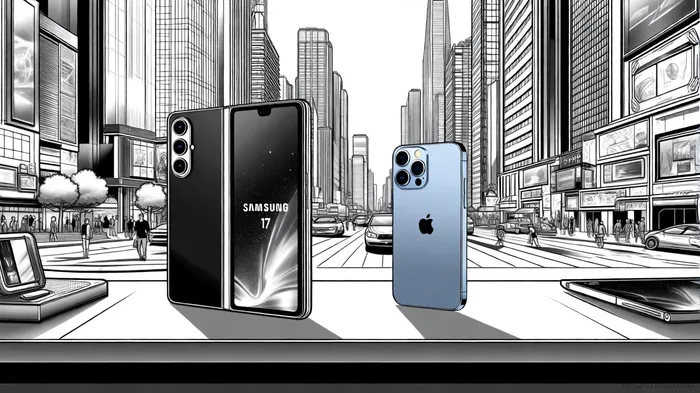
Market Recovery: A Tale of Two Strategies
The 2025 market rebound reflects a shift in consumer priorities. Aggressive pricing promotions and AI-driven features have reignited demand, but the strategies of Samsung and Apple could not be more different. Samsung's dominance in shipments (19% market share) stems from its broad product portfolio, including mid-range devices and foldables, which cater to both emerging and developed markets, the IDC report shows. Apple, meanwhile, focuses on premium pricing and ecosystem lock-in, capturing 18% of the global market with a 62% share of the $800+ segment in H1 2025, according to a Financial Content article.
This divergence is evident in their financials. Samsung's Q1 2025 revenue hit KRW 79.14 trillion ($53.5 billion), driven by high-value products like the Galaxy S25, while Apple reported $124.3 billion in revenue, with the iPhone 17 series projected to deliver a 10–15% sales boost, the Financial Content article noted. Samsung's 16% year-over-year increase in R&D spending (KRW 9 trillion) underscores its commitment to innovation, particularly in foldables and AI, the same article added. Apple, by contrast, is doubling down on software-hardware integration, with its A19 Bionic chip and "Apple Intelligence" strategy emphasizing privacy-centric AI, as Financial Content observed.
Leadership Dynamics: AI as the New Battleground
The 2025 "AI arms race" between Samsung and Apple is redefining smartphone leadership. Samsung's "true AI companion" experience, featuring tools like Generative Edit and Instant Slow-mo, aims to differentiate its foldables in a crowded market, the IDC report said. Apple's approach, however, prioritizes on-device AI processing to maintain user privacy, a key differentiator in an era of heightened data security concerns, Financial Content noted.
Market share projections highlight the stakes. Samsung is expected to maintain a 20.9% global share in 2025, while Apple's 18.1% reflects its premium focus, according to a PocketOption analysis. By 2026, Samsung's expansion into India and Southeast Asia could push its share to 21.2%, whereas Apple faces challenges from limited innovation and pricing constraints, the PocketOption analysis adds. Yet both companies are investing heavily in AI-driven chip development, with Samsung leveraging its 33% global memory chip capacity and Apple refining its silicon for AI workloads, the same analysis notes.
Financial Metrics and Risk Profiles
From an investment standpoint, Samsung and Apple present distinct risk-reward profiles. Apple's gross margin of 46% and 0.5% dividend yield reflect its premium pricing power and ecosystem loyalty, but its reliance on China for production and sales introduces geopolitical risks, the PocketOption analysis observed. Samsung, while more volatile due to semiconductor market cycles, offers a 2.3% dividend yield and a $7.5 billion share buyback program, signaling confidence in its cyclical recovery, the analysis added.
Revenue forecasts further differentiate the two. Apple is projected to reach $478 billion by 2030, driven by services and ecosystem expansion, while Samsung's growth to $295 billion hinges on foldable adoption and semiconductor demand, according to the PocketOption analysis. However, Samsung's operating profit has been hit hard by the ongoing semiconductor slump, with Q2 2025 profits down 55% year-over-year, the same analysis reported.
Long-Term Outlook: Innovation vs. Stability
The next five years will test both companies' ability to adapt. Samsung's leadership in foldables and AI could drive growth, but intensifying competition from Huawei and Motorola in the foldable segment poses a threat, the PocketOption analysis warns. Apple's ecosystem and services revenue provide stability, but its premium pricing strategy may struggle in price-sensitive markets.
For investors, the choice between Samsung and Apple depends on risk tolerance. Samsung offers cyclical upside tied to AI and semiconductor trends, while Apple provides predictable growth anchored by ecosystem loyalty. As J.P. Morgan Research notes, global economic growth in 2025—excluding a sharp Chinese slowdown—supports both companies' trajectories, though high policy rates in developed markets may temper expansion.
Conclusion
The smartphone market's 2025 recovery is a testament to the resilience of Samsung and Apple, but their paths forward diverge sharply. Samsung's aggressive diversification into AI and foldables positions it as a growth story, albeit with cyclical risks. Apple's premium ecosystem and services model offer stability, but its reliance on innovation cycles and pricing power may limit upside. For long-term investors, the key lies in balancing these dynamics: Samsung for its disruptive potential and Apple for its enduring ecosystem.







Comentarios
Aún no hay comentarios