
Smart Contract Vulnerabilities and Their Impact on Crypto Security Markets
The Cost of Smart Contract Vulnerabilities
Recent breaches underscore the financial and systemic risks of smart contract flaws. Access control vulnerabilities alone accounted for $953.2 million in losses in 2024, with logic errors and reentrancy attacks contributing an additional $63.8 million and $35.7 million, respectively according to analysis. High-profile cases, such as the February 2025 Bybit hack ($1.5 billion loss) and cross-chain bridge exploits ($1.5 billion stolen), highlight the scale of damage. Flash loan attacks, though less frequent, remain potent: the Orion protocol hack in 2023 netted attackers $3 million.
These incidents reveal a shift in attacker strategies. Where early hacks exploited simple reentrancy bugs, modern threats leverage complex supply-chain vulnerabilities and multi-vector attacks. 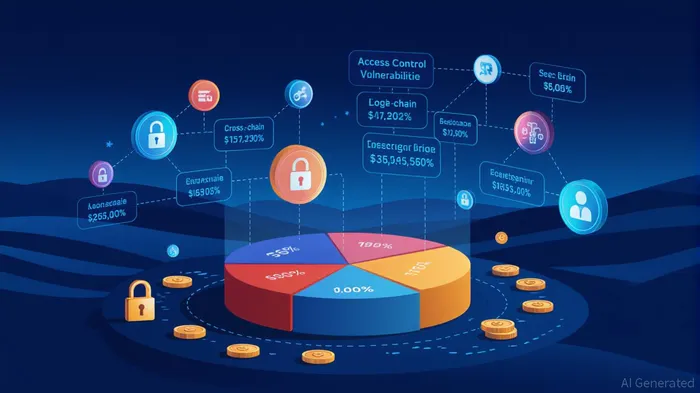 The result is a growing recognition that DeFi's promise of trustlessness cannot offset the consequences of insecure code.
Rising Demand for Cybersecurity and Insurance
The surge in breaches has accelerated demand for institutional-grade risk mitigation. The crypto insurance market, valued at a fraction of the $2.5 trillion crypto market, is projected to grow at an 18% compound annual rate through 2033. Coverage now extends beyond theft to include smart contract failures and protocol exploits. Yet, fewer than 20% of crypto holders are insured, creating a significant gap.
Cybersecurity firms have responded by expanding their offerings. For instance, CertiK has deployed formal verification techniques to mathematically verify smart contracts before deployment. Its services, which include on-chain monitoring and cross-chain auditing, have protected over $300 billion in assets. Similarly, Sherlock's hybrid model combines continuous security validation with financial coverage of up to $2 million for covered exploits, aligning incentives between auditors and protocol developers.
Investment Opportunities in Blockchain Security Firms
Institutional investors are increasingly targeting firms that address DeFi's security challenges. CertiK has raised $296 million across nine rounds, achieving a $2 billion valuation in 2022. Its recent $500,000 grant from SuiSUI-- in 2023 underscores its role in enterprise security. Sherlock, though smaller, has secured $5.5 million in total funding, including a $4 million seed round in 2022, and is gaining traction with its continuous validation platform.
ConsenSys has raised $725 million since 2018, including a $450 million Series D round in 2022 at a $7 billion valuation. Its Linea Layer 2 network and foundational tools like MetaMask and Infura position it as a critical infrastructure provider. Meanwhile, CertiK's audits of major DeFi projects like AaveAAVE-- and 0xZRX-- highlight its credibility in enterprise-grade security.
DeFi Governance Platforms and Institutional Partnerships
Beyond security firms, DeFi governance platforms are maturing as institutional-grade infrastructure. Morpho expanded its lending capabilities through a partnership with CoinbaseCOIN--, growing its outstanding loans from $1.9 billion to $3.0 billion. Centrifuge, which raised $15 million in 2024, has launched tokenized S&P 500 index funds, bridging DeFi with traditional finance. These platforms are also adopting robust governance tools, which enforce compliance and security across decentralized networks.
The tokenization of real-world assets (RWAs) further amplifies the potential of DeFi governance. With $25 billion in tokenized assets as of mid-2025, platforms like OndoONDO-- Finance and Maple FinanceSYRUP-- are offering institutional-grade treasury exposure and credit facilities. Such innovations are attracting traditional financial institutions, as seen in RippleNet's expansion into tokenized assets and R3 Corda's enterprise solutions.
Strategic Considerations for Institutional Investors
For investors, the key is to balance exposure to high-growth security firms with platforms demonstrating institutional alignment. CertiK's valuation and enterprise focus, Sherlock's hybrid audit model, and ConsenSys' ecosystem dominance represent compelling long-term bets. Meanwhile, DeFi governance platforms like Morpho and Centrifuge offer diversification through their partnerships and RWA integration.
However, risks persist. The crypto market's volatility-reflected in a 2025 market cap below previous peaks- and regulatory uncertainties necessitate cautious capital allocation. Investors should prioritize firms with recurring revenue streams, diversified client bases, and clear paths to profitability.
Conclusion
The DeFi ecosystem's vulnerabilities have created a paradox: while smart contract flaws drive losses, they also fuel demand for security and insurance solutions. For institutional investors, the opportunity lies in backing firms and platforms that not only mitigate these risks but also innovate within the space. As the industry evolves, those who align with robust cybersecurity protocols and governance infrastructure will be best positioned to navigate the challenges-and capitalize on the opportunities-of a decentralized future.







Comentarios
Aún no hay comentarios