
X's Smart Cashtags and the Future of Social-Driven Finance
In the past decade, social media has evolved from a platform for sharing cat videos and memes into a powerful force shaping financial markets. Today, a single tweet can move stock prices, and a viral post can ignite a crypto rally. X (formerly Twitter), under Elon Musk's leadership, is now accelerating this trend with a bold new feature: Smart Cashtags. These aren't just a technical upgrade-they're a paradigm shift in how retail and institutional investors interact with financial data, sentiment, and market dynamics. By embedding real-time financial context directly into social conversations, X is redefining the boundaries of "social-driven finance."
The Problem: Ticker Ambiguity and Noise
For years, the ambiguity of financial tickers has plagued traders, especially in the crypto space. A single symbol like "ADA" might refer to Cardano's token, a wrapped token variant, or even a stock with a similar name. This confusion leads to trading errors, misinformation, and a fragmented view of market sentiment. Traditional cashtags (e.g., #BTC) lack specificity, making it hard to distinguish between genuine market analysis and noise.
X's Smart Cashtags solve this by allowing users to tag specific assets or smart contracts. For example, instead of a generic #BTC, a user could tag "BTC-1234," which links directly to Bitcoin's real-time price, historical chart, and aggregated social mentions. This level of precision eliminates ambiguity and turns X into a real-time financial dashboard.
The Feature: A Real-Time Financial Dashboard
When a user clicks on a Smart Cashtag, they're presented with a suite of tools:
- Live price data and interactive charts.
- Aggregated posts related to the asset, filtered by relevance.
- Sentiment analysis derived from social activity.
This integration of data and sentiment is a game-changer. For retail traders, it means no longer needing to switch between apps to check prices and social trends. For institutions, it provides a granular view of retail sentiment, which has historically acted as a leading indicator for price movements.
Nikita Bier, X's Head of Product, emphasized that the platform is in a feedback and testing phase, with a public rollout expected in February 2026. This phased approach suggests X is iterating based on user behavior, a critical step in ensuring the feature's utility for both casual users and serious traders.
Impact on Retail Trading: Sentiment as a Leading Indicator
Retail investors have long relied on social media for trading signals. A 2025 Deloitte report found that 70% of retail investors consider online platforms when making financial decisions. Smart Cashtags amplify this trend by providing actionable data in real time.
For example, a sudden surge in mentions of a token like "SOL-5678" could signal early interest, prompting traders to act before price movements become apparent. This creates a feedback loop: social activity drives sentiment, which drives price, which drives more social activity.
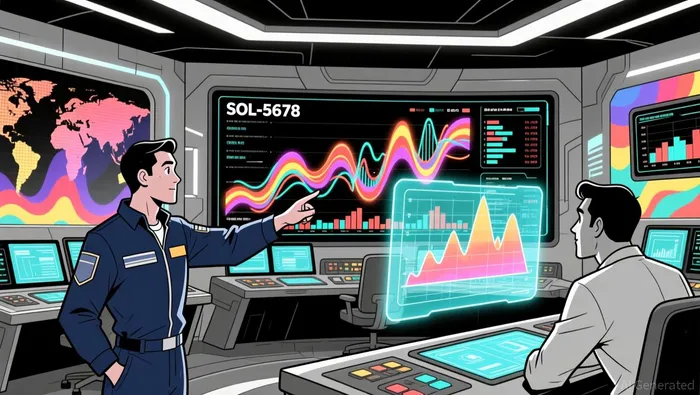
However, this also introduces risks. Viral misinformation or coordinated campaigns (e.g., pump-and-dump schemes) could distort market perceptions. X's challenge will be balancing real-time engagement with verification mechanisms to prevent abuse.
Institutional Implications: From Noise to Signal
Institutional investors, often skeptical of social media's role in finance, are now taking notice. Smart Cashtags offer a structured dataset for analyzing retail sentiment, which can complement traditional fundamental analysis.
Consider a scenario where a hedge fund uses Smart Cashtags to monitor micro-trends in tokens like "ETH-9876." A spike in social mentions might precede a price breakout, allowing the fund to adjust its position. This mirrors how onchain analytics tools use blockchain data to predict market movements, but with a social layer added.
Moreover, the feature reduces noise by filtering out irrelevant or ambiguous content. Instead of sifting through thousands of tweets with conflicting tickers, institutions can focus on verified, asset-specific discussions. This could democratize access to sentiment-driven insights, traditionally the domain of niche data providers.
Broader Market Implications: The Rise of the "Financial Super App"
X's move aligns with Musk's vision of transforming the platform into a financial super app-a hub where social media, trading, and data analysis converge. While the current iteration of Smart Cashtags is limited to data aggregation, future integrations could include trading interfaces, wallet support, or even onchain analytics.
This shift mirrors trends in Asia, where apps like WeChat and KakaoTalk have embedded financial services into their ecosystems. If X succeeds, it could challenge traditional financial platforms by offering a seamless, real-time experience for both retail and institutional users.
Risks and Challenges
Despite its potential, Smart Cashtags face hurdles:
1. Misinformation: Without robust moderation, bad actors could exploit the feature to spread false narratives.
2. Overreliance on Sentiment: Traders might prioritize social activity over fundamentals, leading to volatile, speculative markets.
3. Regulatory Scrutiny: Regulators may question X's role in facilitating financial transactions or disseminating market data.
X's testing phase is critical to addressing these issues. Early feedback will determine whether the feature becomes a trusted tool or a source of chaos.
Conclusion: A New Era of Social-Driven Finance
X's Smart Cashtags are more than a technical fix-they're a catalyst for reimagining how finance operates in the digital age. By bridging the gap between social sentiment and market data, the feature empowers traders to act on real-time insights while reducing ambiguity.
For investors, the key takeaway is clear: social media is no longer a side channel-it's a core component of financial infrastructure. As X rolls out Smart Cashtags in 2026, the winners will be those who adapt to this new reality, leveraging sentiment and data in tandem. The losers? Those who dismiss the power of the crowd-or fail to verify the signals they follow.






Comentarios
Aún no hay comentarios