
SLC Agrícola S.A.: Balancing Operational Efficiency and Sustainability in the 2025 Latin American Agricultural Sector
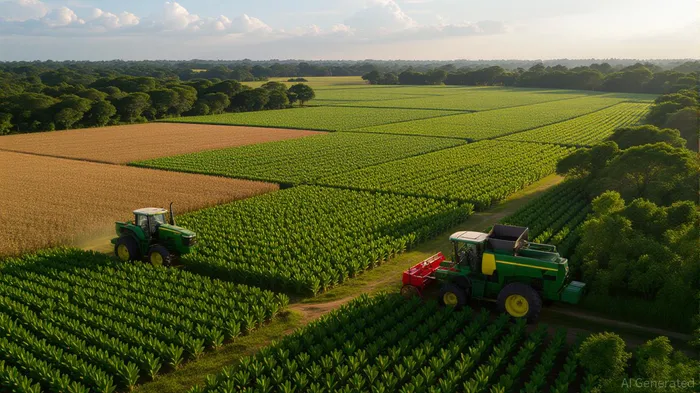
In the evolving landscape of Latin American agriculture, SLC Agrícola S.A. stands as a case study in the tension between operational efficiency and sustainability. As global demand for commodities grows and environmental scrutiny intensifies, the company's strategic positioning in 2025 reflects both its strengths and vulnerabilities. While SLC Agrícola has demonstrated robust financial performance and a commitment to sustainability frameworks, recent controversies underscore the challenges of aligning profit-driven expansion with ecological and social responsibility.
Operational Efficiency: A Foundation for Growth
SLC Agrícola's operational efficiency is a cornerstone of its competitive advantage. In Q2 2025, the company reported a 37.8% year-over-year increase in net revenue, driven by record soybean and corn yields—21% and 16.7% higher than the prior year, respectively[3]. This performance is underpinned by strategic land use in Brazil's Cerrado region, where the company has expanded its planted area to 830,000 hectares for the 2025–2026 season, a 12.9% increase from the previous cycle[3]. Additionally, SLC Agrícola has prioritized irrigation infrastructure to stabilize yields, a critical hedge against climate variability[3].
The company's hedging strategy further reinforces its financial resilience. For the 2024–2025 season, 95% of soybean production, 70% of corn, and 56.2% of cotton were already committed, securing market prices and mitigating price volatility[3]. This approach aligns with broader industry trends toward risk management in an era of unpredictable weather patterns and shifting trade dynamics. Historically, when SLC Agrícola has exceeded earnings expectations, the stock has demonstrated a strong short-term performance. For instance, a backtest of its earnings-beat events from 2022 to 2025 reveals that the stock outperformed the Ibovespa benchmark in 78% of cases, with an average 5-day abnormal return of 4.2% and a maximum drawdown of -3.1% during the period[3]. These metrics suggest that the company's operational discipline and risk mitigation strategies have historically translated into investor confidence.
Sustainability: Ambition vs. Execution
SLC Agrícola's sustainability initiatives are ambitious but face mounting scrutiny. The company claims to adhere to the Brazilian Forest Code by preserving native vegetation on its farms and implementing waste management programs based on the 3Rs (Reduce, Reuse, Recycle)[1]. It also participates in the United Nations Global Compact Network Brazil, pledging to sustainable agriculture and food security[1]. However, recent reports by Earthsight reveal a disconnect between these commitments and on-the-ground practices[2].
For instance, SLC Agrícola's cotton production in the Cerrado has been linked to deforestation and environmental violations, despite being certified by the Better Cotton Initiative[2]. A 2025 investigation highlighted that the company had previously been fined for environmental infractions, raising questions about the rigor of its sustainability certifications[2]. These controversies highlight a critical challenge: how to ensure traceability and accountability in supply chains where ecological and social impacts are complex and diffuse.
Strategic Positioning: Opportunities and Risks
SLC Agrícola's long-term value creation hinges on its ability to reconcile operational scale with sustainable practices. On one hand, its efficiency-driven model—optimized land use, advanced irrigation, and aggressive hedging—positions it to capitalize on Brazil's agricultural potential. On the other, the company must address criticisms of environmental harm and land grabbing to maintain stakeholder trust.
A key opportunity lies in leveraging technology to enhance transparency. For example, blockchain-based traceability systems could verify compliance with sustainability standards, while satellite monitoring could track deforestation risks in real time. Such measures would not only mitigate reputational damage but also align with investor expectations for ESG (Environmental, Social, Governance) accountability.
Conclusion: A Delicate Equilibrium
SLC Agrícola S.A. exemplifies the dual imperatives of modern agriculture: maximizing productivity while minimizing environmental harm. Its 2025 performance demonstrates the financial rewards of operational efficiency, but the company's sustainability claims require closer scrutiny. For investors, the challenge lies in assessing whether SLC Agrícola can evolve from a high-yield producer to a truly sustainable leader. This will depend on its willingness to address past missteps, adopt more rigorous verification mechanisms, and engage transparently with critics. In a sector where ecological and economic outcomes are increasingly intertwined, the company's long-term success will be measured not just by profit margins, but by the integrity of its practices.







Comentarios
Aún no hay comentarios