
SL Green Realty: A Mispriced Opportunity in a Transformed Office Market
The commercial real estate sector remains mired in a valuation paradox. While operators like SL Green Realty Corp.SLG-- (NYSE: SLG) demonstrate operational resilience-posting record leasing volumes and occupancy rates-their stock prices tell a different story. This disconnect, rooted in sector-wide pessimism and short-term market dynamics, creates a compelling case for re-evaluating SL Green's intrinsic value despite its recent performance.
Operational Resilience in a Challenging Environment
SL Green's third-quarter 2025 results underscore its dominance in Manhattan's premium office market. The company reported Funds From Operations (FFO) of $1.58 per share, surpassing the Zacks Consensus Estimate of $1.34 and nearly 40% higher than the $1.13 per share recorded in the same period in 2024, according to SL Green's third-quarter press release. This outperformance was driven by 52 new Manhattan office leases totaling 657,942 square feet, signed at an average rent of $92.81 per rentable square foot, and as of September 30, 2025 Manhattan same-store occupancy reached 92.4%, with projections to climb to 93.2% by year-end.
Historically, SL Green's stock has shown a pattern where, following earnings beats, the stock initially experiences a short-term decline but tends to outperform in the medium term. For instance, over the past three years, the stock has averaged a -1.2% return in the first five days post-earnings beat but has delivered a 15.4% return by day 30, outperforming the S&P 500 benchmark. However, with a sample size of only five events, these results should be interpreted as directional evidence rather than conclusive proof.
However, these gains are partially offset by a 5.5% year-over-year decline in same-store cash net operating income (NOI) to $161 million. This reflects broader challenges in the office sector, including tenant concessions and the lingering effects of remote work adoption. Notably, the mark-to-market on new leases-a critical metric for assessing rental rate momentum-fell 2.7% below previous fully escalated rents. While this signals moderation in rent growth, it also highlights SL Green's ability to secure long-term leases (average term: 8.9 years) in a market where short-term volatility is expected.
A Sector-Wide Undervaluation Crisis
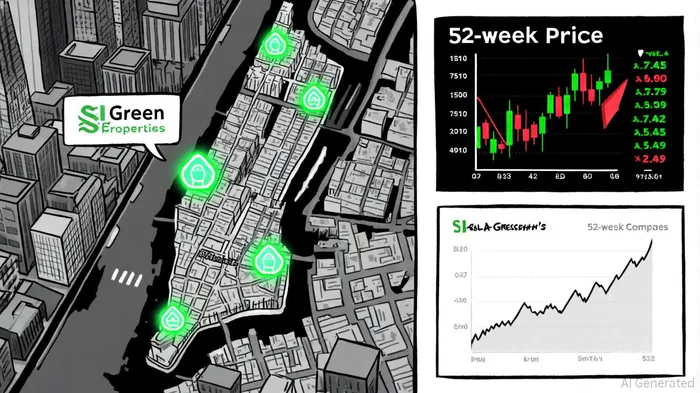
The office REIT sector is experiencing a systemic undervaluation, with SL Green's Price/FFO ratio of 8.18, per StockAnalysis, trailing peers like Alexandria Real Estate Equities (P/FFO: 10.09) and Vornado Realty Trust (P/FFO: 17.57), according to an AAII article. This disparity is partly due to the sector's 19.8% national vacancy rate as of December 2024 and 4.5% year-over-year rental rate growth to $33.11 per square foot, according to the Python & Finance Hub report. For SL Green, the disconnect is even starker: its beta of 1.75-indicating heightened sensitivity to market swings-has amplified its 52-week price decline of -27.91%, even as operational metrics improve.
This mispricing is exacerbated by the market's focus on short-term pain rather than long-term structural demand. Manhattan's Class A office market, where SL Green holds a 12% share, is uniquely positioned to benefit from a bifurcated recovery. While secondary spaces face obsolescence, premium assets like SL Green's Park Avenue Tower (acquired for $730 million in Q3 2025) and 346 Madison Avenue ($160 million) are seeing sustained demand from financial services tenants, which account for 43% of SL Green's annualized cash rent.
Strategic Positioning and Capital Recycling
SL Green's recent capital recycling efforts further justify its valuation discount. The company sold a 5.0% interest in One Vanderbilt Avenue for $86.6 million, a move that enhanced liquidity while retaining long-term value in a landmark asset. Such transactions align with its strategy to optimize a portfolio already skewed toward high-occupancy, high-credit-quality tenants like UBS and Paramount Global.
Comparatively, SL Green's 92.4% Manhattan occupancy rate dwarfs the industry average, which remains below 80% in many secondary markets. Yet its stock trades at a discount to its 2024 P/FFO of 9.2, reflecting investor skepticism about the office sector's ability to sustain rental growth. This skepticism is misplaced: SL Green's FFO payout ratio of 71% (in line with the sector's average) and its $4.59 billion market capitalization suggest a balance sheet capable of weathering near-term headwinds while capitalizing on long-term demand.
The Case for Re-Rating
The key to unlocking SL Green's value lies in the market's eventual re-rating of office real estate. As remote work normalizes and hybrid models stabilize, demand for premium office space-particularly in Manhattan-will likely rebound. SL Green's 93.2% projected occupancy and its focus on long-term leases position it to capture this demand. Additionally, its $730 million Park Avenue Tower acquisition-a 1.1 million-square-foot asset in Midtown-signals confidence in Manhattan's recovery.
Investors should also consider the dividend yield of 4.1%, which outpaces the sector average and offers a buffer against volatility. While the 2.7% mark-to-market decline on new leases is a near-term drag, it reflects disciplined underwriting rather than a lack of demand. As the market differentiates between premium and tertiary assets, SL Green's Class A focus could drive a re-rating.
Conclusion
SL Green Realty's operational performance-robust leasing, high occupancy, and strategic capital allocation-contrasts sharply with its stock price. The company's undervaluation is a function of sector-wide pessimism and the market's short-term focus, not its fundamentals. For investors willing to look beyond the noise, SL Green represents a compelling opportunity in a sector poised for structural re-rating.





Comentarios
Aún no hay comentarios