
Sky High Risks: The Regulatory and Market Implications of Washington’s Airspace Incident
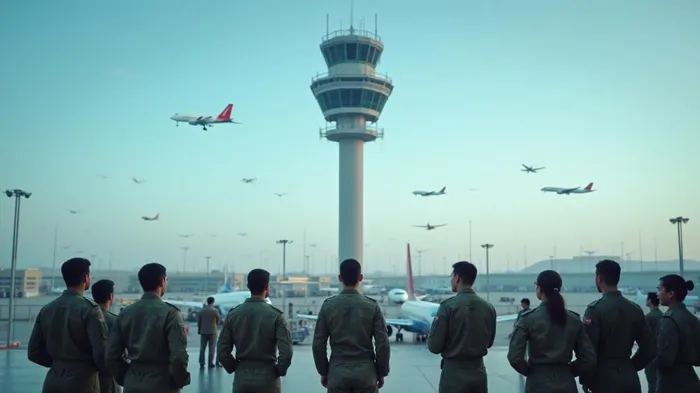
On May 1, 2025, two commercial flights—Delta Air Lines’ A319 and Republic Airways’ Embraer E170—were forced to abort landings at Washington’s Reagan National Airport (DCA) due to an Army Black Hawk helicopter operating too close to the runway. The incident has sparked a federal probe led by the Federal Aviation Administration (FAA) and National Transportation Safety Board (NTSB), raising alarms about airspace safety and regulatory oversight. This event underscores a broader aviation safety crisis: since 2021, there have been 85 near-misses between helicopters and aircraft, defined by lateral separations under 1,500 feet and vertical gaps below 200 feet. For investors, the fallout could ripple across airlines, defense contractors, and air traffic technology firms.
The Regulatory Tightening: Risks for Airlines and Defense Contractors
The FAA and NTSB are scrutinizing helicopter traffic patterns near major airports, particularly those operated by military or government entities. The Army helicopter’s presence at DCA violated FAA altitude restrictions, prompting calls for stricter enforcement of airspace rules. For airlines, this means higher compliance costs. The FAA has already proposed new regulations requiring commercial carriers to implement real-time tracking systems for nearby aircraft—a move that could cost airlines an estimated $500 million industry-wide over the next two years.
Defense contractors, meanwhile, face dual pressures. First, the Pentagon’s “Chinese Military Companies List” now bars contractors from using products linked to entities tied to Beijing, forcing firms like Boeing and Lockheed Martin to audit supply chains. Second, proposed Defense Federal Acquisition Regulation Supplement (DFARS) updates could mandate cybersecurity reviews for contractors handling even unclassified data—a requirement that could add 10–15% to project budgets.
Market Reactions: Airlines Struggle as Defense Firms Navigate Uncertainty
The incident exacerbates existing challenges for airlines. The S&P 500 passenger airline index fell 15% year-to-date in Q2 2025, with Spirit Airlines (SAVE) and United Airlines (UAL) shares plummeting up to 20%. Demand has softened amid rising inflation and safety concerns, with airline spending dropping 7.2% in February y/y. The FAA’s probe adds to operational risks: airlines may face penalties for noncompliance with new safety protocols, while passengers may avoid airlines perceived as less safe.
Defense contractors, however, face a mixed outlook. While companies like Raytheon Technologies (RTX) and L3Harris (LHX) could benefit from military helicopter modernization programs, supply chain disruptions remain a hurdle. For instance, a $900M tariff burden on Apple (AAPL)—driven by U.S.-China trade tensions—hints at broader cost pressures for firms reliant on Asian manufacturing.
Air Traffic Tech: The Silver Lining
The incident has intensified demand for air traffic control modernization. The FAA’s plan to replace radar-based systems with satellite-based ADS-B technology could create opportunities for tech firms like Honeywell International (HON) and Collins Aerospace (COL). These companies are already developing solutions to prevent midair conflicts, such as predictive collision-avoidance software.
Conclusion: Navigating the Storm Clouds
The DCA incident underscores a sector in flux. Airlines face regulatory headwinds, declining demand, and margin pressures—factors that have driven the S&P 500 airline index to a 15% YTD decline. Defense contractors must balance Pentagon modernization spending with supply chain risks, while air traffic tech firms stand to gain from safety-focused upgrades.
Investors should prioritize firms with diversified revenue streams and strong balance sheets. Airlines like Delta (DAL), which has a 1% capacity growth target and a $1.2 billion cash reserve, may weather the storm better than peers. Defense contractors with minimal Chinese supply chain exposure—such as Northrop Grumman (NOC), which sources 95% of its components domestically—also appear resilient.
The FAA’s probe and the 85 near-misses since 2021 are not just safety warnings—they’re market signals. For now, the skies are riskier than ever, but opportunities lie in the firms prepared to navigate them.





Comentarios
Aún no hay comentarios