
Skillsoft's Strategic Transformation and AI-Driven Growth Potential Amid Earnings Softness
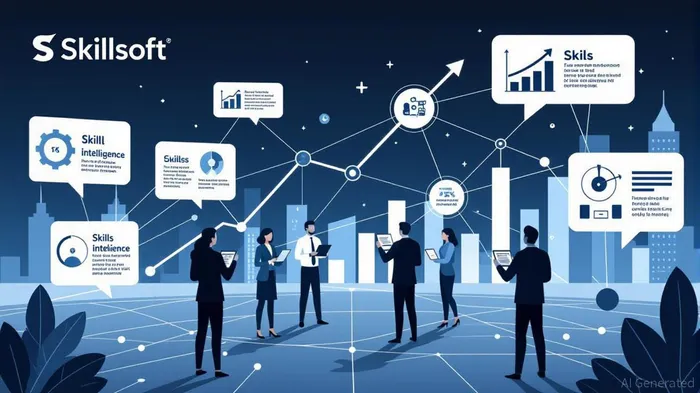
In an era where 90% of HR and L&D professionals express uncertainty about their workforce's readiness for future business goals[1], SkillsoftSKIL-- (SKIL) is doubling down on AI-driven learning and skills intelligence to address critical gaps in leadership, technology, and AI literacy. Despite near-term revenue declines driven by macroeconomic headwinds, the company's strategic pivot toward AI-native capabilities and partnerships positions it to capitalize on a rapidly expanding corporate training market.
Strategic Transformation: AI as the Core of Workforce Development
Skillsoft's 2025 strategic transformation is anchored in its Global Skills Intelligence Survey, which revealed alarming skill gaps and a demand for integrated platforms that unify learning, skills intelligence, and performance[2]. The company is responding by embedding AI-native capabilities such as adaptive training, real-time feedback, and personalized learning paths into its offerings[4]. For instance, AI learning adoption has surged by 74% in learners and 158% in learning hours year-over-year[2], underscoring the scalability of its approach.
A pivotal partnership with Salesforce further amplifies this strategy, integrating AI-powered tools into Skillsoft's ecosystem to enhance workforce productivity[3]. Such collaborations align with broader industry trends: the global corporate training market, valued at $361.5 billion in 2023, is projected to reach $805.6 billion by 2035, driven by AI's ability to deliver personalized, data-driven learning experiences[2].
Navigating Earnings Softness: Balancing Cost Discipline and Innovation
Skillsoft's Q2 2026 results highlight the tension between macroeconomic challenges and long-term innovation. Total revenue fell 3% year-over-year to $129 million, with the Global Knowledge segment declining 10% to $28 million[1]. However, the Talent Development Solutions (TDS) segment demonstrated resilience, with enterprise solutions posting a fourth consecutive quarter of growth[1]. Adjusted EBITDA reached $28 million (22% margin), reflecting disciplined cost management[1].
The company has revised its full-year revenue guidance to $510–$530 million, acknowledging that macroeconomic pressures—such as reduced live training demand in North America and the Middle East—will persist for 3–6 months[4]. Yet, Skillsoft remains focused on AI-driven growth, with CEO Chris D'Amico emphasizing the need for “strategic transformation to reimagine learning as a driver of business performance”[1].
Long-Term Value: AI's Role in Reshaping Corporate Training
The AI-driven corporate training market is accelerating, fueled by technologies like multimodal AI, generative AI, and predictive analytics. These tools are not only boosting engagement (20% higher customer interaction) and efficiency (15% conversion rate lift[3]) but also enabling enterprises to anticipate market shifts and optimize operations. For Skillsoft, this aligns with its vision of creating a “skills intelligence engine” that bridges learning and business outcomes[2].
Financially, Skillsoft's AI initiatives are already showing traction. Free cash flow turned positive year-to-date despite a $23 million Q2 deficit[1], suggesting that long-term investments are beginning to stabilize cash flow. Meanwhile, the company's 22% EBITDA margin[1]—a testament to operational efficiency—positions it to weather short-term volatility while scaling AI capabilities.
Risks and Opportunities
While Skillsoft's AI strategy is compelling, risks persist. Macroeconomic uncertainties could delay enterprise spending on training, and competition from platforms like CourseraCOUR-- and UdemyUDMY-- remains fierce. Additionally, scaling AI-driven solutions requires sustained R&D investment, which could strain margins if not offset by revenue growth[4].
However, the long-term outlook is favorable. As AI adoption in corporate workflows surges—from 55% in 2023 to 78% in 2025[3]—Skillsoft's focus on skills intelligence and agentic AI (piloted in 2026[5]) aligns with the next phase of workforce transformation. By 2026, the company aims to lead in reskilling programs tailored to AI-driven workflows, a niche where its data-driven approach offers a competitive edge[2].
Conclusion
Skillsoft's earnings softness in 2025 reflects broader macroeconomic pressures, but its strategic transformation—centered on AI and skills intelligence—positions it to capture a significant share of the $805.6 billion corporate training market by 2035[2]. While near-term volatility is inevitable, the company's disciplined cost structure, growing AI adoption, and partnerships with industry leaders like SalesforceCRM-- suggest that long-term value creation is on the horizon. For investors, the key question is not whether Skillsoft can survive the current headwinds, but whether it can accelerate its AI roadmap to outpace competitors in the next phase of digital transformation.





Comentarios
Aún no hay comentarios