
Skechers' Exclusion from S&P Global BMI Index: Implications for Value and Investor Sentiment
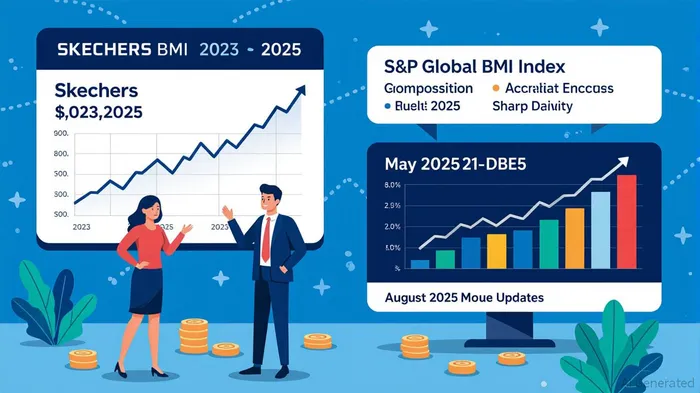
The recent exclusion of Skechers from the S&P Global BMI Index has sparked significant debate among investors and analysts. While S&P Global has not explicitly disclosed the rationale for this change, contextual factors—including Skechers' strategic decision to go private in May 2025 and broader shifts in index methodology—offer critical insights into the implications for the company's valuation and market sentiment.
Strategic Index Realignment and Methodological Shifts
S&P Global's index methodologies are periodically revised to align with evolving market dynamics and investor priorities. In August 2025, the firm announced updates to the S&P Developed BMI Select Aerospace & Defense 35/20 Capped Index, emphasizing adjustments to sector weightings and eligibility criteria[1]. While these changes were not explicitly tied to Skechers, they reflect a broader trend of indices recalibrating to prioritize companies with stable earnings visibility and reduced exposure to geopolitical risks.
Skechers' exclusion may also be linked to its withdrawal from public market reporting. In early 2025, the company pulled its earnings guidance amid heightened uncertainty over global trade policies, particularly U.S.-China tariff dynamics[2]. This move, coupled with its subsequent $9 billion take-private deal with 3G Capital, fundamentally altered its corporate structure. Private companies are typically excluded from public indices like the S&P Global BMI, which prioritize liquidity and transparency for institutional investors.
Market Reassessment and Investor Sentiment
The exclusion of Skechers from the S&P Global BMI Index signals a recalibration of market sentiment toward risk mitigation. Retailers with significant exposure to trade policy volatility—such as Skechers, which sources 70% of its production from China and Vietnam—are increasingly viewed as speculative assets in a fragmented global economy[3]. By exiting the public market, Skechers has distanced itself from quarterly earnings pressures, allowing it to pursue long-term operational flexibility.
However, this strategic shift carries trade-offs. Public indices like the S&P Global BMI serve as benchmarks for passive investment strategies and institutional portfolios. Skechers' absence may reduce its visibility to index-tracking funds, potentially limiting access to capital. Conversely, the take-private deal offers the company greater autonomy to navigate trade uncertainties, such as retaliatory tariffs or supply chain disruptions, without public scrutiny.
Valuation Implications and Forward-Looking Considerations
From a valuation perspective, Skechers' exclusion underscores the growing divergence between public and private market valuations for companies in cyclical industries. The $9 billion buyout price, while a 20% premium to its public market cap, reflects investor skepticism about its ability to sustain growth under volatile trade conditions. Private ownership may also enable the company to reinvest proceeds into innovation or diversify production geographically, though such strategies lack the transparency of public reporting.
For investors, the episode highlights the importance of monitoring index methodology shifts and corporate governance changes. As S&P Global continues to refine its BMI indices to reflect macroeconomic realities—such as the rise of ESG criteria or sector-specific risks—companies with opaque business models or high geopolitical exposure may face increasing exclusion risks.
Conclusion
While the official reason for Skechers' exclusion from the S&P Global BMI Index remains undisclosed, the interplay of strategic corporate decisions and index realignment provides a compelling narrative. The company's transition to private ownership, driven by trade policy uncertainties, aligns with a broader trend of firms prioritizing operational flexibility over public market exposure. For investors, this case underscores the need to assess not only a company's fundamentals but also its alignment with evolving index criteria and macroeconomic tailwinds.







Comentarios
Aún no hay comentarios