
Skanska's SEK 1.7 Billion U.S. Contract: A Strategic Indicator of Construction Sector Recovery and ESG-Driven Growth
The construction industry is navigating a pivotal inflection point in 2025, with infrastructure demand surging amid the global push for AI-driven digital transformation and sustainability. Skanska's recent SEK 1.7 billion project-a 33,400-square-meter, 36-megawatt tenant improvement in the western United States-has emerged as a bellwether for the sector's recovery and its alignment with ESG (Environmental, Social, and Governance) priorities. This contract, set to begin in June 2025 and conclude in June 2027, according to Sweden Herald, underscores how construction firms are repositioning themselves to meet the dual demands of technological modernization and environmental accountability.
Construction Sector Resilience: Data Centers as a Growth Engine
The U.S. construction sector is experiencing a renaissance in data center development, driven by the exponential growth of AI workloads and the need for high-performance computing infrastructure. According to a report by Newmark, annualized spending on new data center construction in the U.S. reached $31.5 billion in 2025, with the market projected to exceed $35 billion by year-end, according to a BuildCheck analysis. This surge is fueled by hyperscalers and cloud providers seeking to expand capacity, particularly in regions with abundant renewable energy and land availability, such as West Texas, according to a DCNN report.
Skanska's project aligns with this trend. The firm's Advanced Technology (SAT) division, which now employs over 285 specialists according to a GlobeNewswire release, is leveraging modular and prefabricated construction methods to accelerate delivery timelines and reduce on-site labor bottlenecks. This approach not only addresses labor shortages but also enhances cost predictability-a critical factor in a sector grappling with rising material costs and supply chain volatility.
ESG Alignment: Sustainability as a Competitive Advantage
The project's ESG credentials further position it as a model for future infrastructure development. Skanska has committed to using low-carbon materials such as green concrete and recycled steel, as reported in a Skanska press release, in line with its corporate goal of achieving net-zero carbon emissions by 2045 and reducing scope 1 and 2 emissions by 70% by 2030, according to the Skanska ESG page. These practices are not merely aspirational; they reflect a broader industry shift toward decarbonization.
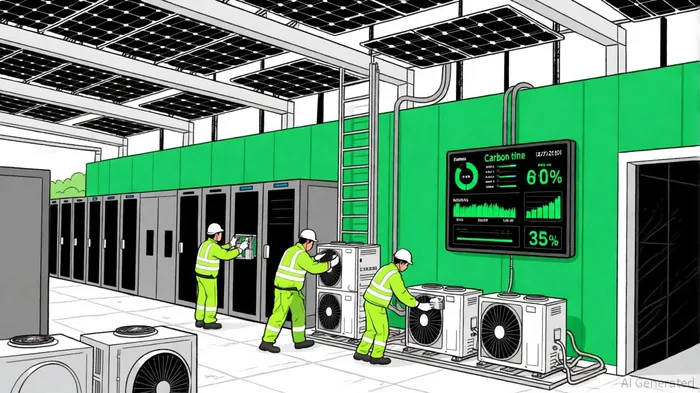
Data from the 2025 ESG Report on data centers reveals that hyperscalers now source 91% of their energy from renewables, while innovations like liquid cooling systems have driven Power Usage Effectiveness (PUE) metrics down from 1.44 in 2019 to 1.38 in 2024, according to industry analyses. Skanska's project will incorporate these technologies, including smart building envelopes and energy-efficient HVAC systems, to minimize operational carbon footprints, as noted in an InvestorsHangout article.
Strategic Implications for Investors
For investors, Skanska's contract highlights the intersection of two megatrends: infrastructure modernization and ESG-driven capital allocation. The firm's CEO has emphasized the U.S. data center market's "strong pipeline" and Skanska's position as a leader in sustainable construction, according to a Construction Owners article, supported by a record backlog and strategic partnerships with tech firms. This aligns with broader market dynamics: JLL's 2025 U.S. Construction Outlook notes that ESG compliance is becoming a non-negotiable for clients, with 78% of developers prioritizing sustainability in project bids.
Moreover, Skanska's expansion of its SAT division reflects a sector-wide reallocation of resources. As Deloitte notes, government policies like the Inflation Reduction Act are incentivizing private capital to fund green infrastructure, creating a fertile environment for firms that can deliver both technical expertise and environmental value.
Conclusion
Skanska's SEK 1.7 billion U.S. contract is more than a single project-it is a microcosm of the construction industry's evolution. By combining cutting-edge technology, modular efficiency, and ESG rigor, the firm is not only securing its competitive edge but also setting a benchmark for the sector. As data center demand accelerates and sustainability becomes a core metric for infrastructure investment, companies like Skanska are poised to lead the next phase of construction recovery. For investors, the message is clear: ESG-aligned infrastructure is no longer a niche opportunity but a central pillar of long-term value creation.







Comentarios
Aún no hay comentarios