
SK Hynix's 2Q25 Earnings and AI-Driven HBM Leadership: A Strategic Powerhouse in the AI Memory Revolution
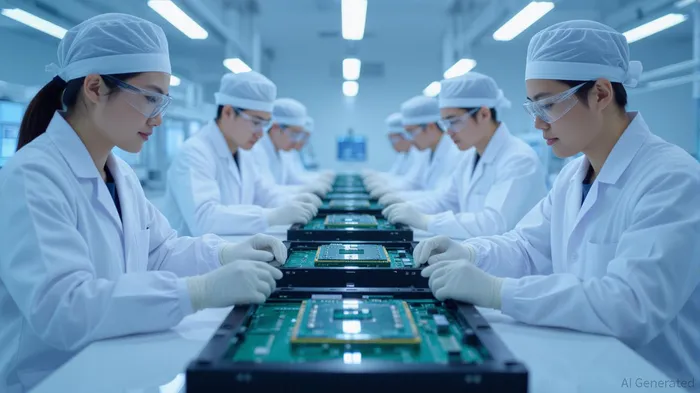
SK Hynix's second-quarter 2025 earnings are shaping up to be a defining moment in the semiconductor industry, driven by its unparalleled dominance in high-bandwidth memory (HBM) and its strategic alignment with the AI revolution. With revenue projected to hit 20.6 trillion won ($14.9 billion)—a 25.5% year-over-year jump—and operating profit expected to surge 65% to 9 trillion won, the South Korean memory giant is not just riding the AI wave; it is leading it. This performance underscores SK Hynix's ability to capitalize on structural demand for HBM, a critical enabler of AI infrastructure, while maintaining a fortress-like financial position.
HBM Leadership: A Structural Tailwind
The company's 70% global HBM market share in Q1 2025 (per Counterpoint Research) is not a coincidence. SK Hynix's proprietary MR-MUF packaging technology—which optimizes thermal management and yield rates for multi-layer HBM stacks—has become the industry benchmark. Its 12-layer HBM3E chips power NVIDIA's Blackwell Ultra GB300 platform, the most advanced AI accelerator in the market. This is no small feat: NVIDIA's Blackwell Ultra is expected to dominate hyperscale data centers in 2025, and SK Hynix's exclusive supply of 12-layer HBM3E ensures it captures the highest-margin segment of the AI memory market.
Moreover, SK Hynix is already preparing for the next phase of HBM evolution. It shipped HBM4 12Hi samples to customers in March 2025 and plans mass production by November 2025. With HBM4 offering bandwidths of 1.6–2.0 TB/s per stack, SK Hynix is locking in its leadership for the next generation of AI hardware. This technological lead is compounded by its $14 billion investment in a new DRAM fab in Cheongju, South Korea, which will focus exclusively on HBM and next-gen memory solutions.
Strategic Partnerships and Financial Resilience
SK Hynix's partnership with NVIDIANVDA-- is the cornerstone of its AI strategy. The two companies operate in a co-development ecosystem, where SK Hynix aligns its R&D roadmap with NVIDIA's product cycles. For example, NVIDIA CEO Jensen Huang personally accelerated SK Hynix's HBM4 timeline by six months to meet the “Rubin” GPU platform's requirements—a level of collaboration that Samsung and MicronMU-- cannot replicate. This symbiotic relationship ensures SK Hynix's HBM development stays ahead of competitors while securing long-term demand.
Financially, the company is in a position of strength. Its Q1 2025 results revealed $5.7 billion in net profit and a 11% net debt ratio, with $10 billion in cash and equivalents. This capital efficiency is critical for funding its $14 billion DRAM fab and HBM4 expansion. Meanwhile, Samsung Electronics, its closest rival, is grappling with weaker-than-expected guidance (4.6 trillion won operating profit, down 56% YoY), hampered by delayed HBM supply and U.S. export restrictions. SK Hynix's long-term HBM contracts with clients like NVIDIA and AMDAMD-- act as a buffer against short-term volatility, making its financial model more resilient than its peers'.
Risk Management and Long-Term Growth
While SK Hynix's dominance is clear, it is not without risks. The HBM market is capital-intensive, and rivals like Samsung and Micron are investing heavily to catch up. However, SK Hynix's hybrid bonding R&D efforts and dual manufacturing strategies (MR-MUF + hybrid bonding) provide a technological moat. Additionally, its U.S. advanced packaging facility diversifies its supply chain, reducing exposure to geopolitical tensions.
For investors, the company's $14 billion Cheongju fab and HBM4 roadmap represent a multi-year growth catalyst. With AI demand showing no signs of slowing, and HBM3E already accounting for over 50% of HBM revenue in Q1 2025, SK Hynix is well-positioned to outperform the broader semiconductor sector.
Investment Thesis
SK Hynix's strategic position in the AI memory market is unmatched. Its combination of technological leadership, financial discipline, and ecosystem integration creates a durable competitive advantage. While near-term risks like trade policy shifts exist, the company's long-term HBM contracts and diversified manufacturing strategy mitigate these concerns.
For long-term investors, SK Hynix offers exposure to the structural growth of AI infrastructure. Its Q2 2025 results will likely confirm its leadership, and its HBM4 roadmap ensures it remains at the forefront of the AI revolution. With a P/E ratio of 18x (as of July 2025) and a 12-month price target of $85 per share from analysts, the stock is undervalued relative to its growth trajectory.
Conclusion
SK Hynix's 2Q25 earnings are not just a reflection of current demand—they are a testament to its strategic foresight and operational excellence. As AI reshapes the global economy, the company's HBM leadership and capital-efficient growth model make it a compelling long-term investment. For those seeking to capitalize on the AI memory boom, SK Hynix is the clear beneficiary of a market it helped create.





Comentarios
Aún no hay comentarios