
SK Hynix's $12.9bn AI Semiconductor Expansion: Strategic and Financial Implications for Investors
The global AI revolution is reshaping the semiconductor industry, and SK Hynix's $12.9 billion investment in a new advanced chip packaging facility in South Korea positions the company as a pivotal player in this transformation. As artificial intelligence (AI) infrastructure demands surge, driven by data centers and high-performance computing, SK Hynix's focus on high-bandwidth memory (HBM) and next-generation memory solutions could redefine its competitive edge-and the risks and rewards for investors.
Strategic Positioning in the AI Memory Market
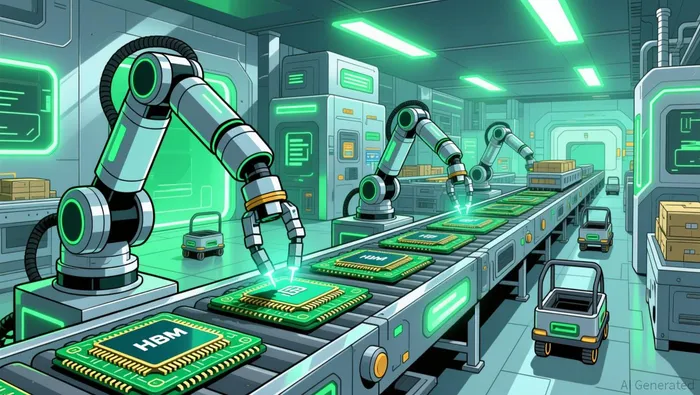
SK Hynix's expansion is anchored in its dominance of the HBM market, a critical component for AI accelerators. According to Bloomberg, the company plans to begin construction of its $12.9 billion facility in April 2026, with completion slated for late 2027. This timing aligns with Macquarie Equity Research's projection that the HBM market will grow at an average annual rate of 33% starting in 2025. SK Hynix already commands a 61% market share in HBM, underscoring its leadership in supplying memory for NVIDIA's AI accelerators.
The company's technology roadmap further solidifies its strategic advantage. SK Hynix is the only supplier capable of delivering both HBM3E and the upcoming HBM4, ensuring it can support two generations of AI infrastructure by 2026. Additionally, the firm is developing AI-optimized DRAM (AI-D) and NAND (AI-N) to enhance performance and efficiency in data centers and inference environments. Collaborations with TSMC on advanced packaging technologies and a $3.9 billion U.S. facility in West Lafayette, Indiana-set to produce turnkey HBM modules by 2028-demonstrate its commitment to vertical integration and global supply chain resilience.
 Partnerships with AI leaders like NVIDIANVDA-- and Google, coupled with R&D investments such as a Global AI Research Center and collaborations with Purdue University, position SK Hynix to stay ahead of technological curves. These efforts are critical as the AI memory market is projected to grow from $189 billion in 2023 to $4.8 trillion by 2033.
Financial Health and Investment Projections
SK Hynix's recent financial performance provides a strong foundation for its ambitious expansion. In Q3 2025, the company reported record revenues of 24.4489 trillion won, with operating profit exceeding 11.38 trillion won and a net margin of 52%-a historic milestone for the firm. By the end of Q3 2025, SK Hynix transitioned from a net debt to a net cash position of 3.8 trillion won, enhancing its flexibility for capital expenditures.
The $12.9 billion investment in South Korea is part of a broader strategy to capitalize on AI-driven demand. While the upfront cost is substantial, the projected growth of the AI market-expected to expand 25-fold by 2033-justifies the scale of the bet. SK Hynix's dominance in HBM (62–64% market share as of Q2 2025) and its early-mover advantage in HBM4 production provide a buffer against near-term volatility.
Risk Factors for Investors
Despite its strengths, investors must weigh several risks. The AI memory market is inherently cyclical, with periods of oversupply or reduced demand posing threats to profitability. For example, a slowdown in AI adoption or a shift in chip architecture could render HBM3E or HBM4 less relevant.
Competition is intensifying. Rivals like Samsung and MicronMU-- are investing heavily in HBM development, and their scale could challenge SK Hynix's market share. Geopolitical risks, including trade tensions and supply chain disruptions, also loom large, particularly as the U.S. and South Korea navigate semiconductor export controls.
Conclusion: A Calculated Bet on AI's Future
SK Hynix's $12.9 billion expansion reflects a calculated bet on the AI-driven memory chip sector. Its technological leadership, financial strength, and strategic partnerships create a compelling case for long-term growth. However, the cyclical nature of the market and rising competition necessitate a cautious approach. For investors, the key will be monitoring SK Hynix's ability to maintain its HBM dominance while navigating macroeconomic and geopolitical headwinds. If successful, the company could emerge as a cornerstone of the AI infrastructure era.





Comentarios
Aún no hay comentarios