
Singapore's Strategic Role in Bridging Traditional and Crypto-Native Markets via Regulated Perpetual Futures
The Regulatory Framework: A High-Stakes Balancing Act
Singapore's regulatory approach to crypto derivatives is defined by the Payment Services Act 2019 (PSA) and the Financial Services and Markets Act 2022 (FSMA). These laws impose a dual mandate: to foster innovation while mitigating risks like money laundering and operational fragility. For digital token service providers (DTSPs), the stakes are high. Entities must secure either a Standard Payment Institution (SPI) or Major Payment Institution (MPI) license, depending on transaction volumes, and adhere to a minimum base capital of SGD 250,000.
The Monetary Authority of Singapore (MAS) has also introduced a high threshold for DTSP licenses, particularly for firms targeting overseas clients. As of June 30, 2025, only a handful of providers have met the criteria, reflecting MAS's cautious stance on cross-border risks. Compliance measures are equally rigorous: AML/CFT protocols, cold storage of 90% of customer assets, and restrictions on public marketing of DPTs underscore the emphasis on investor protection.
SGX's Perpetual Futures: A Bridge Between Worlds
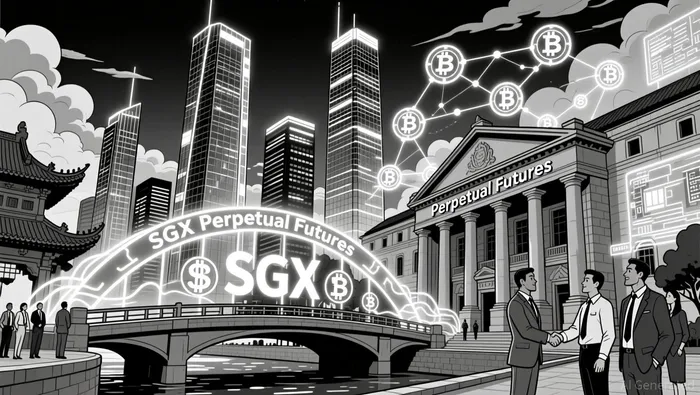
The most significant development in 2025 is SGX's launch of BTC and ETH perpetual futures on November 24. These contracts, benchmarking to the iEdge CoinDesk Crypto Indices, offer institutional and accredited investors a regulated, transparent, and centrally cleared environment for leveraged crypto exposure. Unlike traditional futures, perpetual contracts lack expiry dates, enabling continuous trading and price discovery. Settlement occurs in USD or USDT, aligning with institutional-grade risk management standards.
This initiative addresses a critical gap: while global crypto derivatives markets exceed $187 billion in daily volume, much of this activity has historically occurred on offshore, unregulated platforms. By bringing these flows onshore, SGX is not only enhancing liquidity but also reducing basis risk through dynamic funding rates that tetherUSDT-- perpetual prices to underlying indices.
Industry leaders have praised the move. DBS Bank's Patrick Yeo noted that perpetual futures offer "enhanced precision and capital efficiency" compared to spot trading, while OKX Singapore's Gracie Lin emphasized the importance of regionally anchored benchmarks for integrating crypto with traditional asset classes according to industry analysis.
Strategic Implications: Singapore as a Global Crypto Hub
Singapore's regulatory framework is designed to attract institutional capital without compromising stability. The FSMA's territorial reach ensures that even firms operating solely for overseas clients must comply with MAS standards, preventing regulatory arbitrage. Meanwhile, initiatives like Project Guardian and regulatory sandboxes allow firms to test blockchain innovations in controlled environments, fostering responsible growth according to industry reports.
The launch of SGX's perpetual futures is a natural extension of this strategy. By offering institutional-grade products, Singapore is competing with offshore hubs like Dubai and Hong Kong, which have also sought to capture crypto demand. However, Singapore's advantage lies in its established financial infrastructure and alignment with global standards such as the FATF Travel Rule according to regulatory analysis.
Challenges and Opportunities
Despite its progress, Singapore's approach is not without challenges. The high regulatory bar for DTSPs may deter smaller players, and the focus on institutional-grade products risks excluding retail investors. Additionally, the reliance on USD and USDTUSDT-- settlement exposes participants to stablecoin risks, though MAS's stablecoin regulations mitigate this to some extent.
However, the benefits are clear. For institutions, SGX's perpetual futures provide a low-risk on-ramp to crypto markets, with robust clearing and margining protocols. For Singapore, the move reinforces its status as a regional hub, attracting capital and talent while setting a precedent for global crypto regulation.
Conclusion
Singapore's 2025 regulatory advancements-particularly SGX's perpetual futures-represent a pivotal moment in the maturation of crypto markets. By balancing innovation with oversight, the city-state is not only securing its position as a crypto-native leader but also demonstrating how traditional finance can evolve to embrace digital assets. For institutional investors, the message is clear: Singapore is now a regulated gateway to the future of finance.






Comentarios
Aún no hay comentarios