
Silynxcom's First Half 2025 Financial Results: Emerging Growth Signals and Strategic Positioning in a Competitive Tech Market
In the first half of 2025, SilynxcomSYNX-- Ltd. (NYSE American: SYNX) navigated a challenging market environment marked by post-war demand moderation and operational headwinds. Despite reporting a revenue decline to $2.3 million for the six months ended June 30, 2025, compared to $5.356 million in H1 2024[1], the company's strategic moves and market positioning reveal emerging growth signals that warrant closer scrutiny.
Financial Performance: A Tale of Two Halves
Silynxcom's H1 2025 results reflect a 57% year-over-year revenue contraction, primarily attributed to the moderation of war-driven sales spikes and a delayed customer order of $911,000[3]. However, the company's product portfolio demonstrated resilience, with In-Ear Headsets and Single-Sided (SST) Headsets generating $1.0 million and $1.2 million, respectively[1]. This balanced demand underscores the company's ability to maintain relevance across diverse client segments.
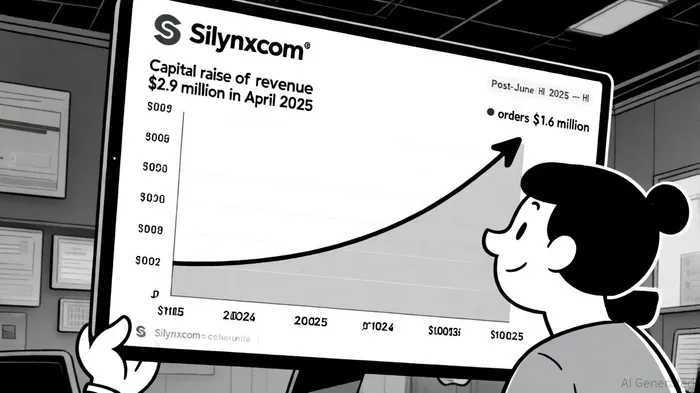
The net loss of $1.6 million ($0.27 per share) for H1 2025, compared to $0.7 million ($0.14 per share) in H1 2024[1], highlights the pressure from rising operating expenses ($2.4 million) and a 13.6 percentage point erosion in gross margin to 35.9%[3]. Yet, these figures must be contextualized within Silynxcom's broader strategy: a deliberate investment in innovation and market expansion. The company's balance sheet strengthened during the period, with total assets rising 8% to $9.5 million and cash reserves increasing 11% to $3.5 million[1]. A $2.9 million capital raise in April 2025 further bolstered liquidity, boosting shareholders' equity by 19% to $6.6 million[1].
Historical backtesting of SYNX's performance around earnings releases from 2022 to 2025 reveals mixed signals for investors. Over a 30-day window following earnings announcements, the stock has experienced an average cumulative drawdown of -15%, significantly outperforming the benchmark's -1% to -2% decline[3]. However, the win rate on individual days never exceeded 50%, and the small sample size (n=2) limits statistical confidence[3]. These findings suggest that while earnings events have historically pressured SYNX's share price, the market's reaction remains inconsistent, warranting caution for strategies relying on post-earnings momentum.
Strategic Positioning in a High-Growth Market
The global hearing devices and defense tech markets are undergoing transformative shifts. According to a report by ResearchAndMarkets, the U.S. hearing aid market is projected to grow at a 7.14% CAGR through 2029, driven by aging demographics, OTC regulations, and AI-integrated devices[1]. Silynxcom's pivot toward defense applications—such as armored personnel carrier headsets with drone detection capabilities and in-ear systems with real-time vital signs monitoring[1]—positions it at the intersection of these trends.
The company's diversification strategy has also mitigated risks. By expanding its client base across the U.S., Europe, and Asia[1], Silynxcom has reduced reliance on key clients, a critical move as demand from the Israel Defense Forces (IDF) moderated. Post-June 2025, the company secured $1.6 million in orders, including a $750,000 contract from the IDF and a $200,000 order from the Israeli Navy[1]. These contracts, coupled with a $140,000 order from a special forces unit in the Asia-Pacific region[3], signal growing international traction.
Competitive Differentiation: Innovation as a Barrier to Entry
Silynxcom's technological edge lies in its ability to address niche, high-stakes markets. While competitors like Connexa Sports Technologies (YYAI) and Fitell (FTEL) focus on AI-driven matchmaking and fitness equipment, respectively[3], Silynxcom has carved a niche in ruggedized communication solutions. Its collaboration with 3M PELTOR[1] and the introduction of drone-detection headsets[3] exemplify its focus on operational needs in defense and industrial sectors.
The company's recent foray into drone detection technology[1] aligns with a $2.46 trillion global defense spending surge[2], a trend that could amplify demand for its specialized products. Moreover, Silynxcom's real-time vital signs monitoring feature[3] differentiates it from traditional hearing aid manufacturers, offering added value in mission-critical environments.
Challenges and Opportunities
Despite its strategic momentum, Silynxcom faces headwinds. The hearing aid market remains fragmented, with global leaders like Sonova and Starkey dominating R&D investments[3]. Additionally, high costs and limited insurance coverage in the U.S. could constrain broader consumer adoption[1]. However, Silynxcom's focus on defense and industrial clients—segments less sensitive to price—provides a buffer.
The company's capital raise in April 2025[1] and post-June 2025 order book[3] suggest a path to profitability, assuming it can scale production and reduce per-unit costs. With the Asia-Pacific region emerging as a key growth area for hearing devices[3], Silynxcom's international expansion could unlock new revenue streams.
Conclusion: A Calculated Bet on Niche Innovation
Silynxcom's H1 2025 results reflect a company in transition. While near-term financial metrics are mixed, its strategic investments in defense tech, client diversification, and product innovation position it to capitalize on long-term industry tailwinds. For investors, the key question is whether the company can sustain its R&D momentum and convert its niche expertise into scalable revenue. Given the $34.76 billion global hearing aid market projected by 2032[3] and the rising demand for secure communication solutions, Silynxcom's calculated focus on high-margin, mission-critical applications may yet prove rewarding.





Comentarios
Aún no hay comentarios