
Silver's Volatility and Structural Supply Deficit: A Case for Strategic Entry Amid Historic Price Swings
The silver market has entered a defining phase, marked by a structural supply deficit, relentless industrial demand, and historic price swings. By late 2025, silver prices had surged over 120% to exceed $65 per ounce, driven by a confluence of factors including the green energy transition, geopolitical tensions, and monetary policy shifts. Yet, this bull market has not been without volatility. A 5% correction in December 2025, pulling prices to $72 per ounce, has sparked debates about whether this reflects a maturing trend or a buying opportunity. For investors, the answer lies in understanding the interplay between real metal scarcity and speculative demand-and how short-term corrections can be leveraged in a long-term bull case.
The Structural Supply Deficit: A Foundation for Long-Term Price Support
The silver market has been in a structural deficit for five consecutive years, with demand consistently outpacing supply. In 2023, global silver demand reached 1.242 billion ounces, while mine production totaled 830.5 million ounces and recycling added 172 million ounces, leaving a deficit of 142.1 million ounces. This imbalance has only deepened in 2024 and 2025, with demand reaching 1.17 billion ounces in 2024 and mine supply declining to 835 million ounces by 2025.
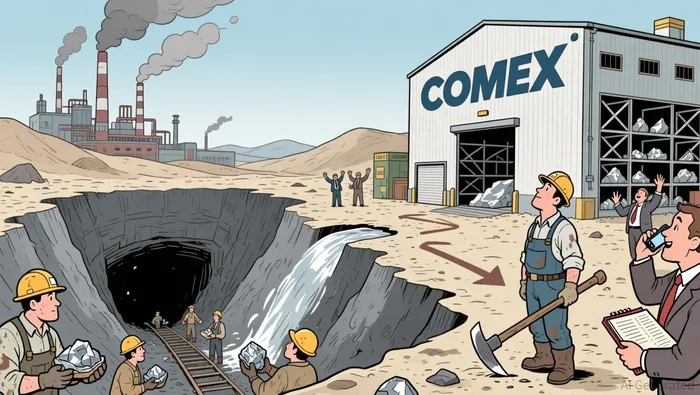
The inelasticity of silver supply is a critical factor. Approximately 75-80% of silver is produced as a byproduct of copper, zinc, and lead mining, meaning higher prices alone cannot stimulate new production without improvements in base metal economics. Additionally, declining ore grades and regulatory hurdles have stifled the development of new projects, with global mine output peaking at 900 million ounces in 2016. Recycling, while growing, remains insufficient to offset these constraints. As a result, above-ground inventories-such as LME and COMEX stocks-have plummeted, with COMEX inventories dropping 70% from 2020 levels.
Industrial Demand: The Irreplaceable Role of Silver in the Green Transition
Industrial demand, which accounts for over 50% of silver consumption, is a key driver of the structural deficit. In 2023, industrial demand exceeded 700 million ounces, fueled by solar panel manufacturing, electric vehicles (EVs), and advanced electronics. By 2024, solar photovoltaic (PV) demand alone accounted for 17% of total silver usage, up from 5.6% in 2015. The International Energy Agency projects that solar PV capacity will expand significantly by 2030, further amplifying silver demand.
The U.S. has recognized silver as a critical mineral for clean energy systems and high-tech manufacturing, underscoring its strategic importance. Meanwhile, EV adoption and data center expansion are creating new demand channels. For example, a single EV requires approximately 15-20 grams of silver, while a solar panel uses around 20 grams. With industrial demand projected to exceed 700 million ounces annually through 2030, the physical scarcity of silver is unlikely to abate.
Navigating Volatility: Strategic Entry During Corrections
Despite the robust fundamentals, silver's price trajectory has been anything but linear. Between 2020 and 2025, the metal experienced sharp corrections, including a 5% drop in December 2025 to $72 per ounce. These swings, however, present opportunities for disciplined investors. Historically, corrections have been driven by profit-taking, margin adjustments, and temporary shifts in monetary policy rather than deteriorating fundamentals.
For instance, the 2025 surge to $86.62 per ounce was followed by a pullback as traders locked in gains, yet the underlying structural deficit and industrial demand remained intact. Analysts argue that such corrections are a natural part of a mature bull market, particularly when driven by speculative demand and ETP inflows. The Silver Institute notes that global silver demand is expected to decline by 4% in 2025 due to economic uncertainty, but this is projected to be offset by industrial applications.
The Case for Strategic Entry
Investors seeking exposure to silver must balance the risks of short-term volatility with the long-term outlook. The structural supply deficit, coupled with inelastic supply and surging industrial demand, creates a compelling case for strategic entry during corrections. Key considerations include:
- Real Metal Scarcity: With mine output declining and recycling insufficient to bridge the gap, physical silver is becoming increasingly scarce. This scarcity is reflected in elevated lending rates-annualized rates reached 200% in periods of acute tightness.
- Speculative Demand: Exchange-traded product (ETP) inflows have surged as investors seek safe-haven assets, further tightening physical supply.
- Monetary Policy: The Federal Reserve's dovish stance and geopolitical uncertainties have bolstered silver's appeal as a hedge against inflation and currency devaluation.
While short-term corrections may test patience, the long-term trajectory remains bullish. Analysts project that silver could reach $95–$100 per ounce by 2026 if supply constraints persist and monetary policy remains accommodative. For investors, the challenge is to distinguish between temporary dips and fundamental shifts-a task made easier by the structural forces underpinning the market.
Conclusion
Silver's volatility in 2025 reflects both the strength of its fundamentals and the speculative fervor driving its price. The structural supply deficit, driven by inelastic production and surging industrial demand, ensures that the metal's long-term trajectory remains upward. Corrections, while inevitable, offer strategic entry points for investors willing to navigate short-term noise. As the green energy transition accelerates and above-ground inventories dwindle, silver's role as a critical mineral-and its potential as an investment-will only grow in significance.







Comentarios
Aún no hay comentarios