
Silver: The Undervalued Precious Metal with Explosive Long-Term Potential
For decades, silver has been overshadowed by its more illustrious cousin, gold, often dismissed as a volatile industrial commodity rather than a strategic investment. However, a closer examination of recent market dynamics, industrial demand, and supply fundamentals reveals a compelling case for silver's explosive long-term potential. This article challenges the misconception that silver is a poor investment and highlights why it deserves a prominent place in a diversified portfolio.
Silver's Outperformance Relative to Gold: A Trend Reversal
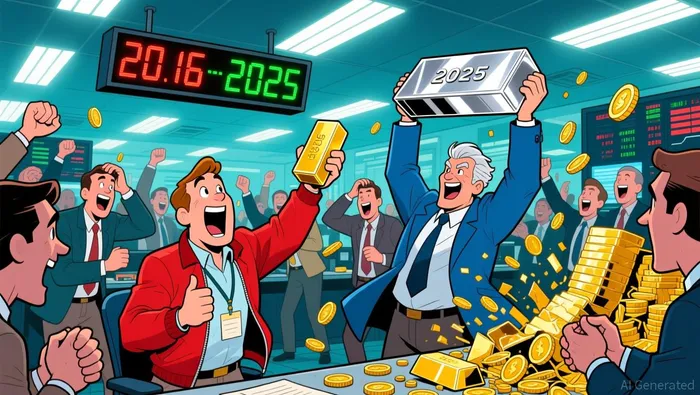
The silver-to-gold price ratio has long been a barometer of market sentiment. Historically, the ratio averaged around 16:1, meaning one ounce of gold could purchase 16 ounces of silver. However, from 2015 to 2025, the ratio fluctuated dramatically, peaking at 80:1 in February 2016 and surging to 99.7 by May 2025. This widening gap reflected a structural undervaluation of silver. Yet, in 2025, silver prices surged 69% year-to-date through October, outpacing gold's 53% gain. This reversal marks a significant shift in investor behavior, driven by industrial demand and macroeconomic factors such as rate cuts and a weaker U.S. dollar.
Industrial Demand: A Structural Tailwind
Silver's dual role as both a monetary and industrial metal is a unique advantage. Over 48% of total demand in 2022 came from industrial applications, including photovoltaics, electric vehicles (EVs), and advanced electronics. The solar energy sector alone consumed 198 million ounces of silver in 2025, accounting for nearly 20% of global demand. As the world transitions to clean energy, this demand is set to grow exponentially.
The supply side tells an equally compelling story. From 2021 to 2025, the silver market faced a cumulative deficit of 796 million ounces, with the 2025 deficit projected at 149 million ounces-15% of annual production. Mine output has declined at an average rate of 1.4% annually since 2016, constrained by the fact that silver is primarily a byproduct of copper, lead, and zinc mining. This supply inelasticity ensures that even modest increases in demand can drive prices sharply higher.
Silver's Monetary Role and the Gold-Silver Ratio
While gold is often viewed as a "safe haven" asset, silver's monetary role is frequently overlooked. The gold-silver ratio (GSR) has historically served as a contrarian indicator. A rising GSR signals a flight to gold during risk-off environments, while a declining GSR reflects industrial optimism and cyclical strength in silver. In 2025, the GSR dropped from 104:1 to 64:1, underscoring silver's outperformance amid industrial demand and macroeconomic tailwinds.
Critics argue that silver's price volatility makes it unsuitable for conservative investors. However, this volatility is a feature, not a bug. During the 1973–1975 recession, silver outperformed both gold and equities due to inflationary pressures. Similarly, in the 2020 pandemic-driven recession, silver recovered strongly in the subsequent economic rebound. While silver may underperform gold during periods of economic contraction, its industrial applications ensure it remains a critical component of a diversified portfolio.
Refuting Bearish Narratives
Bearish arguments against silver often center on its lack of income generation and sensitivity to economic cycles. Dave Ramsey and other traditional financial advisors have long criticized precious metals as unproductive assets. However, this perspective ignores silver's dual role. Unlike gold, which is purely a monetary asset, silver's industrial demand provides a floor for its price, even in bear markets.
Moreover, silver's smaller market size and price volatility are often cited as drawbacks. Yet, these characteristics also create opportunities for aggressive investors. For instance, the 2025 parabolic surge in silver prices-driven by supply deficits and macroeconomic factors-demonstrated its potential for outsized returns. While volatility may deter some, it aligns with the risk-reward profile of cyclical commodities, which can thrive in periods of economic expansion.
Conclusion: A Strategic Addition to the Portfolio
Silver's explosive long-term potential is underpinned by a confluence of factors: surging industrial demand, persistent supply deficits, and a favorable macroeconomic environment. While it may not offer the income generation of stocks or real estate, its role as both a monetary hedge and an industrial necessity makes it a unique asset class. For investors seeking to diversify beyond traditional equities and bonds, silver presents an undervalued opportunity with the potential for significant capital appreciation.
As the world grapples with energy transitions, inflationary pressures, and geopolitical uncertainties, silver's dual identity as a monetary and industrial metal will only grow in relevance. The bearish narrative that silver is a poor investment is increasingly at odds with the fundamentals. For those willing to embrace its volatility, silver offers a compelling path to long-term wealth creation.







Comentarios
Aún no hay comentarios