
Silver Stocks and the Looming Liquidity Trap
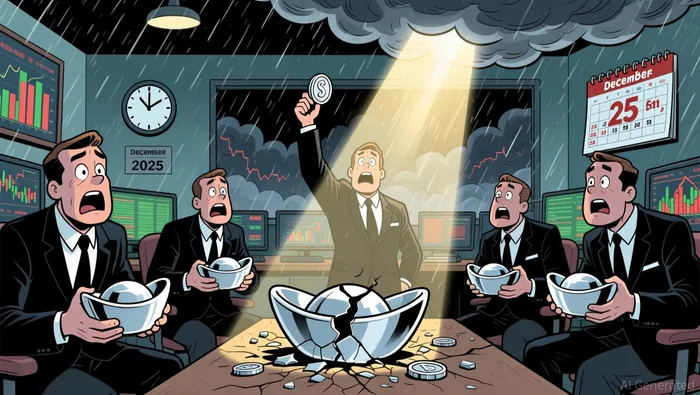
The final weeks of 2025 delivered a dramatic rollercoaster for silver investors. By December 31, the metal had surged to a record $84 per ounce, only to plunge nearly 10% in a single intraday session-the so-called "Christmas Crash"-before rebounding 8% the following day. This volatility, driven by thin liquidity and a margin hike by the CME GroupCME--, underscored the fragility of a market already teetering on the edge of a late-cycle liquidity trap. While industrial demand and structural supply shortages continue to underpin a bullish case for silver, the disconnect between soaring prices and fragile fundamentals has raised urgent red flags for investors.
Industrial Demand and Structural Supply Deficits
Silver's long-term bull case remains anchored in a persistent global supply deficit, now entering its fifth consecutive year. Industrial demand from sectors like solar energy and electric vehicles (EVs) has driven consumption to record levels, with each EV requiring approximately 15 grams of silver for its battery and electrical systems. China's new export licensing system, set to take effect in January 2026, further tightens global supply by restricting the flow of refined silver to international markets. Meanwhile, the iShares Silver TrustSLV-- has continued to accumulate physical silver holdings, signaling strong institutional confidence in the metal's value proposition.
However, these fundamentals are increasingly at odds with the speculative fervor gripping the market. Silver miners such as Coeur Mining and Fresnillo have outperformed the broader market, with Coeur poised to expand through a major acquisition and Fresnillo capitalizing on its pure-play silver exposure. Yet, as senior analyst Joe Mazumdar has warned, such outperformance often masks overvaluation risks, particularly in junior miners where speculative hype can rapidly outpace actual project fundamentals.
The Liquidity Trap and ETF Volatility
The surge in silver ETFs and junior mining ETFs in 2025 has amplified these risks. The Amplify Junior Silver Miners ETF (SILJ) gained 195% in 2025, while the iShares MSCI Global Silver and Metals Miners ETF (SLVP) surged by 200%. These gains, driven by geopolitical tensions and macroeconomic uncertainty, reflect a market increasingly dominated by leveraged macro bets rather than physical demand. SILJ's 30-day median bid-ask spread of 0.04% suggests relatively tight liquidity, but this metric belies the broader fragility of the sector.
The disconnect between paper markets and physical silver availability has also deepened. While ETF inflows and speculative trading have driven prices higher, structural supply constraints-such as the Shanghai Premium's drain on Western inventories-have created a precarious equilibrium. As Mazumdar notes, junior miners are particularly vulnerable to liquidity exhaustion, as their valuations are often tied to short-term market sentiment rather than long-term production capacity.
Caution Amid the Hype
The December 2025 crash serves as a stark reminder of the risks inherent in this environment. The 10% intraday drop was not triggered by a fundamental shift in supply or demand but by a margin hike by the CME Group, which exacerbated liquidity shortages in a market already stretched by high leverage. For junior miners, the implications are even more dire. With over 60% of speculative interest in 2024–2025 focused on gold and uranium juniors, silver juniors face a dual challenge: competing for capital in a crowded space while navigating the same liquidity risks that plagued their peers.
Mazumdar's warnings about overvaluation and exit liquidity risks are particularly relevant here. He emphasizes that junior miners often trade at multiples disconnected from their operational realities, creating a "valuation disconnect" that can collapse rapidly if market conditions shift. This is compounded by the fact that many junior silver miners lack the financial flexibility to withstand prolonged downturns, relying instead on speculative inflows to fund exploration and development.
A Path Forward
For investors, the key lies in balancing the bullish fundamentals with disciplined risk management. Staggered investments and hedging strategies can mitigate exposure to sudden price swings, while a focus on miners with proven reserves and strong ESG frameworks may offer more stability. ETFs like SILJ and SLVP provide high-beta exposure to the sector but should be approached with caution, given their sensitivity to macroeconomic volatility.
As 2026 approaches, the silver market stands at a crossroads. The structural supply deficit and industrial demand remain compelling long-term drivers, but the looming liquidity trap-exacerbated by speculative hype and fragile fundamentals-demands a measured approach. In a market where a 10% crash can be followed by an 8% rebound in days, the line between opportunity and overreach has never been thinner.







Comentarios
Aún no hay comentarios