
Silver's Record 2025 Rally: Is This a Supply-Driven Structural Breakout?
The global silver market has experienced a seismic shift in 2025, with prices surging to record highs of $54.48 per troy ounce in October. This rally, driven by a confluence of structural supply constraints and surging industrial demand, has sparked debates about whether the market is witnessing a long-term reconfiguration of silver's value proposition. For investors, the question is critical: Is this a temporary spike, or does the current dynamics signal a permanent shift in the metal's fundamentals?
Supply Constraints: A Perfect Storm of Declining Production and Recycling
The foundation of the 2025 silver rally lies in a persistent and widening supply deficit. According to the Silver Institute, the global market is on track for a fifth consecutive structural deficit in 2025, with demand outpacing supply by approximately 95 million ounces. However, more granular analysis from Mining Visuals suggests the gap could exceed 200 million ounces, driven by a 7.23% decline in mine production compared to 2016 levels. This contraction reflects the maturation of major orebodies and delays in new mine development, which have left global output stagnant at around 813 million ounces in 2025.
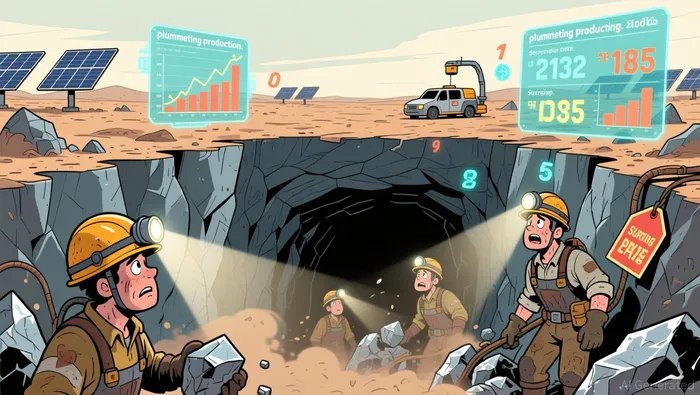 Recycling, often a buffer in tight markets, has provided limited relief. While secondary sources contributed 195 million ounces in 2025-a 24.06% increase from prior years-this remains insufficient to offset declining primary production. The U.S. addition of silver to its Critical Minerals List in August 2025 triggered anticipatory shipments to the country, creating a geographic imbalance. Meanwhile, China's strategic export surge of 660 tons in October 2025-a response to its domestic stockpile slump-highlighted the fragility of global supply chains.
Industrial Demand: The Green Energy Transition as a Catalyst
The structural deficit is not merely a function of shrinking supply; it is equally driven by robust and accelerating industrial demand. Silver's role in the green energy transition has become a defining factor. In 2024 alone, solar photovoltaic (PV) production consumed 232 million ounces of silver, accounting for 19% of global supply. While technological advancements have reduced silver loadings in some PV modules, advanced designs like TOPCon cells require up to 50% more silver than traditional panels. Solar demand is projected to reach 273 million ounces by 2030, underscoring its dominance in the industrial consumption landscape.
Electric vehicles (EVs) and electronics further amplify demand pressures. Each EV requires 25–50 grams of silver, roughly two to three times more than internal combustion vehicles. With global EV production expected to more than double by 2030, this sector alone could absorb significant incremental silver supply. Similarly, the rise of AI data centers and smart devices has entrenched silver in the electronics sector, which now accounts for over half of global industrial demand.
Investment Demand and Price Projections: A Self-Reinforcing Cycle
The interplay between physical shortages and investment flows has created a self-reinforcing cycle. Silver-backed exchange-traded products (ETPs) saw inflows of 95 million ounces in the first half of 2025 alone, exacerbating tightness in the physical market. London's silver inventories have been heavily diminished, contributing to price volatility.
Looking ahead, analysts project continued upward pressure on prices. Forecasts range from $56.53 to $143 per ounce by 2030, depending on the pace of supply adjustments and demand growth. The structural deficit, combined with flat mine production and constrained recycling, suggests that the current rally may be the prelude to a prolonged bull market.
Conclusion: A Structural Breakout or a Cyclical Spike?
The 2025 silver rally appears to transcend cyclical patterns, rooted instead in a fundamental realignment of supply and demand. The green energy transition, coupled with geopolitical and policy-driven bottlenecks, has created a scenario where silver's scarcity is no longer a temporary anomaly but a persistent feature. For investors, the key takeaway is clear: Silver's role as a critical enabler of decarbonization and technological innovation positions it as a strategic asset in a world increasingly defined by resource constraints.
As the market grapples with these dynamics, the question is no longer whether the rally is justified-but whether it has only just begun.







Comentarios
Aún no hay comentarios