
Silver's Margin-Induced Crash: Opportunity or Overcorrection?
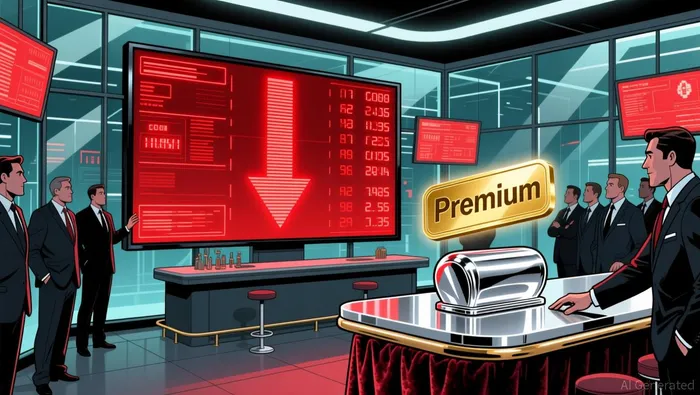
The December 2025 flash crash in silver prices, triggered by the Chicago Mercantile Exchange's (CME) aggressive margin hikes, has sparked a heated debate among investors: Is this a temporary overcorrection in a fundamentally strong market, or a warning sign of deeper structural imbalances? With paper silver prices collapsing from $84.01 to $70.25 per ounce in a matter of minutes, the event has exposed the fragility of leveraged speculative positions while highlighting the growing disconnect between paper markets and physical supply. For investors, the crash raises critical questions about how to navigate regulatory distortions and capitalize on the underlying forces driving silver's industrial and strategic importance.
Regulatory Distortions and the Paper Market's Volatility
The CME's margin hikes-raising requirements for March 2026 silver futures contracts from $22,000 to $32,500 per contract within a week-were a blunt instrument to curb speculative fervor. This move, reminiscent of the 1980 "Silver Thursday" crash and the 2011 silver peak, forced a massive deleveraging, wiping out 67 million ounces of silver positions in 15 minutes. While regulators framed the action as a necessary cooling measure, critics argue it exacerbated a market already strained by structural supply deficits and geopolitical tensions.
The paper-to-physical silver ratio, now at 356:1, underscores the imbalance. Physical silver, particularly in China, trades at record premiums, with Shanghai Gold Exchange prices exceeding COMEX futures by $8 per ounce. This divergence reflects a market where physical demand-driven by industrial consumption in solar, electric vehicles, and electronics-outpaces speculative paper trading. China's new export licensing system, which restricts silver exports to state-approved firms, has further tightened physical supply, creating a "Great Silver Squeeze."
Physical Silver: A Strategic Asset in a Debasement Trade
The collapse of the gold-to-silver ratio to nearly 40:1 signals a shift in investor sentiment. Silver is no longer viewed solely as a precious metal but as a critical input for high-growth technologies, including photovoltaic panels and semiconductors. Industrial demand alone now accounts for 232 million ounces annually, with solar demand alone growing fourfold since 2015. This inelastic demand, combined with dwindling global inventories- COMEX silver vaults have fallen 70% over five years-has made physical silver a compelling hedge against fiat currency devaluation.
Investors seeking exposure to physical silver must navigate logistical challenges, including storage costs and liquidity constraints. However, the current premiums in Shanghai and India suggest physical silver remains a scarce and undervalued asset. For instance, retail prices in China surged to $100 per ounce in late 2025, driven by both industrial demand and speculative retail investors. This environment favors investors who can secure physical delivery or invest in ETFs with strong bullion backing, despite the risks of ETF outflows seen during the CME-driven sell-off.
Mining Equities: Revaluing the "Paper" of the Physical World
Silver mining equities offer a hybrid approach, combining exposure to physical supply chains with equity upside. Post-crash, junior producers like Hecla Mining and First Majestic Silver saw short-term declines but maintained strong 2025 performance due to sustained profitability from higher prices. Wheaton Precious Metals, with its low-cost streaming model, emerged as a beneficiary, capturing peak pricing while avoiding operational volatility.
Valuation metrics for the sector remain attractive. As of late 2025, junior producers traded at 0.76–0.88× P/NAV (price-to-net asset value), a discount to historical averages. This reflects both equity dilution and the sector's high operating leverage, which amplifies cash flow as prices stabilize. Projects like Vizsla Silver's Panuco, with an 111% after-tax IRR at $35.50/oz, highlight the potential for rapid revaluation in a $70–$80 per ounce environment.
However, mining equities are not without risks. Regulatory interventions, such as the CME's margin hikes, can trigger sudden price corrections, while permitting delays and declining ore grades in key regions like Mexico and Peru limit supply-side responsiveness. Investors must balance these risks against the sector's long-term fundamentals, including a projected 117.6 million-ounce deficit in 2025 and growing geopolitical demand for domestic production.
Opportunity or Overcorrection? A Strategic Framework
The December 2025 crash represents a mix of both overcorrection and opportunity. On one hand, the CME's margin hikes artificially suppressed prices, creating a buying window for investors who can stomach near-term volatility. On the other, the structural supply deficit and industrial demand suggest that silver's long-term trajectory remains upward.
For investors, the key lies in leveraging the dislocation between paper and physical markets. Physical silver, despite its premiums, offers a direct hedge against regulatory distortions and monetary debasement. Mining equities, particularly those with low-cost production and strong balance sheets, provide a leveraged bet on the sector's revaluation. A staggered investment approach-accumulating physical silver on dips and selectively investing in undervalued miners-could capitalize on the current inflection point.
Yet caution is warranted. The CME's actions demonstrate regulators' willingness to intervene in volatile markets, and further margin hikes could trigger additional corrections. Additionally, industrial users may seek alternatives to silver, though substitution remains limited by the metal's unique conductivity and durability.
Conclusion
Silver's margin-induced crash is neither a simple overcorrection nor a definitive market failure. It is a symptom of a broader transformation: the reclassification of silver from a speculative asset to a strategic industrial and monetary commodity. For investors, the challenge is to navigate the regulatory distortions of paper markets while positioning for the physical realities of supply and demand. In this environment, physical silver and well-chosen mining equities offer a dual path to capitalize on the "Great Silver Squeeze"-provided investors have the patience to weather the volatility.





Comentarios
Aún no hay comentarios