
Silver's Historic Breakout and the Implications for a New Bull Market
The silver market in November 2025 stands at a pivotal inflection point, marked by a rare alignment of technical and fundamental forces that could signal the dawn of a generational bull market. This convergence-driven by structural supply deficits, surging industrial demand, and macroeconomic tailwinds-has propelled silver to record highs, with prices breaching $55 per ounce in late November. The interplay between technical indicators and fundamental catalysts suggests that the current rally is not merely speculative but rooted in a re-rating of silver's intrinsic value as both an industrial and monetary asset.
Fundamental Catalysts: Supply Deficits and Industrial Demand
The structural imbalance between supply and demand has been a cornerstone of silver's recent ascent. According to a report, global silver mine production has declined by 7% since 2016, failing to keep pace with demand for seven consecutive years. This has resulted in a cumulative deficit of nearly 800 million ounces from 2021 to 2025, with the 2025 deficit projected at 115–120 million ounces. Industrial demand, which accounts for over 59% of silver usage, is being fueled by the solar photovoltaics (PV) sector, where silver demand alone reached 17% of total consumption in 2024 and is expected to grow further.
Investor demand has also surged, with global silver-backed ETPs experiencing record inflows of 95 million ounces in the first half of 2025, surpassing total 2024 inflows. These flows have shifted the demand curve, creating competition with physical industrial users for limited metal supply. The total value of ETF holdings now exceeds $40 billion, reflecting a paradigm shift in how institutional capital views silver as both a hedge against inflation and a strategic asset in a de-pegging global economy according to analysis.
Technical Indicators: Breakouts and Momentum
Technically, silver has formed a bullish triangle pattern, with a key breakout level identified around $53 per ounce. This pattern, combined with RSI readings near 60 and a positive MACD crossover, suggests continued upward momentum. A further breakout above $49.33 could target $50.87 and $52.75, with RSI at 62 indicating positive sentiment without overextension.
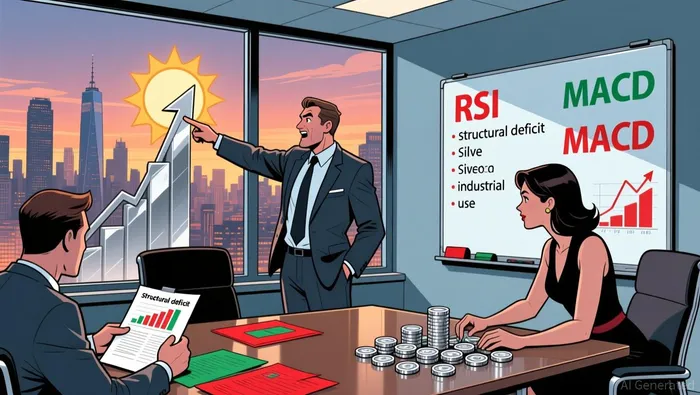
The broader technical case is reinforced by macroeconomic factors. The anticipation of a U.S. Federal Reserve rate cut in December 2025 has reduced the opportunity cost of holding non-yielding assets like silver, pushing prices to a one-week high of $52.46 per ounce. Additionally, the gold/silver ratio of 91-well above its long-term average of 67-suggests silver is undervalued relative to gold, a historically significant signal for potential re-rating according to analysis.
Convergence of Fundamentals and Technicals
The most compelling aspect of silver's current trajectory is the convergence of technical and fundamental drivers. For instance, the U.S. government's designation of silver as a critical mineral in November 2025 has led to supply-side constraints, as some U.S. holders withhold metal to hedge against potential tariffs. This supply tightening coincides with a technical breakout above key resistance levels, creating a self-reinforcing cycle of higher prices and increased investor demand.
Moreover, geopolitical tensions and the U.S.-China trade war have amplified safe-haven demand, with silver benefiting from its dual role as an industrial and monetary asset. The weakening U.S. dollar, a direct consequence of Fed easing expectations, has further amplified silver's appeal to international buyers. This macroeconomic backdrop aligns with technical indicators showing silver emerging from oversold conditions, as evidenced by RSI readings above 25 and MACD crossovers confirming bullish momentum.
Implications for a New Bull Market
The combination of structural supply deficits, industrial demand growth, and macroeconomic tailwinds positions silver for a sustained bull market. Analysts at UBS and Bank of America project prices could rise to $42–$65 per ounce by 2026, while longer-term forecasts from LiteFinance and InvestingHaven suggest targets of $77–$200 by 2030. Institutional investors are also reallocating portfolios toward hard assets, with silver now comprising 7% of global precious metals ETF holdings, up from 4% in 2020.
However, risks remain. A hawkish pivot by the Fed or volatility from U.S. economic data could trigger short-term corrections. Yet, the underlying fundamentals-particularly the structural deficit and industrial demand-suggest that any pullbacks are likely to be short-lived and provide buying opportunities for long-term investors.
Conclusion
Silver's historic breakout in November 2025 is not an isolated technical event but a reflection of deep-seated structural shifts in global markets. The interplay between supply constraints, industrial demand, and macroeconomic factors has created a rare alignment of forces that could redefine silver's role in both industrial and investment portfolios. For investors, this represents a generational opportunity to capitalize on a market that is not merely rallying but re-rating.







Comentarios
Aún no hay comentarios