
The Silent Risk: Underestimated Geopolitical Fragility in 2026
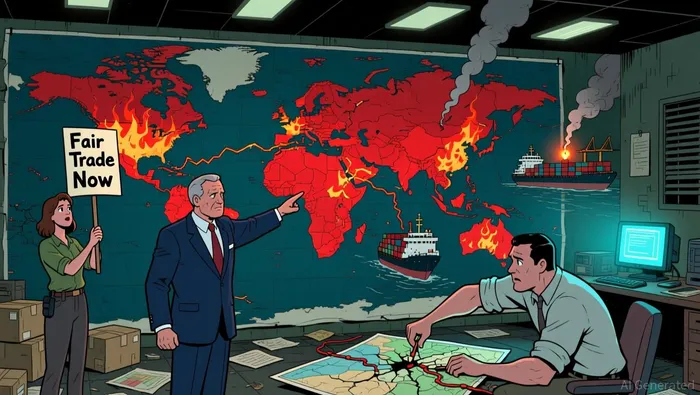
The global economy in 2026 is poised to face a silent but systemic crisis, rooted in the underappreciated fragility of supply chains and the limitations of central bank policies. While 2025 has seen businesses and policymakers scramble to address immediate disruptions, the deeper structural vulnerabilities-exacerbated by geopolitical tensions and protectionist policies-remain underestimated. These risks, if left unaddressed, could trigger cascading failures across markets and economies in the coming year.
The Fragile Foundations of Global Supply Chains
The past year has exposed the fragility of global supply chains, with tariffs and geopolitical conflicts acting as persistent stressors. According to a report by Z2 Data, 82% of surveyed companies in 2025 reported that their supply chains were significantly affected by tariffs, particularly in the United States, where customer demand has weakened. This has led to a dual challenge: 39% of firms face rising supplier and material costs, while 30% grapple with declining demand. In response, businesses have adopted strategies such as dual sourcing, inventory buffers, and nearshoring. However, these measures are often costly and temporary, failing to address the root causes of systemic instability.
Geopolitical tensions-ranging from the Russia-Ukraine war to the Red Sea crisis-have further fragmented trade networks. The World Economic Forum has warned that these disruptions are pushing organizations toward regionalized supply chains, a shift that could reduce efficiency and increase costs. Meanwhile, nationalism and protectionism, fueled by political rhetoric, are accelerating the erosion of the post-WWII global trade order. The result is a landscape where even minor geopolitical shocks could trigger widespread supply chain paralysis.
Central Bank Policy: A Double-Edged Sword
Central banks, tasked with stabilizing economies amid these challenges, are increasingly constrained by the very forces they seek to mitigate. The European Central Bank (ECB) has sounded an alarm, stating that the global risk of economic shocks is at an "unprecedentedly high level", driven by geopolitical tensions, trade policy shifts, and climate-related crises. Similarly, the Central Bank of Ireland has highlighted the heightened risks to financial stability in small open economies, which are particularly vulnerable to external shocks.
Monetary policy responses have been mixed. The U.S. Federal Reserve (Fed) has adopted a more accommodative stance in response to bilateral geopolitical risks, such as U.S.-China trade tensions, while the ECB has maintained a contractionary approach to preserve price stability. However, these strategies are inherently reactive. For instance, APAC central banks have begun cutting rates in 2025 as inflation moderates, but economists warn that this may not be sufficient to offset the drag from U.S. tariffs, which have already dampened growth and trade-related employment.
A critical limitation lies in the inability of central banks to address structural issues such as supply chain bottlenecks or geopolitical-driven capital flight. As the European Banking Supervision Authority notes, heightened geopolitical uncertainty increases market volatility, disrupts capital flows, and erodes asset values-risks that monetary policy alone cannot neutralize. Moreover, climate-related shocks, which the ECB has identified as a long-term threat, further complicate policy-making.
The Interplay of Risks: A Systemic Threat
The interplay between supply chain vulnerabilities and central bank limitations creates a feedback loop that amplifies systemic risks. Tariffs and sanctions not only disrupt trade but also fuel inflationary pressures, forcing central banks into a dilemma: tighten policy to curb inflation and risk triggering a recession, or maintain accommodative stances and tolerate higher inflation. This tension is particularly acute in 2026, as economies face the combined pressures of aging populations, climate adaptation costs, and persistent geopolitical conflicts.
For example, the ECB has emphasized the need for banks to strengthen climate risk management, given the growing frequency of natural disasters and the lagging progress toward net-zero goals. Yet, without coordinated global action, such efforts will remain fragmented. Similarly, the reliance on regional supply chains, while reducing exposure to distant conflicts, could lead to inefficiencies and higher costs that central banks are ill-equipped to offset.
Implications for Investors
Investors must recognize that the silent risk of 2026 lies in the underestimation of these interconnected challenges. Diversification across geographies and sectors will be critical, as will hedging against currency and commodity risks. Sectors with strong regional supply chain resilience-such as renewable energy and advanced manufacturing-may offer relative stability. Conversely, industries heavily dependent on global trade, such as automotive and electronics, could face prolonged volatility.
Moreover, investors should monitor central bank policy shifts closely. The Fed's potential pivot toward rate cuts in 2026, for instance, could signal a broader recognition of the limits of monetary policy in a geopolitically fragmented world. Similarly, APAC central banks' reliance on fiscal support to counteract tariff-driven slowdowns may create new opportunities in government bonds and infrastructure projects.
Conclusion
The risks facing the global economy in 2026 are not merely economic but deeply political. As supply chains become more regionalized and central banks struggle to balance inflation and growth, the silent risk of systemic failure looms large. Investors and policymakers alike must move beyond short-term fixes and address the structural vulnerabilities that underpin today's crises. Failure to do so could see 2026 marked not by overt shocks, but by the slow unraveling of a system already stretched to its limits.







Comentarios
Aún no hay comentarios