
Silent Compliance: How U.S. Tech Giants Align with H-1B Reforms to Fuel Innovation-Driven Growth
The U.S. tech industry's muted response to recent H-1B visa reforms under the Trump administration reveals a strategic alignment with pro-business agendas, even as the policy risks stifling innovation. The imposition of a $100,000 fee for new H-1B applications—a move framed as a crackdown on “exploitation” of foreign labor—has drawn mixed reactions. While some executives, like Elon Musk, have criticized the system as “broken,”[1] major firms such as AmazonAMZN--, MicrosoftMSFT--, and Google have opted for silent compliance, recalibrating their strategies to navigate the new landscape[2]. This calculated silence underscores a broader industry prioritization of short-term operational stability over vocal opposition, even as long-term innovation risks loom.
Policy Changes and Immediate Impact
The Trump administration's $100,000 fee, effective September 2025, targets new H-1B visa petitions, excluding renewals and existing holders[3]. This has forced tech firms to issue urgent guidance to employees, with Amazon, Microsoft, and Google advising H-1B visa holders to avoid international travel to prevent reentry complications[4]. The fee, justified as a measure to “prioritize fair compensation for American workers,”[1] has been met with skepticism by economists, who argue it disproportionately impacts Indian tech workers—accounting for 75% of H-1B holders—and could drive talent to the U.K. or India[2].
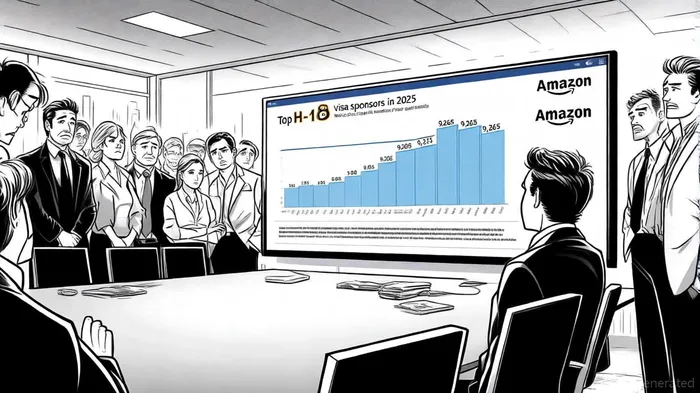
Despite these concerns, major tech firms have not mounted a public campaign against the policy. Instead, they have focused on adapting to the new rules. Amazon, the largest H-1B sponsor in 2025 with 9,265 approvals[5], has reportedly accelerated offshore development hubs in India and Ireland to mitigate reliance on U.S. visas[6]. Similarly, Microsoft and Google are shifting resources to retain existing H-1B workers rather than sponsoring new applicants[7].
Strategic Adjustments and Pro-Business Alignment
The industry's silence reflects a pragmatic alignment with the administration's pro-business agenda, which includes deregulation and tax incentives for tech firms[8]. While the H-1B reforms increase operational costs—particularly for startups like Delve, which struggle with limited budgets[3]—established firms are leveraging their financial muscle to absorb the burden. For instance, Amazon's $100,000 fee per new visa could add $926 million annually to its compliance costs, yet the company continues to prioritize AI and cloud computing roles that require specialized foreign talent[5].
This alignment is further evident in the administration's broader policies. Despite Stephen Miller's hardline stance on immigration, Trump has avoided outright bans on H-1B visas, recognizing their critical role in sustaining U.S. tech leadership[1]. Meanwhile, firms like Meta and Apple are investing in domestic training programs to reduce dependency on foreign labor, a move that aligns with the administration's emphasis on “American workers first”[8].
Implications for Innovation-Driven Equities
For investors, the H-1B reforms present a dual-edged sword. On one hand, the policy's focus on higher wage floors and stricter eligibility criteria could reduce labor costs for firms in the long term by encouraging domestic hiring[7]. On the other, the immediate financial burden and talent shortages may weigh on innovation-driven equities. For example, Amazon's stock has seen a 3% dip since the fee announcement, reflecting market concerns over its reliance on H-1B workers for AI development[5].
However, the pro-business environment offers offsetting benefits. Deregulation and tax cuts under Trump have historically boosted tech sector valuations, and firms adapting to H-1B changes—such as Microsoft's offshore expansion—may gain competitive advantages in global markets[8]. Startups, meanwhile, face a steeper climb, with venture capital firms increasingly favoring firms that demonstrate resilience to immigration policy shifts[3].
Broader Economic Context
The H-1B reforms are part of a larger trend of regulatory tailwinds for U.S. tech firms. The administration's emphasis on “innovation through domestic talent” has spurred investments in STEM education and R&D tax credits[8]. Yet, the policy's long-term success hinges on balancing these goals with the need for global talent. As one economist noted, “The U.S. cannot lead in AI and quantum computing without access to the world's best minds—regardless of where they're born.”[2]
Conclusion
The U.S. tech industry's strategic silence on H-1B reforms signals a calculated alignment with pro-business agendas, prioritizing operational continuity over vocal dissent. While the policy's immediate costs are significant, the broader regulatory environment offers opportunities for firms that adapt swiftly. For investors, the key lies in identifying companies that can navigate these changes—leveraging offshore hubs, domestic training, and alternative visa pathways—while capitalizing on the administration's innovation-friendly policies. In a sector where talent is the ultimate currency, the ability to adapt to shifting immigration rules may well determine the next wave of market leaders.





Comentarios
Aún no hay comentarios