
Signs of Institutional Flight in the Crypto Market: What Whale Activity Reveals About Market Sentiment and Risk
The New Era of Institutional Crypto Dynamics
In 2025, the cryptocurrency market has evolved into a battleground where institutional players and whale investors wield outsized influence. Their actions—whether moving billions into cold storage or liquidating positions on exchanges—serve as barometers for market sentiment and risk. With regulatory clarity emerging in key jurisdictions and behavioral finance principles amplifying market volatility, understanding whale activity is no longer optional for serious investors.
Macroeconomic Catalysts: Regulation and Institutional Adoption
The regulatory landscape has fundamentally shifted. The U.S. GENIUS Act of 2025, under the Trump administration, and the EU's fully implemented MiCA framework have created a dual-tier system of oversight that has both stabilized and fragmented the market[1]. These changes have spurred institutional adoption, with BitcoinBTC-- and EthereumETH-- ETFs attracting over $12 billion in inflows since their approval[1]. However, regulatory tailwinds are not uniform. For example, the EU's stricter surveillance on self-custodial wallets has forced whales to shuffle assets between exchanges and cold storage, creating short-term volatility[3].
Institutional whales, such as BlackRockBLK-- and JPMorganJPM--, have increasingly adopted long-term strategies. Ethereum whales moved 3.8% of ETH into institutional wallets in Q2–Q3 2025, while Bitcoin whales executed a $25.8 billion transfer in early June, signaling bearish short-term sentiment but bullish long-term positioning[4]. These moves reflect a calculated response to regulatory clarity and infrastructure upgrades, such as Solana's partnership with Kazakhstan's Ministry of Digital Development[2].
Behavioral Finance: Herd Mentality and Loss Aversion in Action
Behavioral biases are now embedded in market mechanics. Herd mentality, amplified by social media and AI-driven sentiment analysis, has turned platforms like Reddit and X into echo chambers for speculative trading. In June 2025, a 5.6% drop in total market cap—erasing $100 billion in value—coincided with a surge in whale selling. Over $600 million in crypto was moved to exchanges, with Bitcoin's price swinging from $67,500 to $71,200 in 48 hours as retail traders oscillated between fear and greed[1].
Loss aversion further distorted decision-making. Retail investors clung to underperforming assets, hoping for rebounds, while whales exploited this irrationality. For instance, a Shiba InuSHIB-- whale's $3.6 million transaction in 2024 triggered a 10% price drop—a pattern repeated in 2025 as whales manipulated stop-loss orders and pump-and-dump schemes[3].
Whale Transactions as Sentiment Indicators
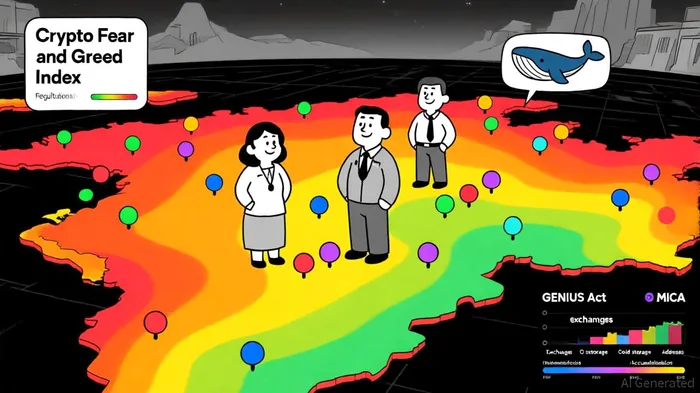
June 2025 offers a case study in whale-driven market dynamics. When the Fear and Greed Index plummeted to 30 (extreme fear), on-chain data revealed 45,000 BTCBTC-- flowing into accumulation addresses—a 2.3% weekly increase[1]. This whale accumulation preceded a 5.5% price rebound, illustrating how institutional positioning can counteract retail panic. Conversely, large sales to exchanges often precede declines, as seen in a 2024 Shiba Inu transaction that caused a 10% drop[1].
The psychological interplay between whales and retail investors is now a self-fulfilling prophecy. AI-driven platforms attempt to mitigate biases, but human emotion remains dominant. For example, confirmation bias led institutions to favor data supporting bullish narratives on BlockDAG, a Layer 1 project with $324 million in funding[2].
Strategic Implications for Investors
For retail and institutional investors alike, the lesson is clear: whale activity and behavioral finance principles are inseparable from market risk. Key takeaways include:
1. Monitor Cold Storage Flows: A surge in institutional cold storage (e.g., Bitcoin's 40,000 BTC transfer in July 2025) often signals long-term confidence[4].
2. Leverage Sentiment Indices: The Crypto Fear and Greed Index acts as a leading indicator for whale-driven volatility[1].
3. Beware Herd Mentality: Avoid FOMO-driven investments in speculative assets; whales often exit before retail euphoria peaks[3].
Conclusion
The 2025 crypto market is defined by a maturing investor base, where whale activity and behavioral biases shape outcomes. Regulatory clarity has not eliminated volatility—it has merely shifted its drivers. As institutions and whales navigate this landscape, their actions will continue to reveal critical insights into market sentiment and risk. For investors, the challenge lies in distinguishing between noise and signal, a task that demands both technical analysis and an understanding of human psychology.





Comentarios
Aún no hay comentarios