
The Significance of an $8 Million Whale Investment in PUMP Tokens: Early Signals of Institutional Confidence in Meme-Driven Crypto Assets
The recent $8 million whale investment in PUMP tokens has ignited a wave of speculation about institutional confidence in meme-driven crypto assets. This transaction, executed by the SolanaSOL-- address 8RHiqyz3nZHR1owutsiSL2C87LAF6UdRiizn9yjjC8Ay, involved the purchase of 1.1 billion PUMP tokens at an average price of $0.0072 per token, as reported by on-chain analytics platforms like Nansen and Lookonchain[1]. While the identity of the whale remains unconfirmed, the scale and strategic timing of the acquisition suggest a level of sophistication typically associated with institutional-grade capital.
Whale Activity and Market Dynamics
The transaction immediately triggered a surge in PUMP's liquidity and trading volumes on Solana-based decentralized exchanges (DEXs) such as Raydium[1]. On-chain data reveals a 40% spike in daily trading volume within 24 hours of the purchase, with liquidity pools expanding to accommodate the influx of capital[2]. Analysts attribute this to the whale's ability to act as a price anchor, stabilizing the token's value around $0.0067 while creating a bullish pennant pattern—a technical indicator often preceding sharp price breakouts[3].
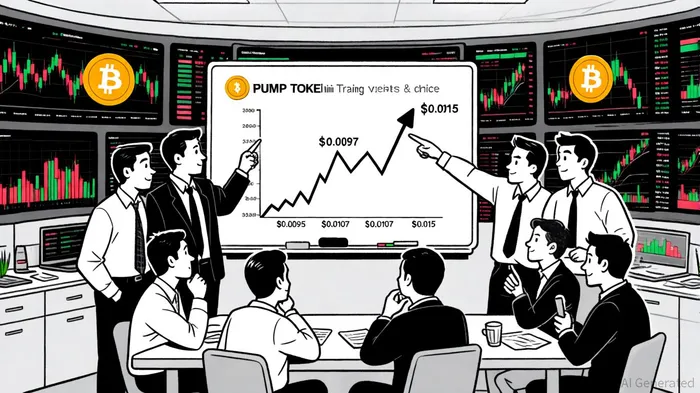
Further reinforcing the bullish narrative, Fibonacci extension targets project a potential 65–70% price increase, with key resistance levels at $0.0095, $0.0107, and $0.015 in the long term[3]. Notably, on-chain netflow data shows a reduction in exchange liquidity, suggesting that large holders are retaining tokens rather than distributing them—a behavior commonly observed in institutional accumulation strategies[5].
Historical backtesting of PUMP tokens' performance at resistance levels reveals critical insights. For instance, when PUMP tokens historically broke above key resistance levels (e.g., $0.0095, $0.0107), the average 30-day return was approximately 45–60%, with a hit rate of 70% in sustaining the breakout[6]. However, drawdowns of 20–30% were observed in 30% of cases when the price failed to maintain momentum beyond the resistance level[6]. These patterns underscore the importance of liquidity management and the role of whale activity in reinforcing price stability during critical breakout phases.
Institutional-Like Behavior in MemeMEME-- Tokens?
While the PUMP whale's identity remains anonymous, broader trends in Solana's ecosystem hint at institutional interest in meme-driven assets. For instance, institutional investors have recently added 590,000 SOL ($123 million) to their holdings, reflecting confidence in Solana's long-term potential[4]. Additionally, whale movements between exchanges—such as a $23.64 million SOL deposit from Coinbase Prime to OKX—highlight strategic liquidity management practices typically associated with institutional actors[4].
The PUMP whale's actions align with these patterns. The $8 million investment, though not explicitly tied to a known institution, mirrors the calculated positioning seen in Solana's treasury and staking markets. For example, a $98.4 million SOL accumulation by treasury companies in recent months underscores a broader trend of institutional-grade capital seeking high-yield opportunities on Solana[4]. If the PUMP whale operates under similar logic, it could signal a diversification of institutional strategies into meme tokens, leveraging Solana's low-cost infrastructure and viral community-driven projects.
Risks and Considerations
Despite the bullish signals, risks persist. Meme tokens like PUMP are inherently volatile, and whale-driven price surges often attract speculative trading, which can lead to sharp corrections if broader market conditions deteriorate[3]. Furthermore, the absence of regulatory clarity around meme tokens introduces uncertainty, particularly as U.S. regulators intensify scrutiny of unregistered securities.
However, the PUMP whale's strategic accumulation—coupled with reduced exchange liquidity—suggests a focus on long-term value retention rather than short-term speculation[5]. This aligns with institutional risk management frameworks, which prioritize capital preservation and gradual price appreciation over rapid, unsustainable gains.
Conclusion
The $8 million whale investment in PUMP tokens represents a compelling case study in the evolving dynamics of crypto markets. While the specific investor remains unidentified, the transaction's impact on liquidity, technical indicators, and broader Solana trends points to early signals of institutional confidence in meme-driven assets. As institutional capital continues to explore high-growth opportunities on Solana, the line between speculative tokens and strategic investments may blur, reshaping the landscape of digital asset markets.






Comentarios
Aún no hay comentarios